Facebook
 Google
 GitHub
 Linkedin
Littelfuse Intros Automotive-Qualified Current Sensors For EVs
Littelfuse has launched six automotive-qualified current sensors aimed at key electric vehicle subsystems, spanning battery management, traction inverters, and high-speed safety disconnects.
Littelfuse has expanded its automotive sensing portfolio with a family of open-loop Hall-effect current sensors designed for electric and hybrid vehicles. The six devices address the different electrical, timing, and safety requirements that coexist inside modern electric vehicle platforms across three functional areas: battery systems, motor control, and pyro-fuse safety hardware.
Rather than offering a single “do-everything” sensor, Littelfuse has segmented the lineup by application and interface. Some parts prioritize low-latency analog outputs for inverter control, others push current data directly onto vehicle networks via CAN or LIN, and one device goes further by combining current detection and pyro-fuse triggering into a single module. The common thread is galvanically isolated, busbar-based sensing intended to handle hundreds of amps without introducing shunt losses or complex isolation stages.
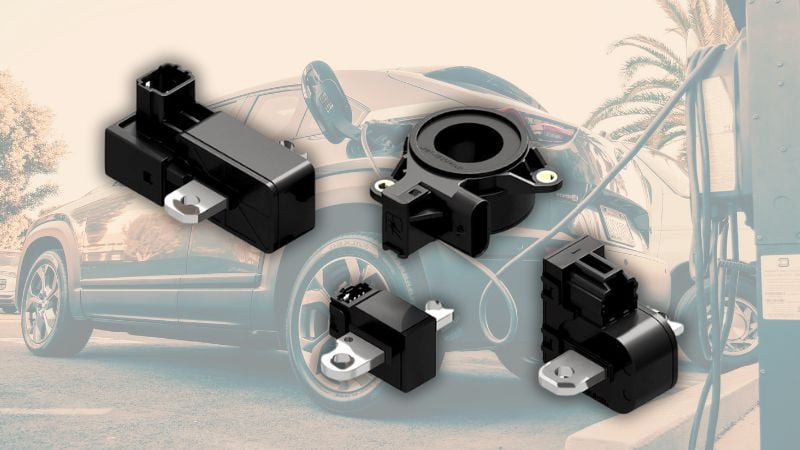
Automotive-qualified current sensors. Image used courtesy of Littelfuse
Analog Simplicity or Digital Integration
In battery packs and high-voltage junction boxes, current measurement underpins state-of-charge estimation, contactor control, and fault detection. Littelfuse offers its CH1 battery-oriented sensors in both analog-output and digital-interface variants, giving designers flexibility based on how centralized or distributed their BMS architecture is.
The analog devices provide ratiometric voltage outputs from a single 5 V supply, with options for single, dual, or redundant outputs. That redundancy is less about signal quality and more about safety architecture, with multiple outputs enabling plausibility checks, separating the monitoring and control domains, and enabling graceful degradation strategies without duplicating sensors.
Quiescent current is kept relatively low for devices that may remain powered continuously, helping manage parasitic load in always-on battery systems.
Digital variants shift more intelligence into the sensor itself. CAN- and LIN-enabled parts package current data together with diagnostics and status information, reducing the need for precision ADCs and complex filtering on the ECU side. By delivering validated measurements directly onto the vehicle network, these sensors can simplify wiring, reduce susceptibility to ground noise, and streamline functional-safety analysis, particularly in systems targeting higher ASIL levels.
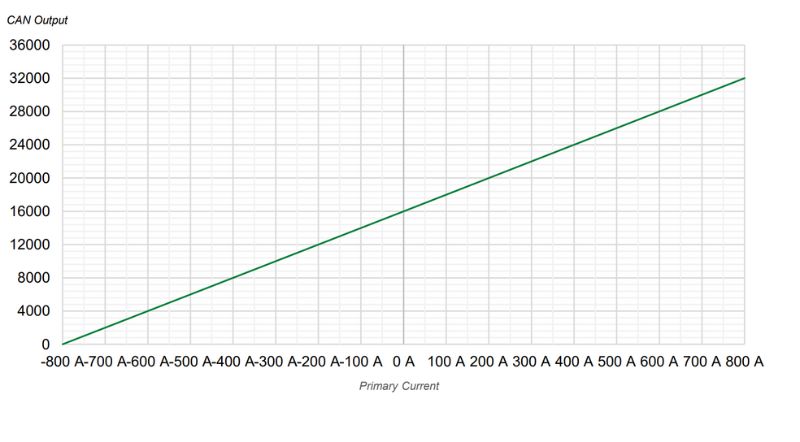
CAN output transfer function for the CH1B032B sensor. Image used courtesy of Littelfuse
Across both analog and digital versions, the use of open-loop Hall sensing and busbar mounting allows measurement of very high currents without the thermal penalties associated with resistive shunts, which is increasingly important as EV pack currents climb.
Bandwidth and Phase Behavior Take Priority
For traction inverters and other high-power motor drives, Littelfuse’s motor-focused sensors lean toward analog outputs, reflecting the continued need for fast, deterministic current feedback inside control loops. These devices track rapidly changing phase currents generated by high-frequency PWM switching, where bandwidth and response time matter more than network integration.
The company claims microsecond-class response times and tens of kilohertz bandwidth, which puts the sensors in a range suitable for field-oriented control and other advanced motor algorithms. From a system perspective, busbar-based Hall sensing reduces both conduction losses and layout pressure. Eliminating high-power shunts frees up thermal budget in the inverter, while integrated isolation avoids the need for additional isolation amplifiers or digital isolators in the signal path.
Collapsing Protection Latency
The most distinctive device in the release is a dedicated pyro-fuse trigger module that combines current sensing, decision logic, and actuation support. In high-voltage EV systems, pyro-fuses are used as a last-resort safety mechanism, physically severing the battery connection in the event of severe faults. In those scenarios, response time and determinism are critical.
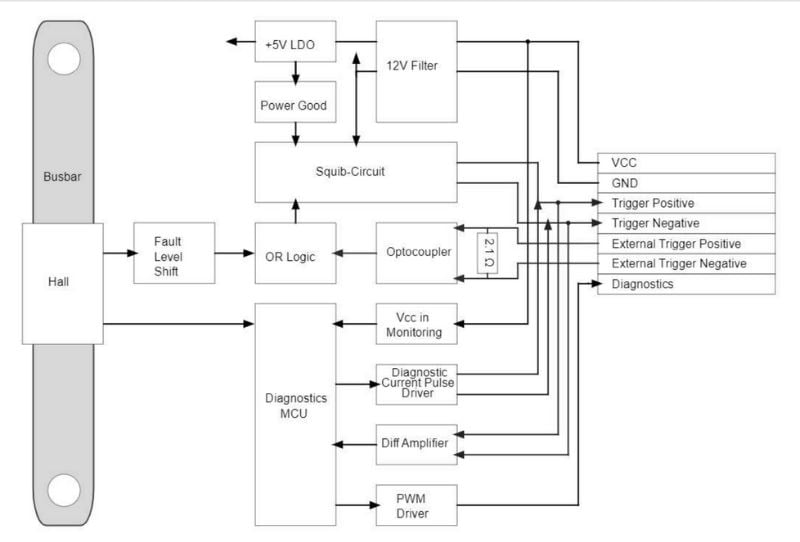
Functional block diagram of the pyro-fuse trigger module. Image used courtesy of Littelfuse
By integrating overcurrent detection and trigger control into a single module, Littelfuse aims to reduce loop latency and design complexity. Instead of routing sensor signals to an ECU, waiting for firmware evaluation, and then driving a separate trigger circuit, the module can act locally within tens of microseconds. That approach also removes several intermediate components from the safety path, simplifying validation and reducing the number of potential failure modes engineers must consider.
On the whole, Littelfuse’s new current sensor family reflects how EV electrical architectures are diversifying rather than converging. Fast analog sensors remain essential for motor control, networked digital sensors are increasingly attractive for battery systems and safety monitoring, and specialized modules are emerging where latency and simplicity outweigh flexibility.
By covering all three with automotive-qualified devices built on the same core Hall-effect sensing approach, Littelfuse is positioning the CH1 family as a toolbox that allows EV designers to choose the right trade-off between speed, integration, and safety without rethinking their sensing strategy from scratch.