Facebook
 Google
 GitHub
 Linkedin
How Integrated Current Sensors Drive Light Mobility Electrification
Electrification has become a major factor in the transport sector because it is one of the main contributors to greenhouse gas emissions. As countries strive toward CO2 neutrality, cars, buses, and taxis have been at the forefront of change.
This article is published by EEPower as part of an exclusive digital content partnership with Bodo’s Power Systems.
Electric vehicles (EVs) have become commonplace. Taxis glide silently up high streets, and 100% electric vans and buses deliver parcels and people to their destinations. However, with so much focus on EVs, it would be easy to overlook the light mobility sector, in particular the growing demand for electrifying two- and three-wheel vehicles. While EVs have certainly garnered most of the attention and prominence in the transport sector, a much larger trend has been developing around the world.
The Most Common Means of Transport
The light mobility sector has experienced a significant acceleration in terms of electrification, in particular in Southeast Asian countries such as Malaysia and Indonesia, as well as India, China (and soon Africa), where two-wheel transportation is by far the most common means of transport. It has been estimated that there are around 70 million two-wheelers on the road and the numbers are growing at a rapid pace. It is widely expected that electrification of two-wheel vehicles will become more common in northern economies in the coming decade, with many companies in the U.S. and Europe already looking into launching products into this market.
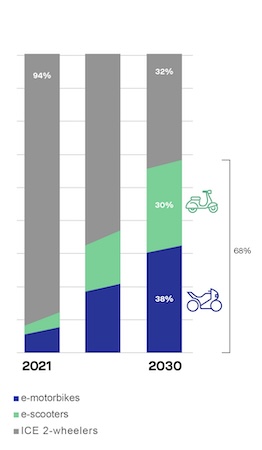
Figure 1. 2-wheeler market shares, ICE vs Electric. Image used courtesy of Bodo’s Power Systems [PDF]
In terms of growth, this sector is expanding faster than the four-wheeler market, not least because certification and design issues are much less complex. Similarly, battery management systems (BMS) are easier to design for the sector because two-wheeler batteries are smaller with less power and voltage. All of this means that start-ups are able to address electric mobility issues much easier in the two-wheeler market than if they were having to design EV systems from scratch.
In 2021 around 6% of light mobility vehicles were electrified, the rest relying on the internal combustion engine (ICE). By 2030, it is estimated that e-scooters and motorbikes will between them represent 68% of the two-wheeler market. In more detail, sales of e-scooters are expected to reach 30 million within the next six years, e-motorbikes 23 million, and e-bikes 40 million. At present, the electric two-wheeler market is based around 48 V e-scooters but the growth is expected to come mainly from 100 V-200 V e-motorbikes followed by electric bikes with 36 V systems. In India, powerful motorbikes represent the largest two-wheeler market and its growth is already inspiring a fresh wave of electric designs where lightweight, compact, and durable components are essential requirements.
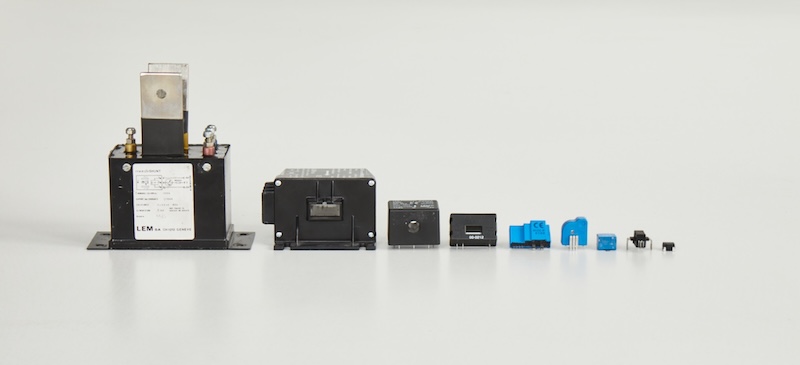
Image used courtesy of Bodo’s Power Systems [PDF]
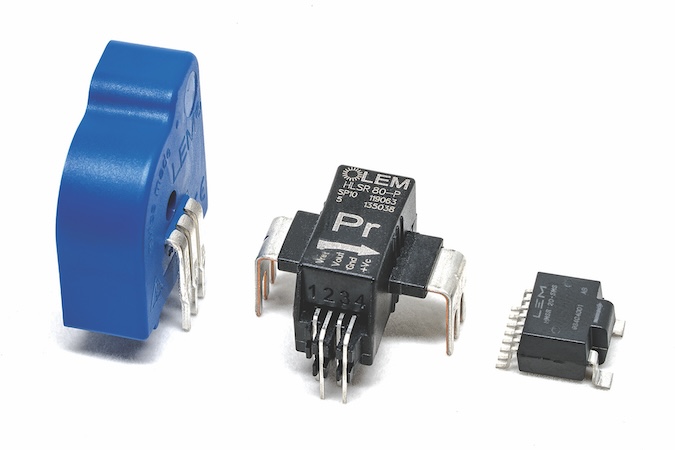
Figure 2. Miniaturizing the current sensing function. Image used courtesy of Bodo’s Power Systems [PDF]
LEM is developing a portfolio to meet the requirements of the light mobility sector—especially electric two-wheelers with three-phase AC motors—with integrated circuit sensors (ICS) that are just as advanced as those are used in EVs and cover every part of the emobility sub-system that would typically include up to eight sensors per vehicle.
There are three main areas where ICSes represent the best fit for electric two-wheelers. The first is power conversion, where the charger turns AC power from the grid into DC for the vehicle’s Lithium-ion (Li-ion) battery.
There are three measurement points for current sensing in the charger that focus not just on power conversion but also on efficiency and control:
- one integrated current sensor carries out AC input measurement where the charger needs to check the current going into the system
- a second ICS monitors the power transistors and switches that convert the signal from AC to DC. This current sensor synchronizes the transistors to make sure the conversion is carried out in an efficient way
- a DC output current sensor measures the current that goes out of the system and compares it with the expected output current. Any difference will indicate a problem at the conversion stage which the microcontroller will need to adjust to ensure the desired output current is achieved.
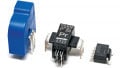
Typical LEM ICSes include GO sensors because the input sensor must be isolated due to the grid voltage. With the AC grid at around 200 V-220 V, at the input stage, a GO SME ICS is ideal for low current or a GO SMS for higher current. GO SME sensors are also suitable at the output stage because less isolation is required when working with 48 V batteries.
Avoiding Battery Damage
The second key area for ICSes in electric two-wheelers is the BMS, with the aim of avoiding battery damage as well as potentially catastrophic failure events such as a fire or explosion. Operating as a protection and safety device, a single sensor in the BMS checks if there is a rush current or surge current in or out of the battery. If there is, the ICS will instruct the microcontroller to open the relay to prevent any more energy from going through the battery. Often, the ICS will work alongside a shunt that uses different technology to carry out the same measurements, with the microcontroller comparing the signals. This double redundancy means that if there is a failure of one sensor for any reason the other will continue to take measurements.
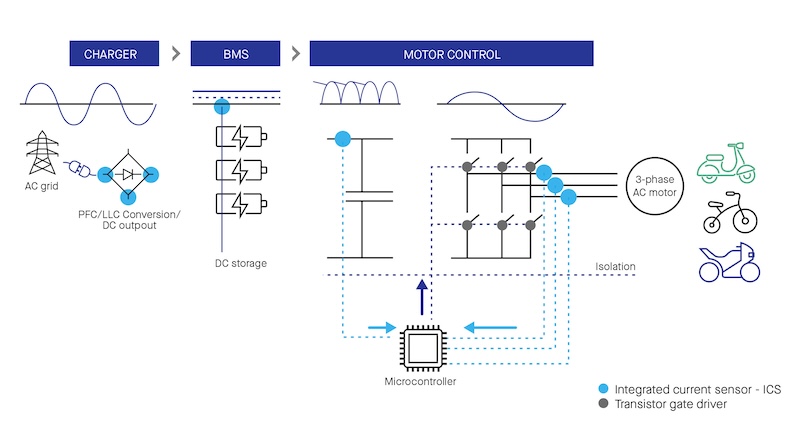
Figure 3. Typical e-mobility application and current measurement points. Image used courtesy of Bodo’s Power Systems [PDF]
The third area where ICSs are ideal for electric two-wheelers is motor control, where the DC current from the battery is turned into a three-phase AC current to operate the electric motor that runs the vehicle. Typically, four sensors would be operating here—one at the input stage and three at the output, all capable of being soldered automatically and directly onto the face of the PCB and taking up minimum space. Again, the microcontroller is involved in checking that input and output levels are as expected. Safety is enhanced by all sensors at the input and output working in harmony to compare rates and ensure the operation is running as it should. With the microcontroller managing transistor gate drivers using the signal sent by the current sensor, this is a highly efficient control loop that provides accurate control over the motor. The result for the end user is smooth acceleration and maximum operational efficiency of the vehicle.
Typical LEM ICSes used here would be the HMSR SMS family, particularly because of a large primary conductor with very low electrical resistance and dedicated pads that make it capable of handling high currents if required. Featuring a micro magnetic core, HMSR sensors are immune to external fields, making them ideal for power electronic applications that have high levels of disturbance.
Integrated Current Sensors in Light Mobility
Integrated current sensors in electric two- and three-wheel vehicles offer superior performance in a smaller low-cost package that delivers impressive levels of power density in light mobility applications. The sensors combine high levels of isolation and accuracy with the ability to handle higher currents but in a more integrated package that can deal with issues directly on the PCB.
The global electrification of two- and three-wheel vehicles is set to take off, and by delivering on precision, reliability, integration, and power density, next-generation integrated current sensors will play a vital role in driving growth.
This article originally appeared in Bodo’s Power Systems [PDF] magazine.