
 Facebook
 Google
 GitHub
 Linkedin
Infineon Adds 2300 V SiC MOSFET Modules to Power Module Family
The high-power CoolSiC variants support 1500 V DC-link voltages, with RDS(on) from 1 to 2 mΩ and 4 or 6 kV isolation, targeting wind, solar, and battery storage.
Infineon Technologies has expanded its XHP 2 high-power module portfolio with new variants built around 2300 V CoolSiC MOSFETs, designed for renewable energy and energy storage systems running at DC-link voltages of up to 1500 V. The modules offer on-resistance values between 1 and 2 mΩ and isolation voltages of either 4 kV or 6 kV. Munich-based Infineon positioned the launch as an answer to the renewable industry’s continued push toward higher system voltages.
The 2300 V class fills a gap between Infineon’s existing 1700 V and 3300 V SiC modules. As wind, solar, and battery energy storage system (BESS) operators push DC-link voltages up to 1500 V to reduce conduction losses and increase transmission efficiency, the 2300 V breakdown rating provides margin for derating and transient over-voltages without forcing designers to step up to 3300 V devices that carry a higher cost per amp.
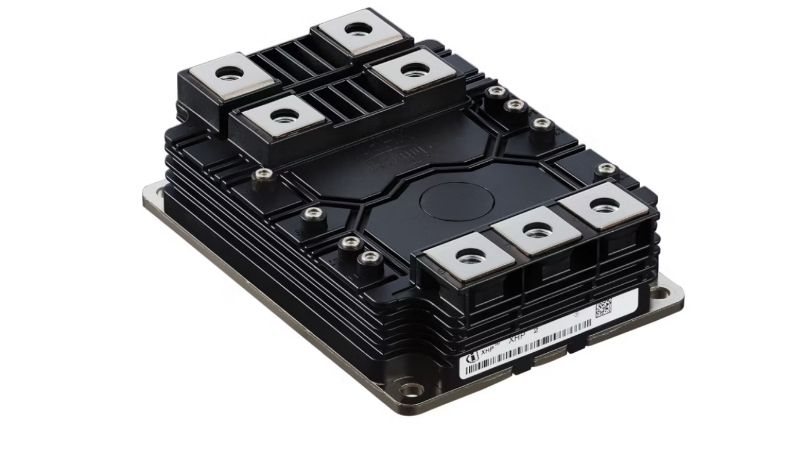
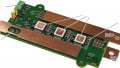
The half-bridge module 2300 V. Image used courtesy of Infineon
Higher Voltage Class, Lower Losses
The XHP 2 CoolSiC 2300 V modules cut both switching and conduction losses compared to silicon-based IGBT solutions of equivalent rating, according to Infineon.
The company published two performance reference points for the new lineup: power densities reaching 300 kW/L in wind power demonstrations and semiconductor losses below 0.7% of output power in battery storage applications. Both metrics depend heavily on switching frequency, gate-drive design, and thermal management, so real-world numbers will vary, but they establish the upper-bound performance envelope Infineon is targeting.
The 1 to 2 mΩ RDS(on) range gives designers options for matching the device to inverter current ratings without parallel device counts that complicate gate-drive timing. The 4 kV and 6 kV isolation options support different system grounding and partial-discharge requirements; 6 kV isolation is typically required for utility-scale BESS and large-scale wind turbine converters, while 4 kV is sufficient for many commercial and industrial PV inverters.
Form Factor and Reliability
The modules use the existing XHP 2 platform, which Infineon designed with symmetrical switching characteristics to simplify paralleling in larger converters. The package integrates Infineon’s .XT interconnection technology, which replaces standard wirebond and solder die-attach with a sintered structure that improves thermal conductivity and extends power-cycling lifetime by an order of magnitude over conventional die-attach.
Optional pre-applied thermal interface material ships with the modules to reduce assembly steps and improve thermal consistency on large baseplates, which matters most in utility-scale converters, where uniform thermal contact across hundreds of square centimeters of baseplate area is difficult to achieve manually.
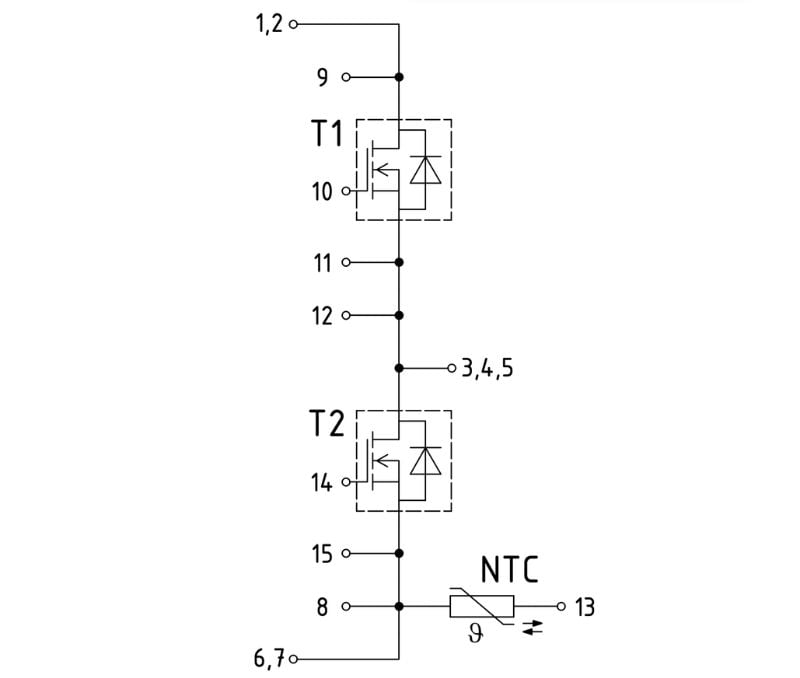
Circuit diagram for the FF1000UXTR23T2M1. Image used courtesy of Infineon
Pin compatibility within the XHP 2 family means designers can substitute the 2300 V SiC parts into existing platforms that previously used Infineon’s 1700 V SiC or IGBT XHP 2 modules, subject to gate-drive and thermal redesign. That backward compatibility is a draw for inverter OEMs already shipping wind, solar, and BESS platforms on the older 1700 V XHP 2 footprint and looking to step up to 1500 V DC architectures without retooling the converter mechanicals.
The variants Infineon introduced include the FF1000UXTR23T2M1, FF1300UXTR23T2M1, FF2000UXTR23T2M1, and FF1000UXTR23T2M1_B5, available now from Infineon and its distribution partners.
HE Power Conversion in Renewables Infrastructure
The launch reflects accelerating demand for higher-voltage, high-efficiency power conversion in renewable energy infrastructure, utility-scale battery storage, and grid modernization projects. As 1500 V DC architectures have become standard in utility-scale solar and BESS over the past five years, the supply chain for 2300 V SiC modules has tightened, with onsemi, Wolfspeed, ROHM, and Mitsubishi Electric all pushing competitive parts in the same voltage class.
For Infineon, which already sells across the CoolSiC voltage range (400 V, 650 V, 1200 V, 1700 V, 2000 V, 2300 V, and 3300 V), the XHP 2 SKUs broaden coverage at the high-voltage end without requiring customers to redesign for a new module footprint. The 1500 V DC-link sweet spot now commands the bulk of utility-scale renewable inverter design wins, and the 2300 V class is increasingly the default for those topologies.
A big shift in competition for 2300 V SiC has occurred in the last 18 months. Wolfspeed’s financial restructuring has put pressure on its module roadmap, while Mitsubishi Electric’s N-series and ROHM’s fourth-generation SiC MOSFETs have closed performance gaps with Infineon’s CoolSiC line. Infineon’s lead in module-level integration is a major differentiator, particularly with the.XT interconnection technology and the XHP 2 paralleling characteristics.




Sorry, I don’t know how to report a typo.
An Rds(on) of 1–2 megaohms would be extraordinarily high — I believe the author meant 1–2 milliohms.
You are three orders of magnitude too large in your statement of internal on-resistance!! This mistake is repeated consistently throughout the article!!! I would highly recommend you proofread before publishing. This is an error so glaring as to make the article’s content nonsensical!