Facebook
 Google
 GitHub
 Linkedin
EPC Launches GaN-Based Motor Drive Evaluation Board
At APEC 2026, EPC introduced the EPC91121, built around a seventh-generation 40 V eGaN transistor, targeting drones, robotics, and industrial motor applications.
Efficient Power Conversion (EPC) has unveiled its EPC91121 motor drive inverter evaluation board, offering engineers a complete three-phase BLDC motor drive platform built around the company's seventh-generation GaN technology. EPC introduced the board at APEC 2026/
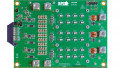
At 79 mm x 80 mm, the EPC91121 is a compact reference design that delivers up to 70 A peak (50 ARMS) output current from input voltages between 18 V and 30 V, putting it squarely in the 24 V battery class used across drones, robotics, handheld power tools, and industrial automation systems.
The board's PWM switching frequency reaches 150 kHz, nearly four times the typical 20 kHz to 40 kHz switching frequency used in silicon MOSFET motor drive designs. This frequency elevation allows designers to shrink magnetic components, reduce switching losses, and improve overall system responsiveness. The higher switching frequency also reduces acoustic noise from the motor and windings.
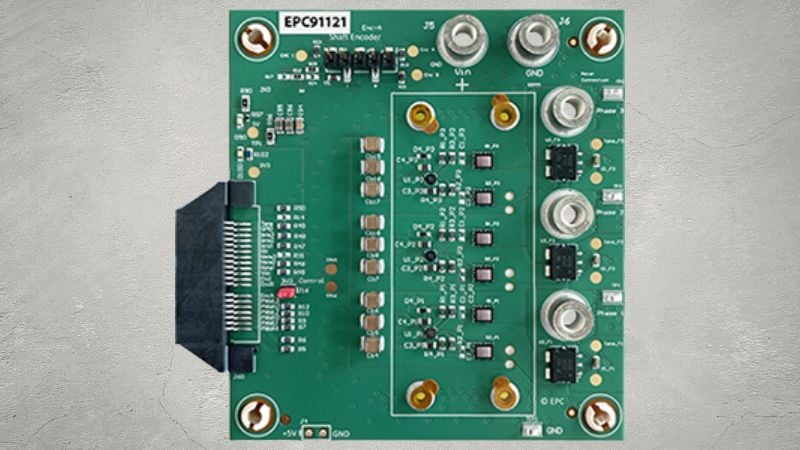
The EPC91121 evaluation board. Image used courtesy of EPC
7th-Gen GaN
The evaluation board is built around six EPC2366 eGaN FETs configured as a three-phase half-bridge inverter. The EPC2366 is a 40 V enhancement-mode GaN transistor with an on-resistance of 0.84 milliohms, representing EPC's latest commercially available GaN power device generation.
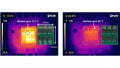
This low on-resistance directly reduces resistive losses across the six MOSFETs at rated load. At 50 A RMS, the on-state power dissipation is dominated by I2R losses. The 0.84 milliohm figure translates to approximately 2.1 W dissipated per transistor pair in steady-state operation.
In compact enclosures typical of battery-powered systems, designers could eliminate or significantly reduce active cooling and rely instead on small aluminum baseplates or integrated thermal management within the host system, substantially lowering cost, weight, and component count.
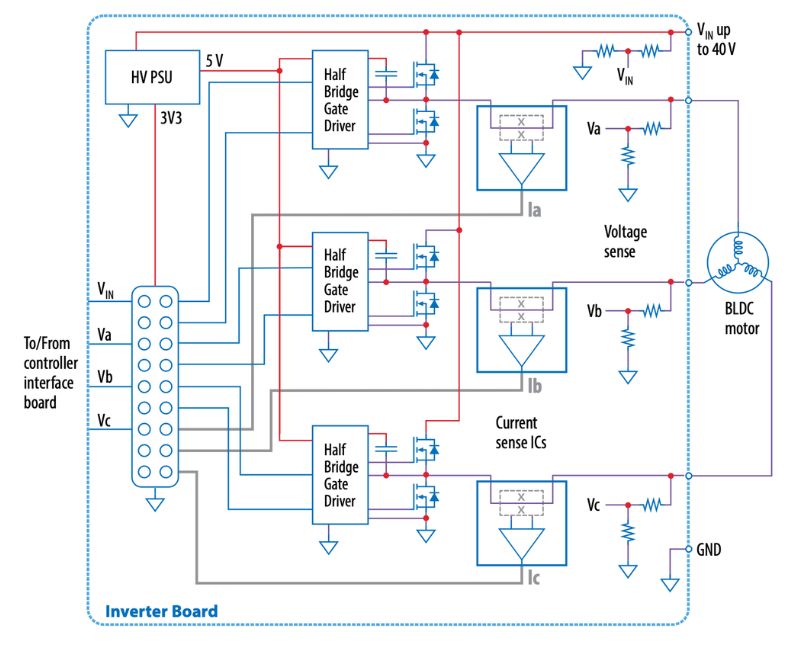
Block diagram in a BLDC drive application. Image used courtesy of EPC
GaN transistors switch faster than their silicon counterparts and require lower gate charge, resulting in reduced switching losses at high frequencies. In motor drive applications, this means less energy wasted as heat in the power stage, enabling smaller heatsinks or fanless designs in space-constrained platforms like drones and robotic joints.
At 150 kHz operation, switching losses become a significant portion of total power dissipation. Combining low on-resistance and GaN's superior switching characteristics ensures that the thermal budget remains manageable even at the upper end of the frequency range.
The board supports both field-oriented control (FOC) and space-vector PWM operating modes, giving motor control engineers access to the two most widely used algorithms for high-performance brushless DC and permanent magnet synchronous motor drives.
Integrated Sensing and Broad Controller Support
EPC designed the EPC91121 as a self-contained development platform, and the board integrates gate drivers, housekeeping power supplies, and voltage and temperature monitoring, along with three-phase current sensing with a bandwidth of ±125 A, phase and DC-bus voltage sensing, and interfaces for both Hall sensors and shaft encoders.
The layout has been optimized to keep the voltage slew rate (dv/dt) below 10 V/ns. This is a deliberate design choice aimed at reducing the distortion, acoustic noise, torque ripple, and electromagnetic interference that can plague high-speed GaN switching stages when parasitic inductances in the power loop are not carefully managed.
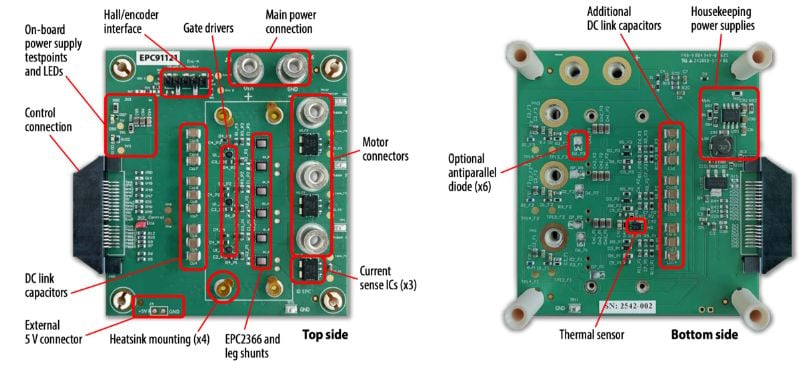
Features of the EPC91121. Image used courtesy of EPC
High dv/dt rates inject common-mode noise into the power loop, coupling through stray capacitances into nearby signal traces and shielding. By controlling dv/dt through careful placement of decoupling capacitors, optimized return paths, and controlled gate drive slew rates, the EPC91121 achieves superior EMC performance. This is essential for products destined for applications with sensitive radio receivers or precision sensors in the same enclosure. Regulatory EMC testing margins improve, reducing the need for external filtering that would otherwise add cost and complexity.
A 40-pin controller header provides compatibility with development platforms from Renesas, Microchip, Texas Instruments, and STMicroelectronics. This multi-vendor approach lowers the barrier to evaluation for engineering teams that may already be committed to a particular microcontroller ecosystem for their motor control firmware, eliminating the need to learn a new toolchain just to evaluate GaN performance.
Multiple test points are distributed across the board for oscilloscope probing during development, and the compact footprint enables mounting the board directly in a prototype enclosure for system-level thermal and EMC testing alongside the target motor.