Facebook
 Google
 GitHub
 Linkedin
CUI Introduces High-Performance Industrial DC-DC Converters
The two isolated DC-DC converters are designed for e-mobility, railway, and industrial sectors.
Advancements in electric and industrial systems have intensified demands on power conversion technology. Modern e-mobility, railways, and industrial automation applications require DC-DC converters that can handle higher power densities while maintaining strict safety and reliability standards.
In response to these industry-wide challenges, CUI has introduced two high-performance DC-DC converters designed specifically for industrial applications. The converters incorporate many desired features to meet demands for power density, thermal management, and safety.
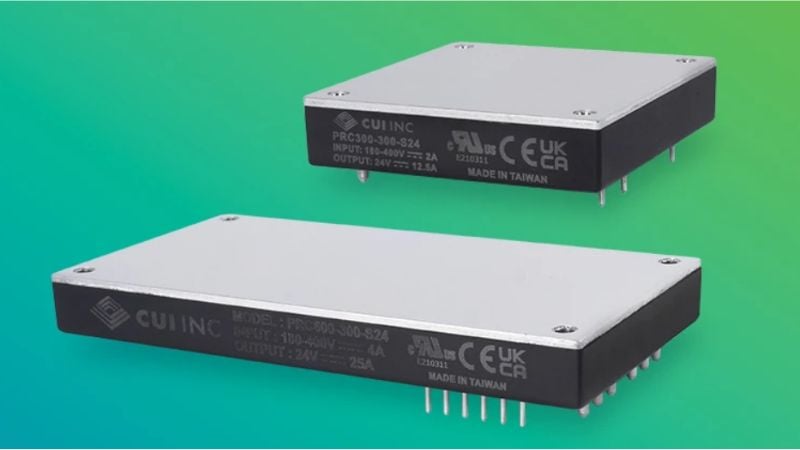
The PRC300 and PRC600 series converters. Image used courtesy of CUI
Modern DC-DC Converters
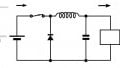
DC-DC converters exist in almost all modern electronics. They convert electrical energy between different voltage levels to meet various applications' specific power needs. Standard solutions operate by selectively switching input voltage through high-frequency transistors, storing energy in inductors or capacitors, and then regulating the output using feedback control to achieve desired voltage and current levels.
Heat dissipation is a major consideration when designing DC-DC converters. In high-density modules, for example, inadequate thermal management can cause rising temperatures and component failures.
Conventional cooling methods include fan-based cooling, casing-based dissipation, and baseplate cooling.
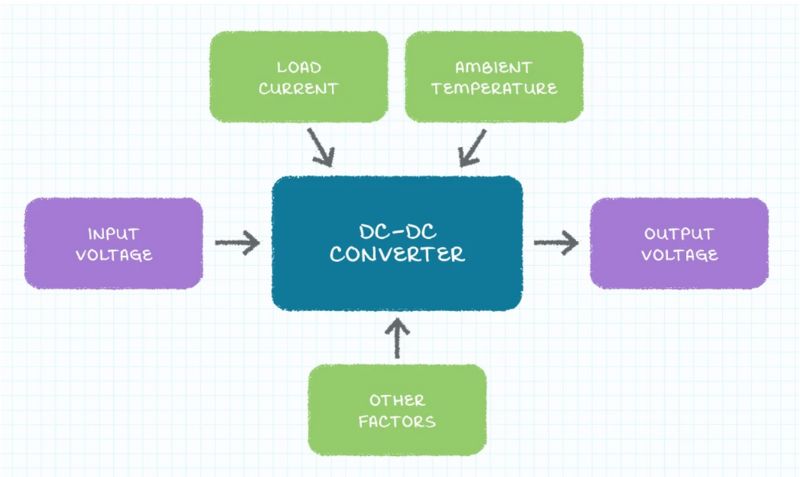
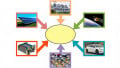
Features to consider in a DC-DC converter. Image used courtesy of CUI
While efficient, fans introduce noise, dust, and reliability concerns into systems. They often become the first failure point in 24/7 operations. Casing-based dissipation offers minimal improvements in thermal performance. Baseplate cooling transfers heat from the power supply's primary heat-generating components to an external heat sink or the device casing.
From an architectural perspective, parallel DC-DC converter systems have effectively enhanced output power capacity. Current sharing in parallel DC-DC converters occurs through control mechanisms that balance the load current among parallel units. Techniques like droop control adjust output voltage based on load, while active current-sharing circuits use feedback loops to match current across converters, ensuring equal distribution and preventing overloads.
Introducing the PRC300 and PRC600 Series
CUI Inc. has introduced the PRC300 and PRC600 series DC-DC converters for high-performance applications in e-mobility, railway, and industrial sectors. These converters feature 4.2 kV isolation, a wide input voltage range (180–400 VDC), a broad operating temperature (-40°C to 100°C), and compliance with UL/EN/IEC 62368-1 standards.
The PRC600 series delivers up to 600 W in a compact brick design, offering positive and negative logic options, remote on/off control, and output voltage trimming for flexible integration. It also incorporates the option of output current sharing, allowing multiple DC-DC converters to operate in parallel and share load current so that the combined output power scales efficiently while maintaining equal stress across converters.
The PRC300 series offers 300 W of output power and a 2:1 input range. Notably, this solution also incorporates baseplate cooling to improve thermal performance and allow for improved thermal density. Both converters adhere to EN 61373 and EN 45545-2 standards.
Setting New Standards
As e-mobility and industrial applications evolve, manufacturers will develop products to balance power density, thermal management, and safety compliance. CUI aims to deliver on these needs with the PRC300 and PRC600 series. Both solutions are immediately available in the market.