Facebook
 Google
 GitHub
 Linkedin
Allegro Intros Hall-Effect Current Sensor for Power Conversion
The ACS37017 isolated sensor targets drift reduction and precision feedback in high-voltage power conversion systems and offers a sensitivity error of 0.55%.
Allegro MicroSystems has unveiled the ACS37017, an isolated Hall-effect current sensor and accuracy-focused member of its high-performance current-sensing portfolio.
The device is aimed at high-voltage power conversion applications, including xEV traction inverters, industrial motor drives, solar inverters, and data center power supplies. With the ACS37017, Allegro completes a three-part expansion strategy, including the ACS37100, which addresses high-bandwidth protection and fast transient detection, and the ACS37200, which targets low insertion loss and compact layouts.
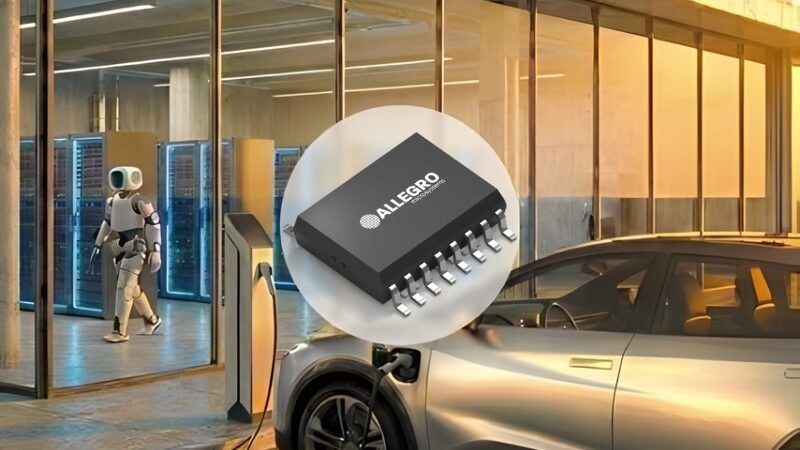
The ACS37017 is suitable for motor drives, data centers, and solar inverters. Image used courtesy of Allegro
Accuracy Over Temperature and Lifetime
The ACS37017’s standout feature is a +/-0.55% typical sensitivity error specification, maintained over temperature and throughout its lifetime, which focuses on drift across the operating range and aging.
The device also specifies +/-3 mV offset error over temperature and lifetime. Offset performance matters most in lower-current regions because even the smallest shifts can distort closed-loop regulation or bias torque control in motor systems. Designers will typically budget for offset drift in the ADC and reference chain here, and integrating that stability at the sensor level reduces the need for frequent recalibration or firmware compensation.
Bandwidth is 750 kHz with a 1 µs typical response time, placing the ACS37017 well above many precision-oriented magnetic current sensors that trade bandwidth for accuracy. In switching converters operating in the hundreds of kilohertz range, this bandwidth supports both feedback measurement and fast overcurrent detection without resorting to a separate high-speed shunt path.
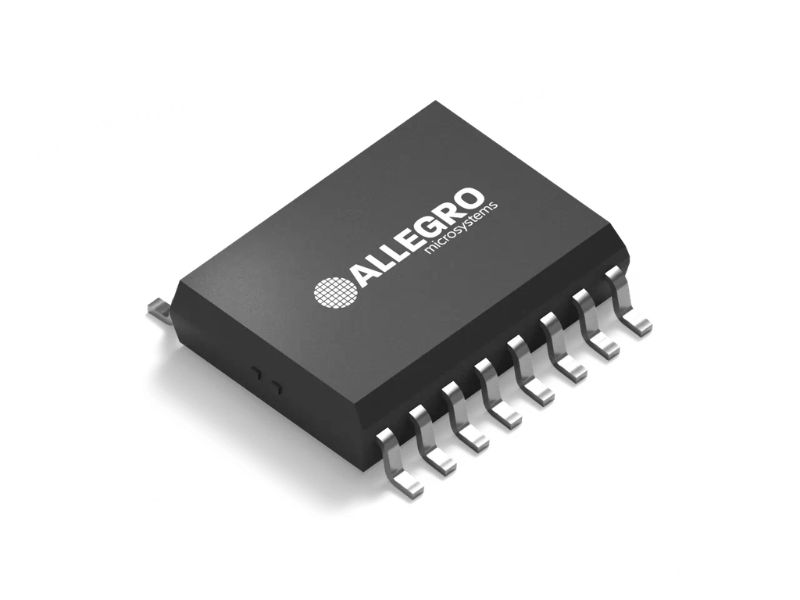
The ACS37017. Image used courtesy of Allegro
Allegro attributes the stability improvements to a proprietary compensation architecture intended to address temperature and aging drift. While the company has not publicly detailed the internal implementation, the emphasis on lifetime error suggests trimmed or digitally assisted analog compensation.
Integrated Reference and Differential Routing
Architecturally, one of the more consequential choices with the ACS37017 is the inclusion of a precision, non-ratiometric voltage reference and a zero-current reference output pin. In many Hall-based current sensors, the output is ratiometric to supply voltage, requiring careful matching between the sensor supply and the ADC reference to avoid gain error introduced by supply variation.
By integrating a stable internal reference and exposing a VREF output for differential routing, the ACS37017 allows designers to route the sensor output and reference together into a differential ADC input. This can reduce susceptibility to common-mode noise and ground potential differences in high dV/dt environments typical of traction inverters and server power stages.
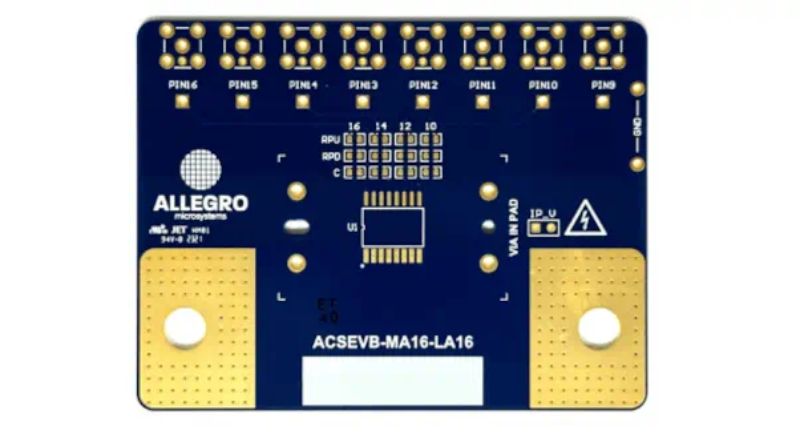
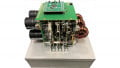
Evaluation board. Image used courtesy of Allegro
In practice, differential routing of VOUT and VREF, combined with appropriate filtering and Kelvin sensing at the primary conductor, can reduce measurement noise without increasing analog front-end complexity. Allegro has previously published layout guidance emphasizing thermal management and via-in-pad techniques to control self-heating, which directly affects offset drift in high-current devices.
System Fit
The ACS37017 is housed in a wide-body SOICW-16 package with a primary-conductor resistance of 0.85 megaohms. Conduction loss through the integrated copper path remains low enough for mid-range current applications without introducing typical thermal challenges.
Meanwhile, isolation ratings include 5000 VRMS withstand and +/-800 VPK, or 565 VRMS reinforced isolation, making the device suitable for high-voltage DC bus monitoring and grid-tied power conversion under reinforced isolation requirements.
By introducing the ACS37017 alongside the ACS37100 and ACS37200 as the third and final entrant in the series, Allegro is segmenting the current-sensing problem that all designers face into three distinct design priorities. In practice, however, those priorities often overlap. A traction inverter, for example, may require high bandwidth for protection, low insertion loss for efficiency, and tight accuracy to maintain torque precision across temperature. Rather than building a single compromise device, Allegro is offering differentiated parts optimized around each problem.