Facebook
 Google
 GitHub
 Linkedin
3 New DC-DC Platforms Tackle Industrial and AI Demands
OmniOn Power, Recom, and Navitas Semiconductor have launched DC-DC platforms to deliver versatility in efficient power design.
Power electronics designers face new challenges every day, regardless of industry or application space. Major industry players, including OmniOn Power, RECOM, and Navitas Semiconductor, have launched DC/DC platforms to address the unique demands designers face in power conversion.
Omni Power’s ProLynx is designed for 24 V and 48 V industrial and embedded applications, while Recom is offering a non-isolated buck module for high-voltage industrial DC rails. Navitas’s new DC-DC platform uses an all-GaN design and focuses on data centers.
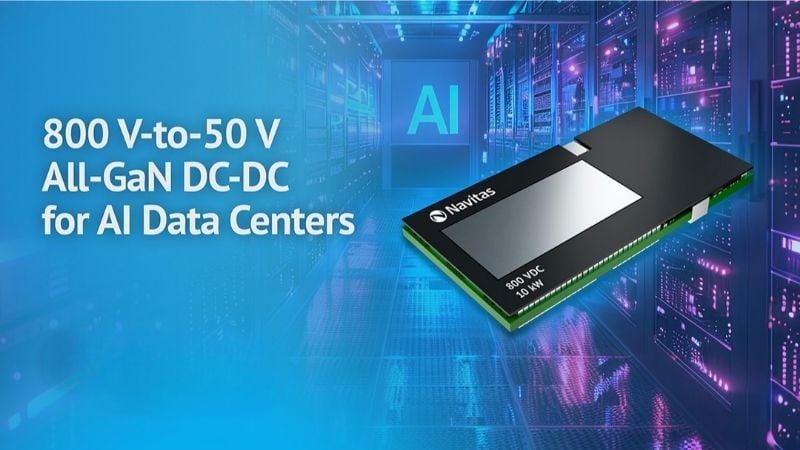
Navitas is one of three companies offering new DC-DC systems. Image used courtesy of Navitas
OmniOn Power’s ProLynx II
OmniOn Power has introduced its ProLynx II series of point-of-load DC-DC converters. Many industrial and embedded systems are moving toward 24- and 48-V distributed power architectures to reduce stress on high-current point-of-load converters. To match this trend, the ProLynx II series of non-isolated modules accepts inputs from 5 to 59 VDC, with programmable output voltages from 2 to 30 VDC.
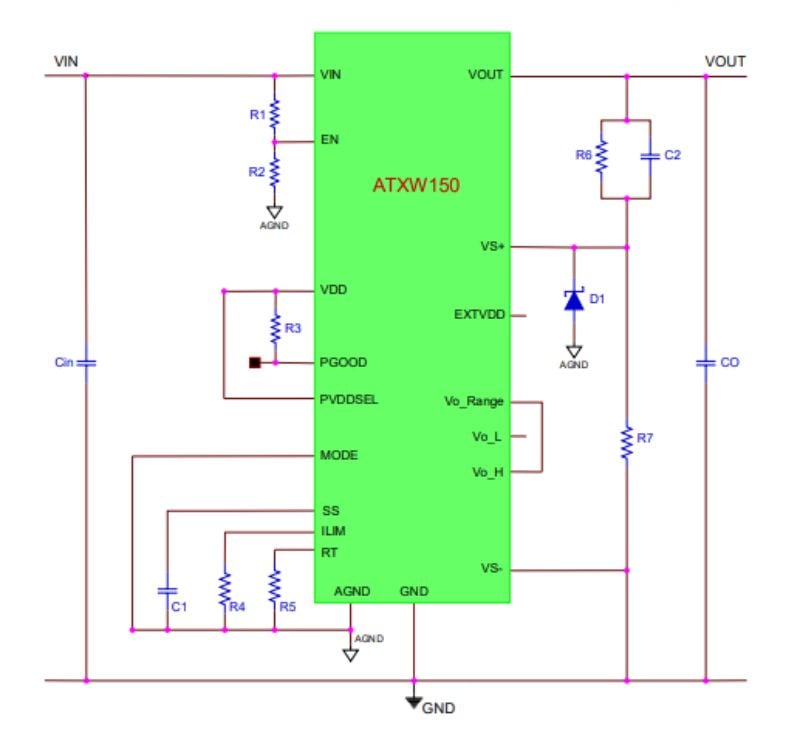
Typical application schematic of the ProLynx II series. Image used courtesy of OmniOn Power
The portfolio includes a 150 W version rated at 20 A and a 250 W version rated at 30 A, both of which reach efficiencies up to 96% for a 36 VIN to 12 VOUT conversion. Coming in a 29.4 x 15.5 x 14.5 mm package, the modules also operate from -40 to 105°C and meet MIL-STD-810G shock and vibration standards. Integrated protection functions include output overvoltage and overcurrent protection, ensuring system reliability under abnormal conditions.
Recom RPMVH-0.5
Recom has released the RPMVH-0.5 series to support industrial systems operating from high-voltage DC rails and exposed to line surges or fluctuating supply levels. The non-isolated buck module accepts input voltages from 6 to 115 VDC and delivers up to 0.5 A, with nominal outputs of 3.3, 5, 12, or 24 V.
Notably, each variant provides programmable trim ranges from 2.6 to 28 V, depending on configuration, and supports switching frequencies from 300 to 800 kHz, allowing designers to balance conversion efficiency and transient response.

Efficiency versus output load percentage for the RPMVH-0.5 series. Image used courtesy of Recom
Efficiency for these devices reaches up to 90%, allowing them to sustain full-load operation at ambient temperatures up to +100°C without forced airflow. The design also includes hiccup-mode short-circuit protection and overcurrent limiting at roughly 140% of rated load to protect downstream circuitry during fault events. The device operates to 120°C with derating and offers an MTBF of 1.9 million hours at 25°C.
The devices come in a 12.19 x 12.19 x 3.75 mm LGA package that integrates six-sided shielding and, with an external filter, satisfies EN 55032 Class B conducted emission limits.
Navitas 10 kW 800 VDC-to-50 V GaN DC-DC Platform
Navitas has developed a 10 kW full-brick DC-DC platform to support AI-focused data centers transitioning from traditional 54 V distribution to 800 VDC infrastructure. The platform converts 800 VDC to 50 V at the rack level.

GaN and SiC used at different stages in the data center power transmission path. Image used courtesy of Navitas Semiconductor
The solution features an all-GaN design that uses 650- and 100-V GaNFast FETs in a three-level half-bridge topology with synchronous rectification, achieving up to 98.5% peak efficiency and 98.1% efficiency at full load. Operation at 1 MHz supports smaller magnetics and passive components, which contribute to a power density of 2.1 kW/in^3 within a 61 x 116 x 11 mm full-brick footprint.
Navitas also integrates auxiliary power and control circuitry into its platform to reduce the external component count and simplify system qualification for hyperscale AI deployments.
A Solution for All Industries
While each platform focuses on a different segment of the power chain, all share a common objective. Designers need solutions that compress more performance into smaller volumes while maintaining thermal stability, robustness, and high conversion efficiency.
As system demands intensify in factories, embedded equipment, and data centers alike, DC-DC systems will need to continually keep up to unlock the next generation of power architecture.