Facebook
 Google
 GitHub
 Linkedin
This EV Integrates Solar Cells To Create an Energy-Positive EV
Clemson University students designed an electric vehicle prototype that generates more energy than it consumes.
What if a car could generate the solar energy needed to power itself? That’s the question that 16 graduate students at Clemson University’s Deep Orange program set out to answer.
They created a Luminetta, a solar-integrated electric vehicle prototype that combines lightweight engineering and intelligent vehicle controls. The car is energy-positive, meaning that it generates more energy than it consumes during a typical drive.
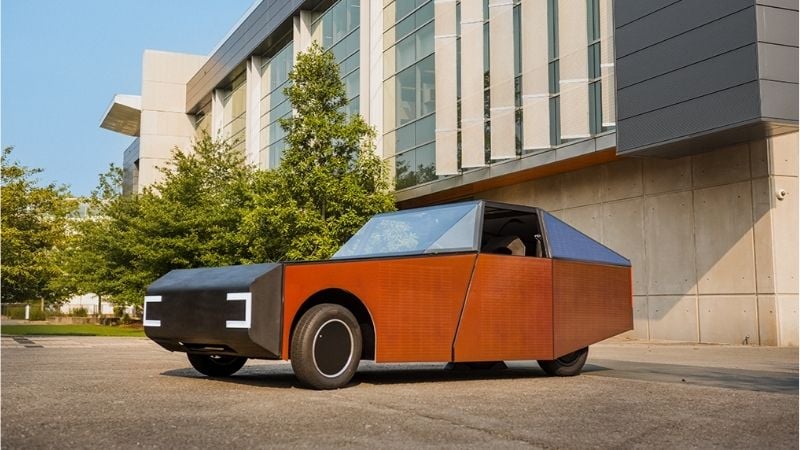
Close-up on the exterior of Deep Orange 17, showing integrated solar cells. Image used courtesy of Clemson
The Deep Orange Project
Deep Orange 17 is a hands-on program in Clemson’s master's program in automotive engineering. Student cohorts spend two years engineering a fully functional prototype vehicle built from the ground up.
Launched in 2010, the project encourages student engineers to design the “next big thing” in vehicles while also managing market analysis, budgets, chassis engineering, software integration, and physical manufacturing.
The Deep Orange 17 team worked together over two years to develop the prototype, which will be featured at the 2027 Consumer Electronics Show in Las Vegas.
The Energy-Positive Car
When the Deep Orange 17 team began working together, BMW’s research and development group challenged the cohort to rethink vehicle efficiency. Instead of focusing solely on improving driving efficiency, the team considered how to make the vehicle more efficient in its most basic states: idle and parked. As a result, the car was designed to harvest solar energy throughout the day, whether stationary or on the move.
Building and unveiling the Luminetta. Video used courtesy of Clemson
The result was the Luminetta, a lightweight, solar-integrated coupe designed to generate more energy than it consumes, assuming a typical day of urban commuting. The concept increases energy efficiency while reducing dependence on charging infrastructure, which remains a limitation for many electric vehicles currently on the road.
Solar Integration
Solar integration is a key part of Deep Orange 17’s efficiency strategy. The vehicle’s exterior has
1,781 built-in photovoltaic cells, allowing the system to generate solar energy continuously.
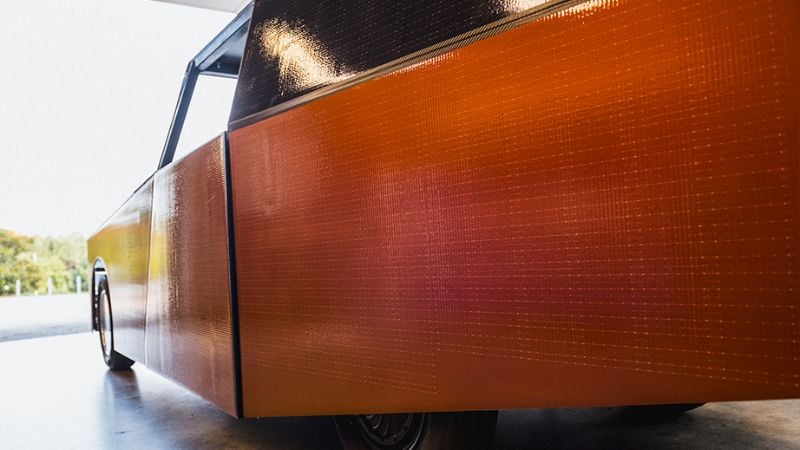
Close-up on the exterior of Deep Orange 17. Image used courtesy of Clemson
The solar panels, developed in collaboration with the Fraunhofer Institute for Solar Energy Systems ISE, use an innovative technique that enables solar power generation even under partial shading.
To ensure the concept could translate to real-world conditions, the graduate team modeled environmental conditions in Greenville, South Carolina; Frankfurt, Germany; Madrid, Spain; and Mumbai, India. Across all four locations, assuming a daily commute of 12 miles, the Deep Orange 17 generates enough solar energy to provide an average of 31 additional miles of driving range.
But this feat is accomplished through more than solar integration alone.
Efficient & Innovative Design
The car was designed holistically around efficiency, with every aspect of the vehicle considered as an opportunity to reduce energy consumption.
At just 1,212 pounds, Deep Orange 17 weighs around one-fourth as much as similarly sized production vehicles. Its lightweight chassis combines structural steel, aluminum, carbon fiber, and 3D-printed metal joints to maintain strength and safety while minimizing weight.
The vehicle’s unique shape takes inspiration from the boxfish, helping reduce drag while maintaining interior space.
Regenerative braking, intelligent torque distribution, and optimized drivetrain controls further improve energy recovery and efficiency.
BMW also challenged the team to show that efficiency doesn’t have to come at the expense of design. The two-door coupe draws from BMW’s recognizable design language while incorporating modern elements. Inside, a custom interface provides real-time vehicle data alongside familiar features like Apple CarPlay and Android Auto, balancing innovation with everyday usability.