Facebook
 Google
 GitHub
 Linkedin
Texas A&M Pairs LLM and Digital Twins for Reactor Monitoring
An AI framework uses a human-in-the-loop GPT agent to provide real-time advisory support for advanced nuclear reactor operations.
Texas A&M University researchers have developed an AI-powered monitoring tool that integrates a large language model (LLM) agent with a physics-informed digital twin to support the safe operation of advanced nuclear reactors.
The framework, called AROMA-GPT (Advanced Reactor Operation and Monitoring Assistant using Generative Pre-trained Transformer), is designed to help nuclear engineers understand reactor behavior in real time and to suggest informed operational steps. The system works by pairing a GPT-based LLM agent with a continuously updated virtual replica of the reactor system that reflects the system's evolving condition.
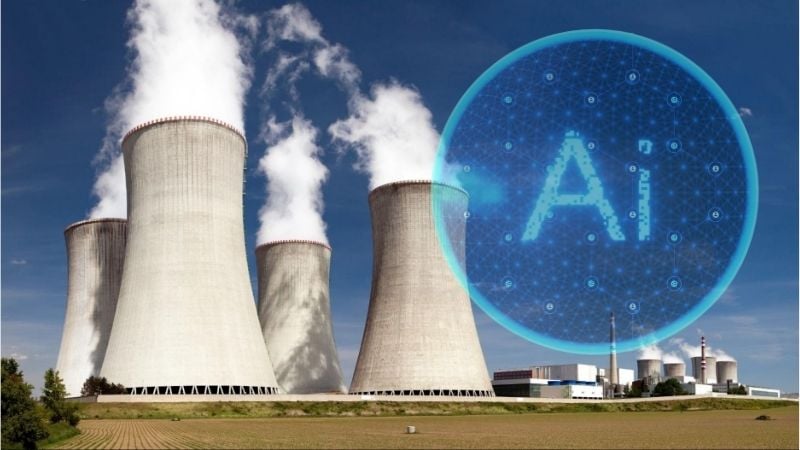
Can AI and LLM help design better reactors? Adapted from image used courtesy of Adobe Stock
A Modular, Physics-Grounded Architecture
The framework addresses three persistent concerns about deploying AI in safety-critical nuclear environments: keeping human operators involved in decision-making, grounding AI outputs in established physics and engineering logic, and ensuring the system stays close to verified reactor behavior.
AROMA-GPT functions as a supervisory decision-support layer. It processes sensor data, retrieves relevant engineering knowledge from curated domain-specific databases, and generates actionable insights for operators.
Physics-based models and validated reactor behavior constrain its outputs, rather than relying solely on the LLM.
One of the framework's key technical contributions is its modular architecture. The AI layer is decoupled from reactor-specific implementations, making AROMA-GPT adaptable across different reactor designs and computational models. The physics-informed backbone can be swapped independently of the AI layer, and vice versa.
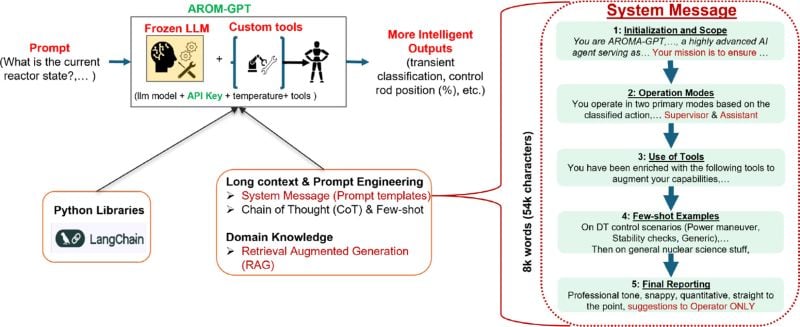
The AI hybrid control architecture. Image used courtesy of Ndum et al.
This model-agnostic approach facilitates integration with existing simulation codes, control systems, and operator training platforms.
Digital Twins as Virtual Testbeds
The digital twin component is central to AROMA-GPT’s operations. For advanced reactor designs that don’t yet exist as physical plants but are well-developed engineering concepts, the digital twin provides a rigorous virtual testbed. Engineers can use it to explore design optimization, test control strategies, and examine difficult edge cases that can’t be easily tested on operating hardware.
The twin stays aligned with how a nuclear reactor would evolve under changing conditions, providing enough realism to support real-time analysis and decision support. This is particularly valuable during the development phase of next-gen reactor technologies, when physical prototypes are expensive and regulatory constraints limit hands-on experimentation.
The researchers developed the framework within Texas A&M's Scientific Machine Learning for Advanced Reactor Technologies (SMART) Lab. The lab focuses on applying machine learning techniques to reactor modeling, health physics, and nuclear safety applications.
Part of a Broader AI-Nuclear Vision
AROMA-GPT represents the real-time supervisory and monitoring extension of a broader research program that builds around physics-informed, human-in-the-loop generative AI for nuclear engineering.
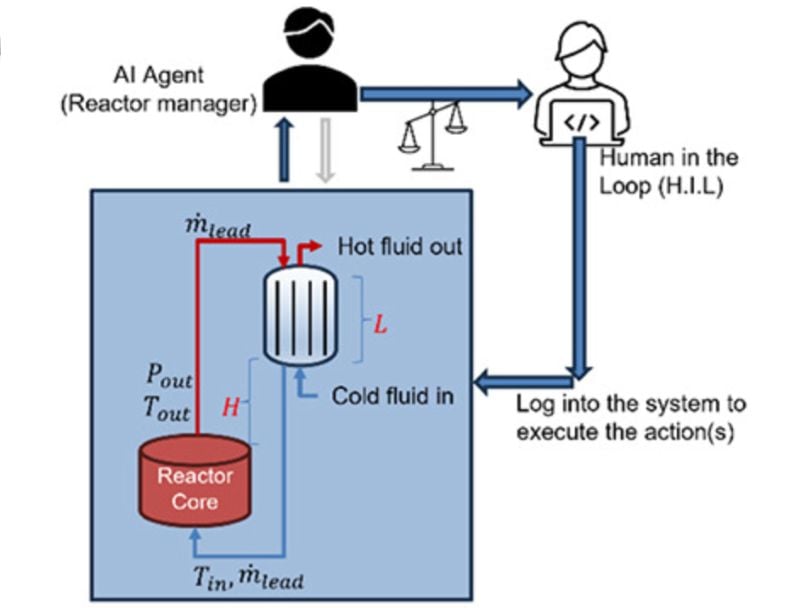
The AI and human operator work together. Image used courtesy of Ndum et al.
The larger goal is to create a suite of trustworthy AI-assisted applications that can accelerate the development, analysis, monitoring, training, and eventual deployment of advanced reactor technologies. This involves connecting established physics codes, digital twins, and curated nuclear knowledge bases to specialized AI agents.
The work builds on earlier research from the SMART Lab, including AutoFLUKA, an LLM-based application developed for automating workflows within the FLUKA nuclear simulation software. AutoFLUKA demonstrated that LLM agents could take and edit simulation input files, run computations, and analyze results, all while keeping proprietary data local and secure.
The progression from automating individual simulation tasks to providing real-time reactor monitoring also highlights a broader trend in nuclear engineering: using AI not to replace human expertise, but to extend it. AROMA-GPT keeps the human operator firmly in the loop while handling the data retrieval, contextual analysis, and knowledge management tasks that would otherwise consume significant engineering time.
With the nuclear industry increasingly exploring advanced reactor concepts, frameworks that can adapt across reactor types without requiring ground-up AI rebuilds could prove valuable as these technologies move from the design phase toward licensing and deployment.
The study appeared in Progress in Nuclear Energy.