Facebook
 Google
 GitHub
 Linkedin
Smarter EV Charging: A Honey Badger Perspective
The honey badger algorithm helps grid operators manage impacts from electric vehicle chargers and renewable energy sources.
Electric vehicle charging stations are expanding to meet the growing demand. However, integrating new charging stations into the grid is challenging. EV charging causes local energy fluctuations, presenting an unexpected load, potentially leading to power losses and voltage instability. Renewable energy and other intermittent distributed energy resources (DER) cause similar challenges in grid operations.
Smart grids can manage multiple infrastructure systems with assistance from the honey badger algorithm, introduced in 2020. In a study published in Nature’s Scientific Reports, researchers in India optimized the honey badger to handle the uncertainties of EV charging, vehicle-to-grid, and other changing conditions.
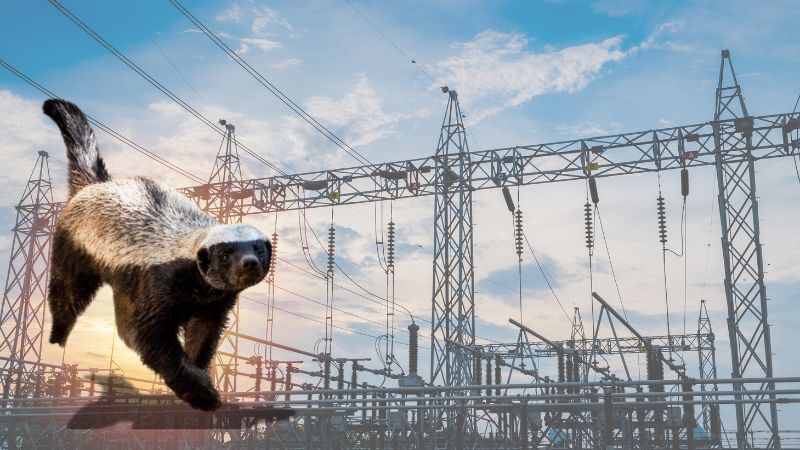
Can a honey badger algorithm optimize the grid for EV charging? Image adapted from images courtesy of Canva and Wikimedia Commons
EV Charging Grid Challenges
More public charging infrastructure is being deployed in cities and towns worldwide. When numerous electric vehicles unexpectedly charge simultaneously, it can impact grid operation and planning of radial distribution systems (RDS), causing localized spikes in power demand. Charging even a moderate number of EVs can lead to overloads and degraded voltage profiles while elevating peak demand and reducing electricity reliability locally.
Ensuring Grid Resilience With Renewables and EVs
The decreasing cost of solar cells and wind turbines has increased their integration into the grid. Renewable energy technologies can enhance grid reliability and resilience during peak demand, power demand spikes, and power outages by supplying electricity that has been harvested and stored in microgrids. This power is provided when traditional grid energy is low. Renewables can also help to reduce power loss and improve voltage profiles in RDS.
Another crucial infrastructure piece is battery energy storage systems (BESS). Alongside charging stations and DERs, BESSes are essential for optimizing RDS. Microgrids can be optimized to provide energy when required, but an optimal mix of renewables coming into the grid is needed to ensure a sustainable supply.
EVs can also add energy to the grid via vehicle-to-grid (V2G) and remove power in grid-to-vehicle (G2V) operations. More efficient optimization protocols are needed to better manage local grid infrastructure and ensure the grid is reliable and resilient due to increasing intermittent power demands from EVs.
Optimizing EV Charging With the Honey Badger Algorithm
Researchers used a honey badger optimization algorithm (HBOA) to optimize the many aspects of the grid. HBOA uses a swarm intelligence optimization algorithm that simulates a honey badger’s foraging and dynamic hunting behavior that relies on digging/seeking techniques. The HBOA examined the dynamic conditions of the charging stations over a 24-hour cycle, observing driving behaviors and V2G capabilities.
Renewables such as wind, solar, and bio-based generators were placed in the model to provide clean energy to local populations, reducing potential transmission losses and reducing carbon emissions, all while providing extra grid resilience capabilities.
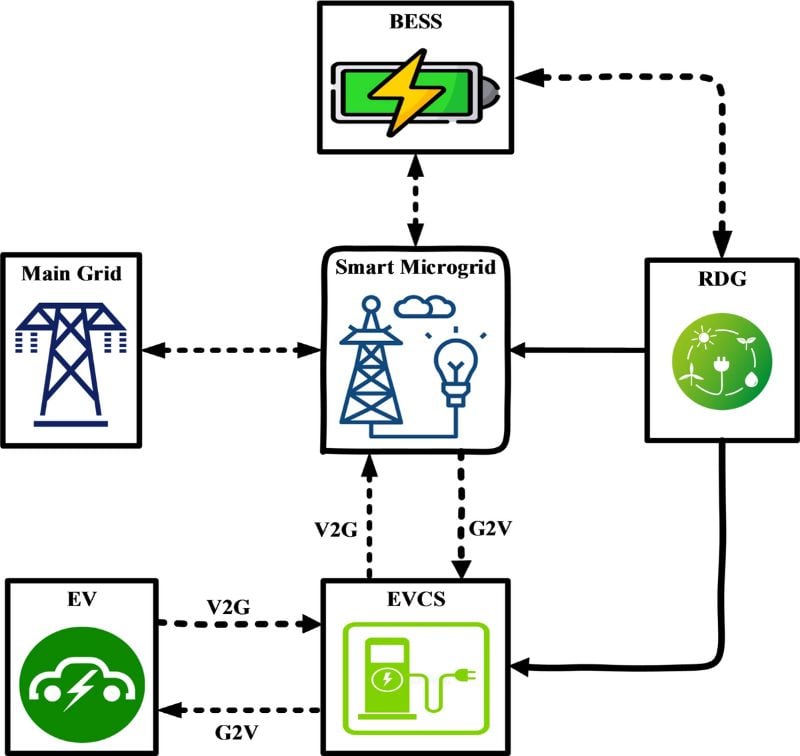
Configuration of the microgrid model. Image used courtesy of Muthusamy et al.
A smart microgrid was used as a central hub to provide advanced control techniques to manage energy flow in real time, balance energy load, and support bidirectional energy exchanges in EVs. This scenario enabled any surplus energy to be added back into the grid via V2G and allowed the EVs to act as mobile energy storage units. The researchers proposed a smart microgrid structure with interconnected microgrids for commercial, residential, and industrial sectors to mitigate EV charging station impacts on the local grid.
Overall, the algorithm optimized the placement of different renewables to address potential uncertainties and varying load conditions in local environments and reduce the charging stations' impact on the local RDS.
The algorithm was tested on standard IEEE 69-bus and real-time Indian 28-bus RDS and looked at grid stability, carbon emissions, and power losses. In these models, researchers found the optimization algorithm reduced the power loss by 62% in the IEEE 69-bus system and increased the voltage stability index (VSI) from 0.7139 to 0.8311. Optimizing the local energy also led to a 66% reduction in carbon dioxide emissions. By comparison, optimization of the Indian 28-bus system showed a 55.5% decrease in power loss, a 50% reduction in CO2 emissions, and an increase in the VSI from 0.7394 to 0.9964.
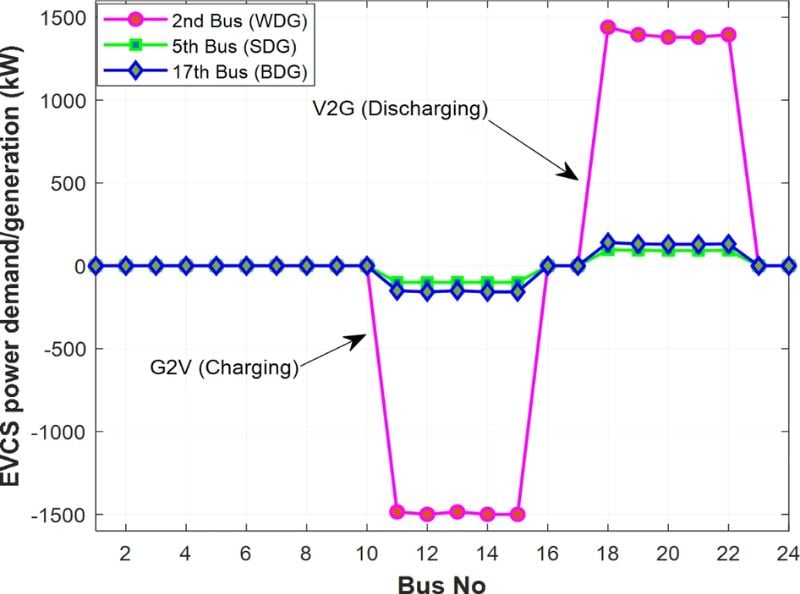
EV charging impact on HBOA-enhanced grid model. Image used courtesy of Muthusamy et al.
HBOA Advantages the Key to Grid Optimization
The HBOA provided advanced optimization capabilities to improve the performance of local RDS, enhance energy distribution, reduce the demand during peak loads to improve grid stability, lower operational costs, and improve local sustainability efforts. With the increasing need to integrate renewables and EV charging stations into local grids, optimization algorithms such as HBOA could provide many benefits for local distribution networks.