Facebook
 Google
 GitHub
 Linkedin
Porsche Rolls Out Wireless Inductive EV Charging
Porsche’s one-box wireless charging enables 11 kW inductive charging for Cayenne EVs.
Porsche has unveiled an 11 kW inductive wireless charging system for its Cayenne EV, making the car giant among the first manufacturers to offer electric vehicle charging built around a one-box floor-mounted base plate, with no separate wallbox or external control unit required. The SUV will also support high-power DC fast charging up to 400 kW for long-distance travel.
Base plate sales are slated for 2026, initially launching in Europe with other markets to follow. The company is also offering optional pre-installation for the inductive system, including the vehicle-side receiver plate. Although it's designed for indoor or outdoor use at carports, residential garages, or open-air parking lots, the product will ultimately reach a massive subset of customers who do most of their charging at home. Porsche reports that roughly three-quarters of charging for all-electric vehicles happens at residential buildings.
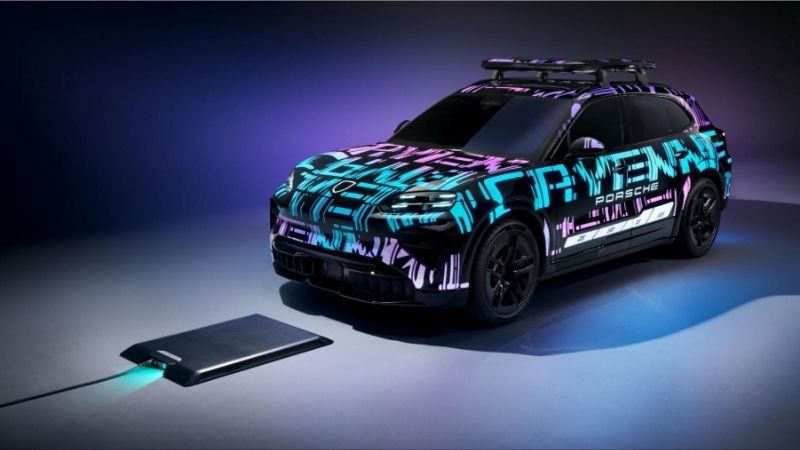
Porsche's inductive charging system. Image used courtesy of Porsche
Inductive Charging Technology
Inductive charging transfers energy through an air gap via a magnetic field. Although EV battery-scale inductive charging is relatively new, the concept is already used through in-vehicle smartphone charging docks. Mercedes-Benz offers wireless phone-charging as an optional or standard feature in several models, while BMW made its wireless device-charging system available for every new model in 2024.
Although traditional wired charging is often more efficient without the air gap, Porsche reports its contactless hardware reached up to 90% efficiency in transferring energy from the grid to the battery—a promising result for a more convenient charging alternative.
In Porsche's EV battery charging architecture, the 110-pound floor plate serves as the charging dock, measuring about 3.8 feet long, 2.5 feet wide, and 2.3 inches tall. AC transfers through the base plate's transmitter coil—made of ferrites and copper—and generates a magnetic field linked to a secondary receiver coil under the vehicle. A rectifier converts AC into DC to charge the high-voltage battery.
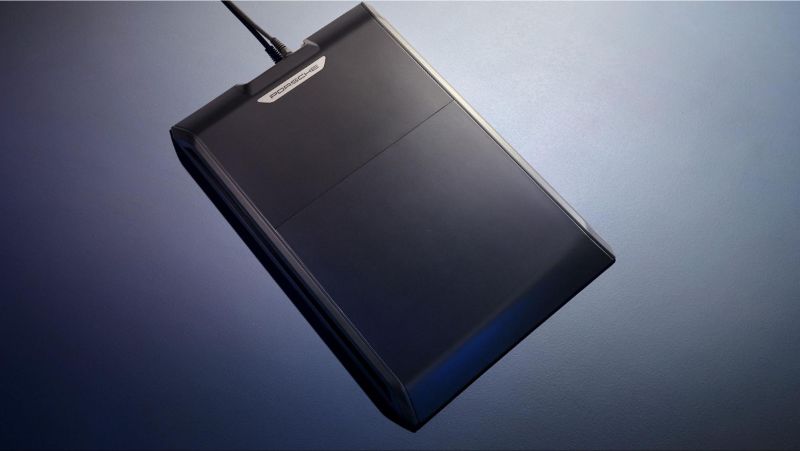
The base plate in Porsche's EV wireless charging system. Image used courtesy of Porsche
Other automakers have explored similar concepts. In 2023, Tesla leaders mentioned they were working on inductive charging for the Cybertruck so drivers could juice up their vehicles by parking over a pad rather than plugging in. However, Tesla reportedly has canceled those prototype efforts because the truck's height creates a large air gap and related efficiency losses. Cybertruck's lead engineer stated the base station would need around 6 inches to meet the truck's clearance.
How Does Porsche's System Work?
Porsche's wireless charging system underwent extensive validation, including TÜV SÜD testing and secured UL and CE certifications for U.S. and European markets.
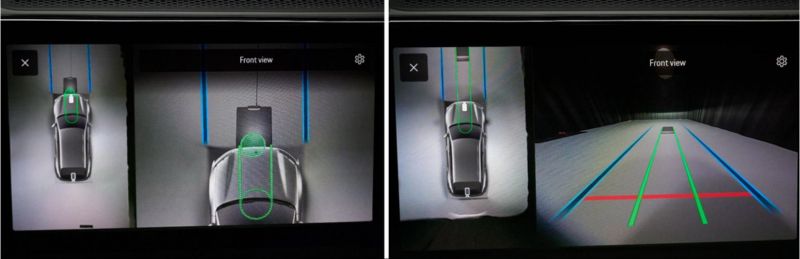
Front views of an EV activating the base plate. Image used courtesy of Porsche
Operation is straightforward. A driver parks the Cayenne over the floor plate, aided by Porsche's ultra-wideband technology that aligns the vehicle with the pad.
Once in position, the two units automatically begin to transfer energy across a gap of a few centimeters. The receiver component is located between the front wheels of the underbody. The system also features motion detection functions to stop charging if a person, animal, or object enters the field, or if metallic objects are detected and begin to heat up.
The base plate integrates WLAN and LTE modules for software updates and support.