Facebook
 Google
 GitHub
 Linkedin
EV Tech Advances Smarter Sensors, Charging, and Fleet Trials
LEM has developed a high-voltage monitoring system, while partnerships between L-Charge and Epic, WeaveGrid and Rivian, and AV Dawson and VEV are advancing EV charging.
As electric vehicles continue their rapid ascent across global markets, the supporting technologies that make widespread adoption possible are evolving at an even greater pace. Engineers are tackling complex challenges across high-voltage power management, charging availability, and grid interaction, all while ensuring safety, efficiency, and compliance at scale.
Manufacturers are introducing hardware and software solutions that operate with precision, adapt in real time, and address both current limitations and future needs. These advancements span from ultra-compact sensors that protect and monitor power systems to charging platforms that integrate directly with utility networks or bypass the grid entirely.
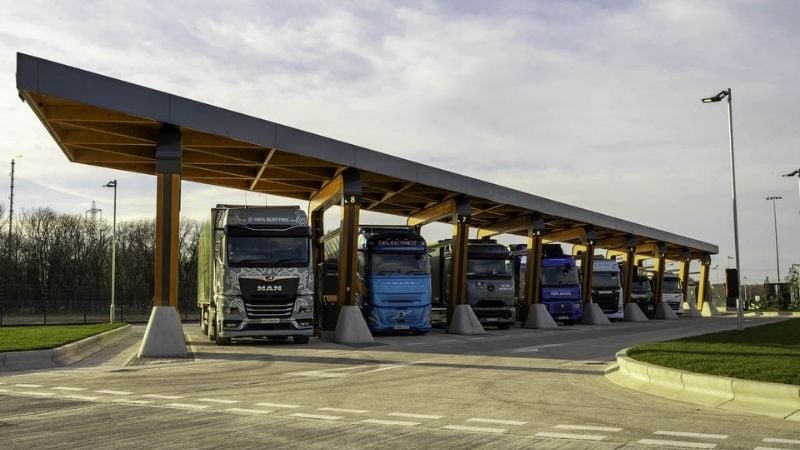
Electric truck charging. Image used courtesy of VEV
High-Voltage Monitoring from LEM
LEM’s Single Monitoring Unit, or SMU, is designed to support EVs’ growing electrical demands. The sensor uses Hall effect technology in an open-loop configuration to measure currents up to ±1500 A, specifically designed to handle standard automotive applications of 400 V and 800 V. It provides full galvanic isolation between the high-voltage battery systems and the low-voltage control electronics, which is critical in maintaining safety and signal integrity in harsh environments.

The SMU is a transducer designed for high power, low voltage applications ranging from 400 A up to 1500 A. Image used courtesy of LEM
This component also offers strong flexibility across designs by allowing different current ranges in the same housing. It operates between -40°C and +125°C temperature range, and supports either LIN or UART outputs for seamless communication with automotive control systems. Built for installation using a primary fastening approach, the SMU is ideal for battery packs, hybrid drives, and utility vehicles that require high reliability without added system complexity.
Off-Grid Charging from L-Charge and Epic
In locations where grid access is limited or expansion is too slow, L-Charge offers a way to deploy EV charging without waiting for utility infrastructure. Its mobile charging units operate independently of the grid, using onboard energy systems to deliver ultra-fast charging to vehicles in parking lots, retail spaces, and other commercial sites. These units are especially valuable for landowners looking to quickly monetize unused space or offer EV services.
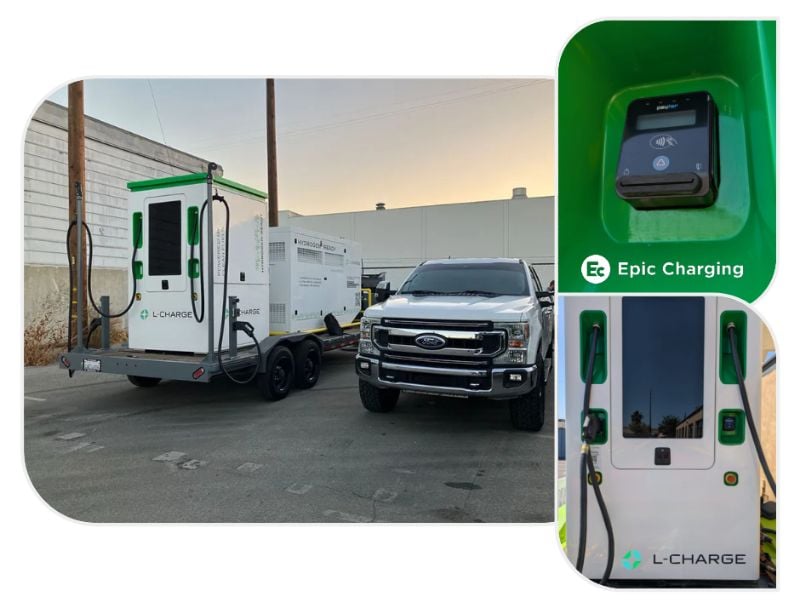
Mobile units provide off-grid EV. Image used courtesy of L-Charge
Epic Charging has added a software layer that manages each station through the OCPP 2.0 protocol, enabling full interoperability and real-time control, including built-in credit card readers and a streamlined user interface that supports private fleets and public use. Businesses like Discount Tire have already begun using this model to transform their existing properties into fast, revenue-generating EV hubs. This combined solution removes one of the largest barriers to EV adoption by making charging available without waiting years for utility upgrades.
Electric Truck Trials from AV Dawson and VEV
Commercial transport is still one of the most difficult areas to electrify, but AV Dawson Transport has completed a promising trial of an electric heavy goods vehicle. In partnership with VEV, the company tested a 42-tonne truck over a ten-day period. The vehicle logged more than 1,800 miles and demonstrated a clear reduction in emissions, providing a real benchmark for what large-scale electric freight might look like in the near future.
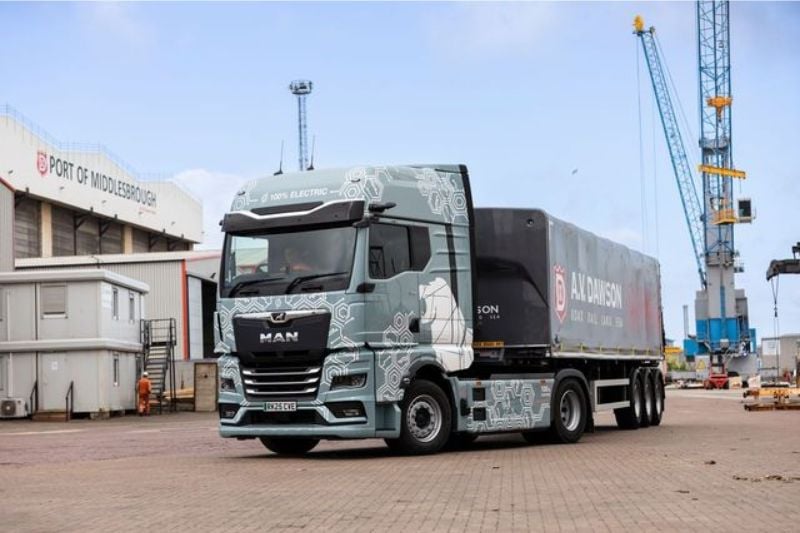
EV heavy goods vehicles can reduce net carbon emissions. Image used courtesy of AV Dawson
The pilot also helped customers like steel manufacturers reduce their Scope 3 emissions, including logistics providers' indirect impact. By adopting electric trucks, AV Dawson lowers its environmental footprint and creates value for clients under pressure to decarbonize their supply chains. VEV supported the process by offering a full-service solution that covered everything from infrastructure planning to performance analytics. The data gathered from the trial will help guide future decisions about expanding the electric fleet.
Smart Charging with WeaveGrid and Rivian
WeaveGrid and Rivian are collaborating to tackle the problem of managing home EV charging in a way that benefits both drivers and utility providers. The platform allows Rivian vehicles to charge during periods of lower grid demand, which can help reduce energy costs for the driver and align usage with cleaner sources of electricity. These shifts are handled automatically while still meeting the driver’s target state of charge.
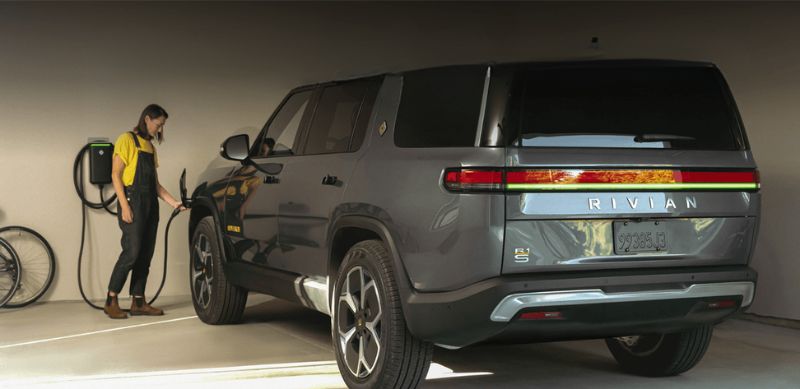
WeaveGrid and Rivian aim to reduce charging costs while supporting current grid stability. Image used courtesy of WeaveGrid
This innovative approach uses Rivian’s software-focused vehicle architecture to enable over-the-air integration when combined with WeaveGrid’s charging optimization platform. It eliminates the need for users to manage schedules manually while giving utilities more control over when and how charging occurs. By using secure, OEM-approved data channels, the system also maintains strong protections around driver information and vehicle performance. The result is a smarter, more scalable charge method that works across thousands of utility networks.
EV technology is expanding in more ways than just battery range or acceleration. These new tools, ranging from current sensors to grid-aware software and mobile charging platforms, solve practical problems that engineers face daily. They make it easier to build EVs that are not only high performing but also easier to support, easier to charge, and better integrated with modern energy systems. As demand increases, these innovations will play a critical role in turning electrification into a truly scalable reality.