Facebook
 Google
 GitHub
 Linkedin
Analyzing Load Profile Distortion in High-Power EV Charging
This article explores how load profile distortion from high-voltage EV charging impacts the power grid and presents solutions to the challenges it creates.
Electric vehicle adoption is rising globally across segments like compact cars, SUVs, and commercial vehicles, accelerated by technological advancements and environmental awareness. With more EVs on the road, high-power EV charging stations delivering over 150 kW are increasingly important in meeting growing demand. However, these high-power charging stations challenge the electrical power grid, particularly load profile distortion.
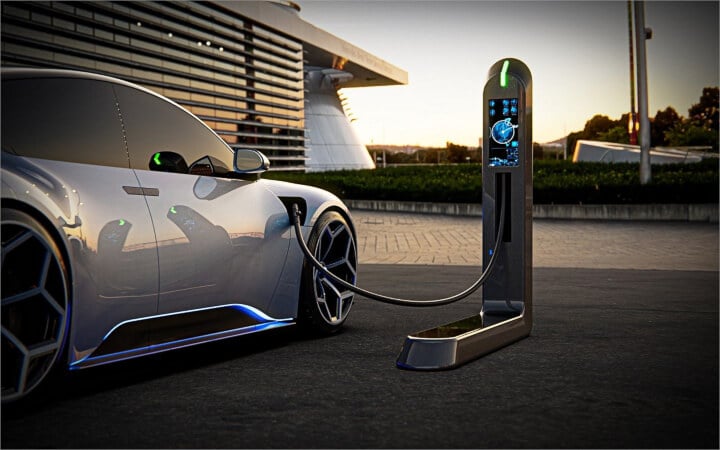
Figure 1. EV charging from a charging station. Image used courtesy of Pixabay
Load Profile Distortion
During high-power EV charging, the grid is exposed to a challenge that affects its efficiency, stability, and reliability. This challenge, referred to as load profile distortion, results from the unpredictability and variability in the demand pattern of the grid’s power introduced by high-power EV charging stations. The increase in demand for electricity from the grid is an aspect that results from sudden high loads.
When 50 kW or more is drawn from the grid by these high-power charging stations, a notable increase in power demand can be created. Where there are simultaneous EV chargers at work, the peak load curve can spike even more. To better visualize this power demand concept, consider the following example: multiple 50 kW EV charging stations are operating simultaneously at a voltage of 400 V.
The current drawn from the grid by a single 50 kW charger at 400 V is:
\[I=\frac{P}{V}\]
\[I=\frac{50000}{400}=125\,A\]
The total power supposing 10 EV charging stations are in simultaneous operation:
\[P_{total}=n\times P\]
Where n is the number of EV chargers operating at the same time.
\[P_{total}=10\times50000\]
\[P_{total}=500000=500\,kW\]
The example calculations above show that multiple chargers simultaneously draw a lot of power from the grid. This sudden surge in power can strain the local power distribution networks, leading to voltage drops, overload, or even power outages if not correctly handled.
Load Variability and Unpredictability
Another aspect of load profile distortion that affects the grid is the variability and unpredictability of loads resulting from intermittent charging patterns. This makes predicting and managing loads by grid operators challenging. EV charging varies based on charging requirements, time, and user behavior. Compared to the predictable patterns of traditional loads, EV charging can affect the grid’s load profile by causing random peaks and valleys. Ultimately, this fluctuation causes grid strain. For better analysis of predictability and variability, statistical measures like standard deviation can be used by grid operators to manage random peaks and intermittent charging patterns. To better relay the concept, consider the table below with sample hourly load data recorded in 24 hours representing power demand in kW.
Table 1. Sample data of power demand in each hour
| Hour | Load (kW) |
| 1 | 100 |
| 2 | 120 |
| 3 | 130 |
| 4 | 110 |
| 5 | 115 |
| 6 | 150 |
| 7 | 200 |
| 8 | 250 |
| 9 | 300 |
| 10 | 350 |
| 11 | 400 |
| 12 | 450 |
| 13 | 300 |
| 14 | 250 |
| 15 | 200 |
| 16 | 150 |
| 17 | 100 |
| 18 | 150 |
| 19 | 200 |
| 20 | 250 |
| 21 | 300 |
| 22 | 350 |
| 23 | 400 |
| 24 | 450 |
The variability and spread of load data can be determined based on the sample data above by calculating the load’s mean and standard deviation.
The average power demand due to EV charging, mean load \((\mu)\):
\[\mu=\frac{1}{24}\sum^{24}_{i=1}Pi=\frac{1}{24}(100+120+...\,+450)=250\,kW\]
Standard deviation \((\sigma)\):
\[\sigma=\sqrt{\frac{1}{24}\sum^{24}_{i=1}(Pi-250)^{2}}\]
Substitute the load values:
\[\sigma=\sqrt{\frac{1}{24}\Big((100-250)^{2}+(120-250)^{2}+...+(450-250)^{2}\Big)}\]
\[\sigma=\sqrt{\frac{1}{24}(22500+16900+...\,+40000)\approx120\,kW}\]
With a 120 kW standard deviation, we can conclude that the load profile is significantly variable, which indicates the unpredictable and intermittent nature of EV charging. Given the randomized peaks and valleys, the EV charging load profile graph shows that the charging does not follow a smooth or predictable pattern.
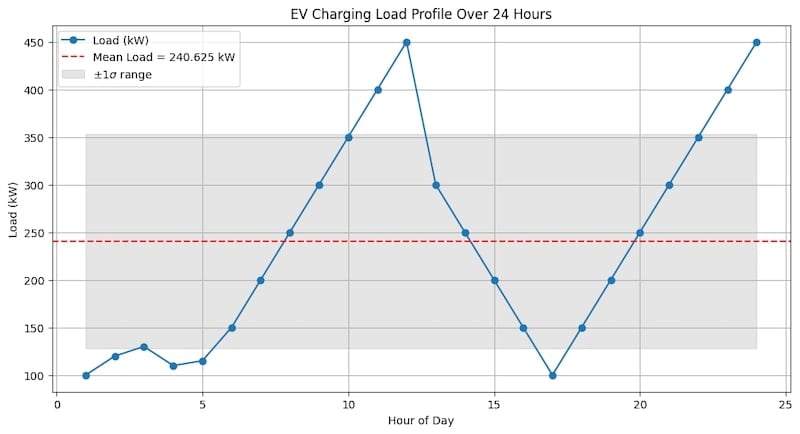
Figure 2. Graph shows the unpredictable pattern of EV charging in 24 hours. Image used courtesy of Bob Odhiambo
Considering the similar analysis approach illustrated by the example above, implementing actual metrics of high-power EV charging systems over a period can aid grid operators and power engineers in deciding how to approach load variability for a stable grid system.
Load Profile Distortion Mitigation Strategies
Below are some methods that can be implemented to mitigate load profile distortion resulting from high-power EV charging.
Direct Load Control
Direct load control is a mitigation strategy for load profile distortion that can be used as a demand response program to remotely control the electricity consumption of EV chargers and consumers' appliances. Utilities can flatten the load curve by shifting loads to off-peak periods. After the demand response, the new peak load can be evaluated using the formula below, in which (f) is the fraction of the shifted load.
\[P_{new\,peak}=P_{peak}\times(1-f)\]
Vehicle-to-Grid Integration
Vehicle–to–grid technology (V2G) allows connection between EVs and the grid to act as a distributed energy resource (DER) that discharges back power to the grid during peak demand. V2G can be implemented to enhance the grid's stability by storing surplus power and releasing it back to the grid when needed, eliminating the need for peaking power plants. To best visualize the potential contribution of V2G to the grid support, we can consider using the analysis of the initial sample data of EV charging profile in a 24-hour span in which we can integrate V2G into the charging process during peak demands. Assuming we have 100 EVs supplying 5 kW back to the grid, the V2G power contribution (PV2G) would be:
\[P_{V2G}=n\times P_{EV}\]
\[P_{V2G}=100\times5=500\,kW\]
This 500-kW contribution can be seen in the graph below, where V2G integration has flattened the peak of the load profile by providing additional power supply to the grid.
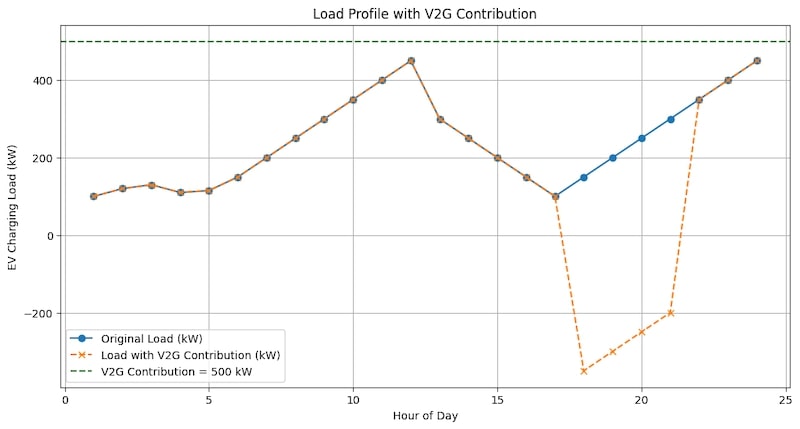
Figure 3. Load profile graph when V2G contributes 500 kW to the grid. Image used courtesy of Bob Odhiambo
Advanced Metering Infrastructure and Grid Management
One approach to address the challenge of load profile distortion is advanced metering infrastructure (AMI). This includes smart metering systems that provide real-time data on how electricity is being used to help better manage and monitor the load profiles of EV chargers. This is useful in initiating demand response programs as AMI facilitates two-way communication between the consumer and the utility, enhancing load forecasting and aiding engineers and operators in making decisions on grid management based on real-time load data for a more efficient and reliable grid. Some of these decisions include integrating energy storage systems that store energy during low demand and release it when energy demand is high.
Regarding grid management and optimization, load profile distortion can be mitigated using machine learning algorithms to allow utilities to provide real-time load prediction based on time (t). With the prediction based on the current condition and the historical data of the load profile, proactive grid management can be done, and to optimize the grid and minimize the overall cost of power generation and distribution, power engineers can solve the optimization problem:
\[\sum\limits_{i}Ci(Pi)\]
subject to:
\[\sum_{i}Pi=P_{demand}\]
Where (i) represents the power source, (Pi) represents the generated power, and (Ci) represents the cost function.
Grid Impact
Load profile distortion affects the grid by causing voltage fluctuations, electrical supply and demand imbalance, and increased grid operational costs. With the world fighting for environmental awareness, EV numbers and charging infrastructures are growing. This increases the potential for load profile distortion, and it is therefore essential for power engineers to meet the demand without negatively affecting the grid power system. By implementing the mitigation strategies mentioned above, the effects of load profile distortion can be effectively neutralized for a stable and reliable grid power system while supporting the growth of EVs.