Facebook
 Google
 GitHub
 Linkedin
Seawater Battery Innovation: Thicker Anodes, Longer Life
Nanomaterials for anodes could make aqueous seawater batteries a better alternative to lithium-ion in renewable energy storage systems.
Safe and durable energy storage systems are necessary for viable large-scale renewable energy production. Storage systems commonly use lithium-ion batteries, but these batteries can experience thermal runaway and fire due to high temperatures and degradation.
New anode material for aqueous batteries. Video used courtesy of Canadian Light Source
Aqueous batteries are safer and less expensive. However, they have limited energy density and can become chemically unstable. Adding seawater to the electrolyte can increase stability, but problems with other battery parts, such as anodes, can limit cycle life and capacity.
University of Saskatchewan scientists, partnering with Canadian Light Source, have discovered a method to make thicker anodes for aqueous and saltwater batteries. Their innovation created batteries that lasted up to 380,000 charging cycles, making them ideal for grid-level energy storage.
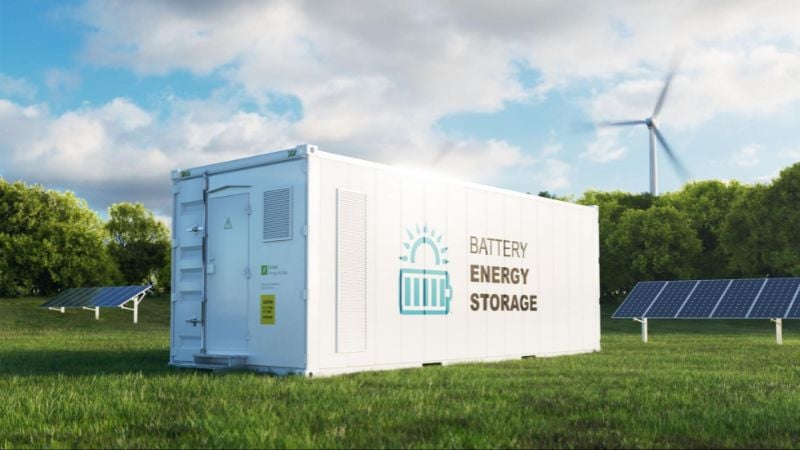
Battery storage for renewable energy. Image used courtesy of Adobe Stock
Anode Issues
Seawater is cheap, abundant, and environmentally friendly. In batteries, the seawater offers high conductivity. However, it also contains chloride ions and other complexities that can lead to corrosion in electrode materials. Aqueous saltwater can cause low electrochemical performance and decrease Coulombic efficiency.
Anode materials must be compatible with the electrolytes and able to withstand repeated charge and discharge cycles. Scientists have experimented with various materials, including metal oxides, activated carbon, graphene variations, zinc alloys, and titanium dioxide, with limited success. None of them could meet the storage demands necessary for large battery systems.
The Thicker Anode
Canadian researchers believe they have a solution for the anode problem. They created thicker anodes made of polymer nanosheets and carbon nanotubes. The material can store the types of ions found in seawater.
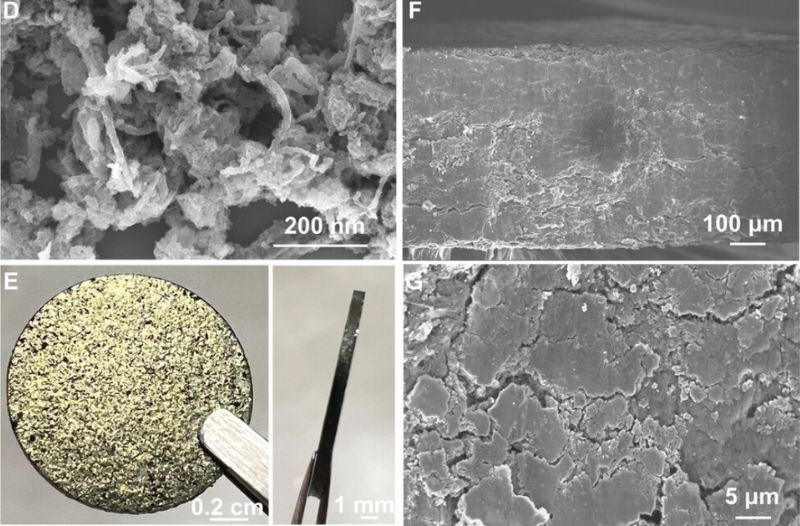
Microscopic images of the polymer nanostructures. Image used courtesy of Xu et al.
This material allows anodes as large as 1 mm in thickness and 100 mg in mass. Thicker electrodes have structural advantages, including:
- Low tortuosity for straighter and faster ion transport
- Low electrolyte solubility
- Stronger mechanical compressibility
- Better electrical conductivity
- More resistance to corrosion
In testing, the anodes surpassed records in lifespan and life cycle, delivering up to 380,000 charging cycles. They can also function at low temperatures, which is essential for battery energy storage systems used in colder climates.
The Synchrotron Light
Researchers used Canadian Light Source’s ultrabright synchrotron light to study the anode material’s electrochemical behavior. The synchrotron can study materials at the molecular and nano level.
The light works by accelerating the electrons around a ring at close to the speed of light. Radiofrequency waves and powerful electromagnets move the electrons. When traveling the ring, the electrons emit energy as very bright and highly focused light. They also release photons, which can be filtered into various kinds of light ranging from infrared and ultraviolet to X-ray.
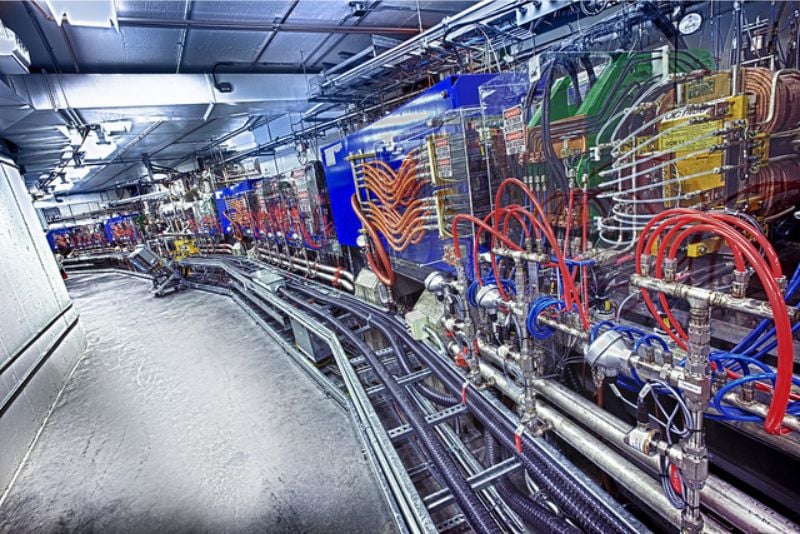
Inside Canadian Light Source’s synchrotron. Image used courtesy of Canadian Light Source
Scientists use a synchrotron to analyze the chemical, physical, and geological processes. It can also be used for biological studies. The synchrotron can reveal changes in material processes, including oxidation or crystallization, and analyze complex electrochemical reactions.
Aqueous Batteries in Storage Systems
While the majority of battery energy storage systems still use lithium-ion batteries, many manufacturers are trying alternative batteries, including sodium-ion, lithium-iron phosphate, iron air, and flow batteries. All have seen limited use, but none have been successful enough to supplant lithium-ion.
Thicker, more durable anodes could resolve some drawbacks of seawater batteries. Since they use natural, abundant, and sustainable sources, these batteries could become an appealing support for renewable energy facilities.