Facebook
 Google
 GitHub
 Linkedin
Q&A With Richard Qiu: Fast-Response Storage for AI Data Centers
In this virtual interview, Richard Qiu, president of LiCAP Technologies, explains why fast-response energy storage and ultracapacitors matter in the AI data center energy landscape.
Long-duration energy storage systems (LDES) seem to dominate new developments, as they provide grid reliability for renewable energy and can replace gas peaker plants to meet peak demand. However, LDES cannot meet all energy needs, according to Richard Qiu, president of LiCap Technologies.
Qiu, who connected with EEPower in a virtual interview, said fast-response energy storage (FRS) is often the better solution for applications like AI data centers, where energy gaps must be filled immediately. He also discussed the importance of energy storage architecture and ultracapacitors.
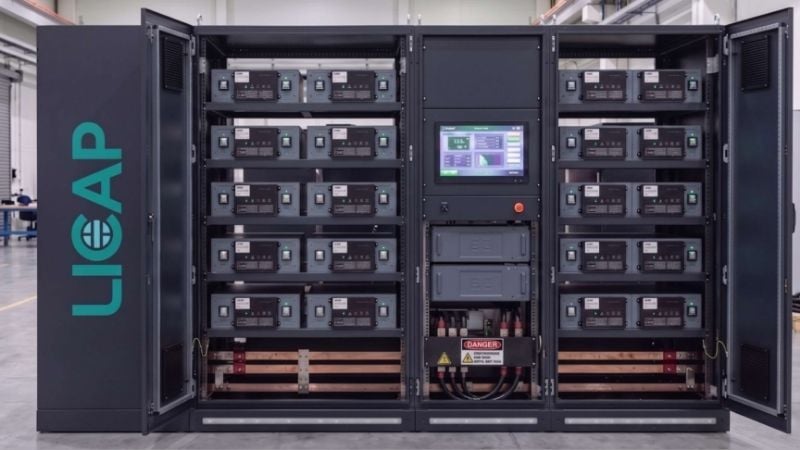
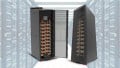
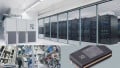
Rack-level ultracapacitor energy storage.
Long-Duration vs. Fast Response Energy Storage
EEPower: In terms of grid stability, the emphasis right now seems to be on long-duration energy storage. Can you explain why fast-response storage is needed, especially for AI data centers?
Qiu: Long-duration storage primarily addresses an energy problem: when energy is available and how long it needs to be delivered. Fast-response storage addresses a power problem: how quickly a system can absorb or deliver large amounts of power when demand changes suddenly.
AI data centers create both problems. GPU-intensive workloads can cause power demand to rise or fall very rapidly as large numbers of processors operate in parallel. Those changes can occur on timescales very different from the hours-long requirements that conventional energy-storage systems are typically designed around.
Batteries can respond quickly, but repeatedly using them for high-frequency, high-power transients can increase cycling and thermal stress while consuming capacity better reserved for longer-duration energy needs. Fast-response storage can absorb or supply those short-duration power swings, helping smooth the load seen by batteries and the grid while maintaining stable power for the data center.
Extreme Weather, AI Data Centers, and Grid Stability
EEPower: Extreme weather and AI data centers are major stressors for grid stability. How do fast-response storage systems help stabilize the grid in these conditions? Can you give an example?
Qiu: Extreme weather can create faults, voltage disturbances, and rapid changes in grid conditions, and data centers are sensitive because even very brief power-quality events can trigger protective systems or transfers to backup power.
A good example occurred in Northern Virginia in July 2024, when a transmission-system disturbance during a thunderstorm produced very short voltage dips. Roughly 1,500 MW of data-center load disconnected from the grid nearly simultaneously, creating a sudden imbalance that grid operators had to manage.
Fast-response storage located at or near a facility can provide a buffer during disturbances on these timescales. For events lasting milliseconds to seconds, it can supply or absorb power while protection and power systems respond, potentially reducing the magnitude of the load change the grid sees. The same capability can also support frequency response and other short-duration grid services.
When the disturbance happens in milliseconds, the response technology has to operate on the same timescale.
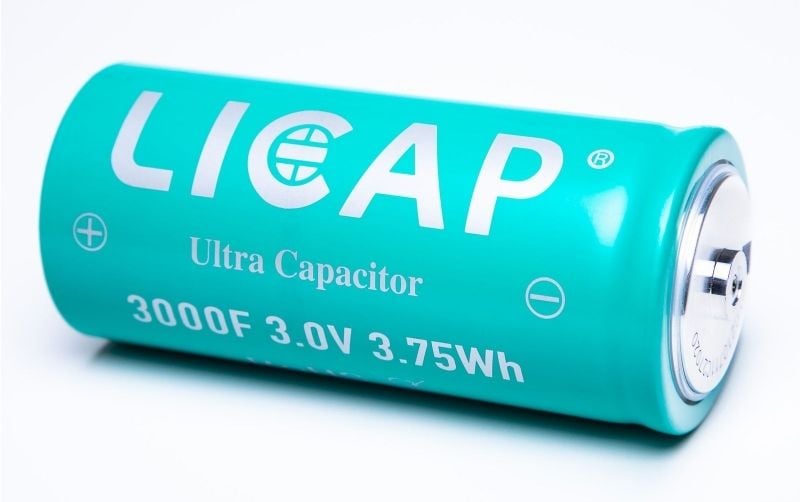
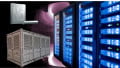
Ultracapacitor.
Fast-Response Architectures
EEPower: When engineering batteries for fast-response storage for data centers, which technologies are most effective, and why?
Qiu: I would broaden the question beyond batteries, because the fastest-response storage does not necessarily need to be a battery. The key is matching the storage technology to the timescale of the power requirement.
Lithium-ion batteries, particularly LFP, are well suited to providing energy over minutes to hours. Ultracapacitors are optimized for a different job: delivering and absorbing very high power over milliseconds to seconds, repeatedly, with minimal degradation.
In a hybrid architecture, the control system can direct the fastest, highest-power transients to the ultracapacitors while batteries handle longer-duration energy requirements. This allows each technology to operate where it is strongest and can reduce high-frequency cycling and thermal stress on the battery system.
Ultracapacitors and Fast-Response Storage
EEPower: What advantages do ultracapacitors bring to fast-response energy storage systems?
Qiu: Ultracapacitors are fundamentally high-power devices. Because they store energy electrostatically rather than relying primarily on chemical reactions, they can respond extremely quickly and tolerate very large numbers of charge-discharge cycles.
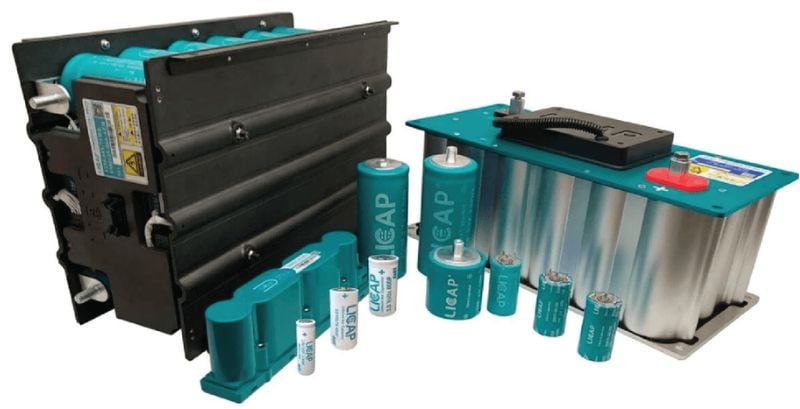
Ultracapacitor energy storage.
For fast-response applications, one of the most important parameters is equivalent series resistance, or ESR. Lower ESR means less voltage drop and less energy lost as heat when large currents move through the device. That translates directly into more usable power and better efficiency during a transient event.
Ultracapacitors also offer high cycle life, strong power density, and operation across a broad temperature range. Those characteristics are particularly valuable in applications where the storage system may be called upon repeatedly throughout the day rather than only during an occasional outage.
For AI data centers, the value proposition is therefore not how many hours of energy an ultracapacitor can store. It is how much power it can deliver, how quickly it can deliver it, and how many times it can do so reliably.
Considering Ultracapacitors, Integration, and Supply Chain
EEPower: What are some important points about energy storage or ultracapacitors that should be considered?
Qiu: The first point is that ultracapacitors are not a replacement for batteries or long-duration storage. They store less energy for a given size, but they can deliver much higher power very quickly and withstand far more frequent cycling. The right architecture starts by understanding the application's power profile, which is how much power is needed, for how long, how quickly it must respond, and how often the event occurs, and then matching the storage technology to those requirements.
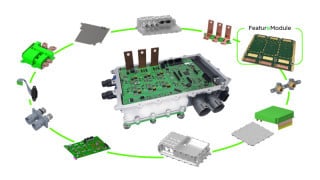
The second consideration is integration. Cell performance alone is not enough. Modules, monitoring and balancing, thermal management, controls, power electronics, and communication with the UPS or facility power system all determine how effectively that performance translates into a reliable data-center solution.
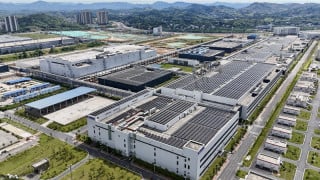
Finally, supply chain and manufacturing capacity matter. Data centers are being built on much shorter timelines than new energy-storage manufacturing capacity typically takes to develop. As AI infrastructure expands, resilient domestic supply chains for batteries, ultracapacitors, and other critical power technologies will become increasingly important.
The industry should think about energy storage as part of the data center's power architecture from the beginning, not as something added after power constraints appear.
All images used courtesy of LiCAP.