Facebook
 Google
 GitHub
 Linkedin
Compressed Air Storage: The Energy Transition’s Missing Piece
Compressed air energy storage can provide efficient, long-duration grid power using caverns underground, without burning fossil fuels.
Ask most people to imagine energy storage, and they'll picture a battery: a sealed box of lithium, cobalt, and nickel, charging and discharging in a rhythm measured in hours. That picture captures much of what the grid needs today, but it doesn't capture all of it. Some of the most valuable storage the energy transition now requires must hold power for weeks or months, not hours—and for that job, the more interesting answer might be sitting a kilometer underground, in a cavity carved out of salt.
A newer generation of technology is emerging to close the gap: compressed air energy storage, re-engineered in a way to solve a problem that has limited it for decades. Here's how it works, why the timing matters now, and where long-duration storage is heading.
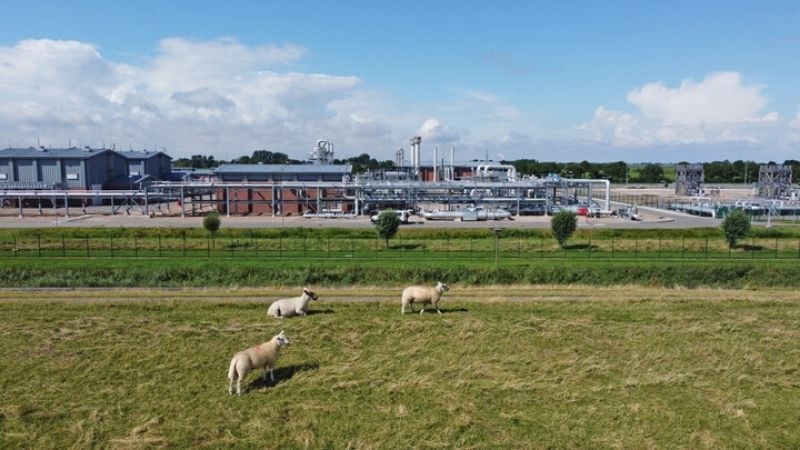
Jengum storage facility. Image used courtesy of SEFE
Compressed Air, Stored Underground
When more renewable electricity is available than the grid needs, that surplus power is used to compress air rather than switch turbines off. The compressed air is pushed into a sealed underground cavern, where it sits under pressure, waiting. When the grid needs the power back—because the wind has dropped or the sun has set—the air is released and used to generate electricity again.
That's the storage part. What varies between systems is how the compressing and releasing actually happens—and that's where Airengy's technology comes in.
Airengy’s AirBattery uses what's called a liquid piston. Rather than compressing air with a mechanical piston, it uses water. Two underground vessels are connected by a pump: one full of water, one full of air. Pump the water into the air-filled vessel, and, as the water rises, it squeezes the air like a fist closing—compressing it until it's ready to be sent off to storage in the cavern.
To get the energy back out, run the process in reverse: compressed air is released from the underground cavern back into a water-filled vessel, the expanding air pushes the water out, and that moving water spins a turbine to generate electricity. It's a closed loop, and nothing is burned or consumed in the process.
If you know anything about pumped-hydro power stations—the ones that shift water between two reservoirs at different heights—the resemblance isn't a coincidence. We've essentially borrowed pumped-hydro's turbomachinery and applied it to compressed air instead of gravity.
An Old Idea, Proven Underground
Storing compressed air underground in salt caverns isn't a new idea. The natural gas industry has done it for decades, and a handful of early compressed-air power plants have operated since the 1970s. Salt caverns are ideal for this: they're naturally airtight and structurally stable, and Europe already has large numbers of them in place, built for exactly this kind of underground storage.
The cavern isn't what's changed. What's changed is the process used to charge and discharge it—and that's a different story.
Where the Real Innovation Lies
Older compressed-air power plants ran into a stubborn problem: compressing air heats it up, and expanding it cools it down. Left unmanaged, that heat loss eats into a large share of the energy you were trying to store in the first place.
The traditional fix was to burn natural gas during the discharge phase, reheating the air to keep the turbine running efficiently, which rather defeats the purpose of a clean storage technology. More recent variants have tried capturing and storing that heat separately in molten salts or ceramics, which works, but adds cost, complexity, and extra machinery.
This is the part we've changed. Because we compress and expand air using water rather than mechanical pistons, the process runs close to isothermal—the temperature barely moves in the first place, so there's much less heat to manage or replace. There's no gas burned on the way out, and no separate thermal store to build, maintain or fund.
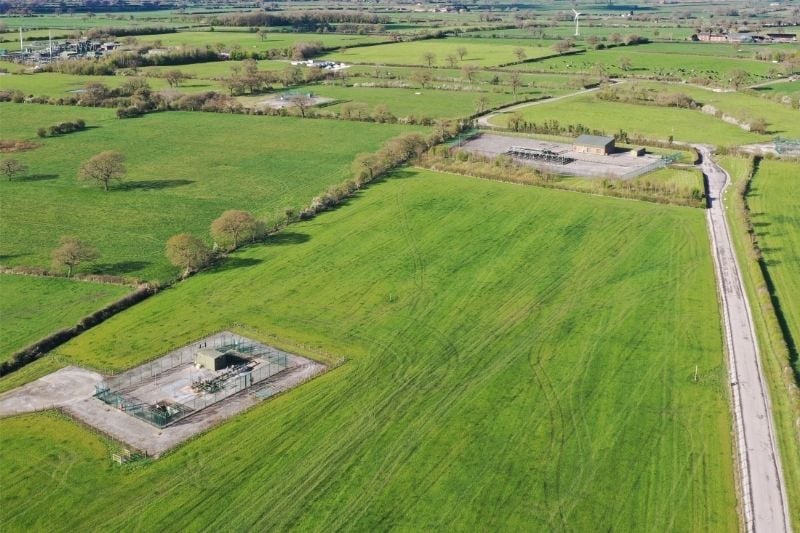
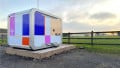
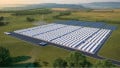
Hill-top energy storage site, Cheshire. Image used courtesy of Kistos
That matters beyond the engineering. A system that doesn't need gas isn't exposed to gas prices or gas supply, which matters when the whole point is reducing dependence on volatile international energy markets.
It also means fewer moving parts, lower maintenance, and round-trip efficiency that doesn't fluctuate with fuel costs. It's the difference between storage that still leans on fossil fuels, and storage that doesn't need to lean on anything at all.
The Gap in the Energy Transition
Lithium-ion batteries have done something remarkable for the grid: they can soak up excess solar at midday and release it during the evening peak, a few hours later. That's an enormously valuable service, and it's a large part of why battery storage has grown so fast.
But a few hours is not the same problem as a few weeks. Wind and solar output doesn't just dip for an afternoon. It can dip for a stretch of days with low sun and low wind, a pattern with an evocative name in Germany: “Dunkelflaute,” or “dark doldrums”.
Batteries sized for daily cycling aren't economically built to bridge that kind of gap; you'd need an enormous, and enormously expensive, battery fleet sitting mostly idle. This is the gap long-duration energy storage exists to close—and closing it is what will let renewables carry a much larger share of the grid than short-duration batteries alone can support.
The Nobian Project: Storage Built into an Operating Industrial Site
To make this concrete, it helps to look at an actual project rather than the theory. In July, Airengy signed a partnership with Nobian, a major European producer of salt and industrial chemicals, to explore a compressed air power plant connected to one of its salt caverns in Denmark.
That cavern isn't empty and waiting for us. Right now, it holds brine—salt dissolved in water—that Nobian draws on to supply Dansk Salt's Mariager plant. This is where the project gets genuinely interesting as an engineering story, not just an energy one.
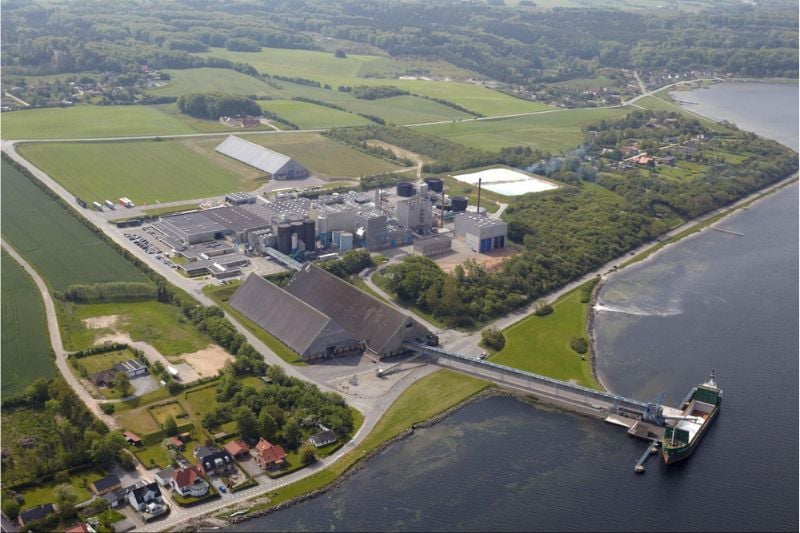
Dansk Salt Mariager. Image used courtesy of Nobian
To bring the cavern into service for compressed air storage, the initial phase of air-charging pushes the existing brine out of the cavern. That brine doesn't go to waste. As it's displaced, it's processed to recover high-purity salt—a useful commercial product in its own right, and one Nobian is well placed to handle given its existing salt production operations.
Only once that brine has been cleared does the cavern begin its life as a compressed air reservoir, with a targeted output of 3-10 MW and storage capacity of around 2.5 GWh—enough to matter to the grid, on a duration measured in days rather than hours.
It's a neat illustration of how this technology tends to work in practice: not building new caverns from scratch, but repurposing existing underground infrastructure and industrial relationships that already sit in the right geology.
Four Countries, One Pattern
The Nobian project is the fourth partnership of its kind that we've announced, following agreements in the U.K. (with Kistos Energy, in Cheshire), Romania (with Hagag Europe, near Ramnicu Valcea) and Germany (with SEFE, near Jemgum). Four different countries, four different partners, four different regulatory environments—but the same underlying pattern each time: an existing cavern operator with underground assets already in place, paired with our technology to convert that geology into long-duration storage.
That pattern is worth paying attention to, because each of these markets already shows the pressure that makes long-duration storage necessary. Denmark generated more than 80% of its electricity from renewables in 2024, with wind alone contributing close to 60%. Germany saw renewables supply 59% of generation in 2024, alongside 457 hours of negative electricity prices—a clear signal that supply is regularly outrunning demand.
The U.K. has built a specific regulatory mechanism, Ofgem's cap-and-floor regime, to support exactly this class of asset. Romania is scaling storage targets from a low base as it builds out its own renewable capacity.
We expect projects like these to become far more common, and not simply because renewable penetration keeps climbing. This approach ticks most of the boxes long-duration storage needs to tick to get built at scale: no dependence on critical minerals or fragile supply chains, mostly local labor and materials, underground assets that already exist in many of the right places, and running costs that don't rise and fall with fuel markets. Those are exactly the conditions regulators, financiers and grid operators are looking for as they work out what a fully renewable grid actually needs.
The grid of the next decade will need more than batteries. It will need somewhere to put weeks' worth of energy, cheaply and without burning anything to get it back. In many parts of Europe, that somewhere already exists. It's just been holding gas, or brine, instead of air—and as the energy transition accelerates, we expect a lot more of it to start doing exactly that.