Facebook
 Google
 GitHub
 Linkedin
Capacitors: Indispensable Building Block of Electrification
As inverter-based resources replace spinning generation, capacitors are becoming a critical tool for maintaining grid stability.
Electrification is usually described as a fuel switch that leads to changes such as heat pumps replacing gas furnaces or electric motors used instead of gasoline engines. But this narrow framing misses the more significant shift. Instead, electrification can better be described as technology densification, in which power electronics replace mechanical systems. In practice, this means a gearbox becomes a motor drive, a conventional transformer becomes a high-frequency power converter, and a one-way connection to the grid becomes a bidirectional inverter.
Each of these conversions adds a stage of power electronics that relies on passive components, such as capacitors, to operate. And as the grid itself becomes more inverter-based, the role of the capacitor shifts from a supportive component to an active participant in keeping the lights on. This article examines how, as electrification accelerates and inverter-based systems proliferate across the grid, capacitors are evolving from supporting components into critical enablers of grid stability, fast energy response, and reliable power conversion.
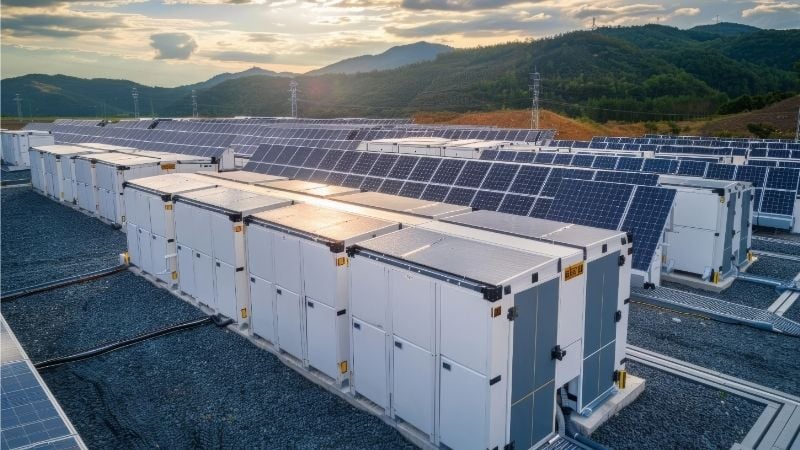
A solar farm with storage.
The Inertia Problem
Historically, grid stability has been a byproduct of physics, as coal, gas, hydro, and nuclear plants spin a heavy rotating mass that resists sudden changes in frequency, much like a flywheel resists a sudden change in speed. As a result, when a large load or generator drops off the system, the resulting inertia buys the grid time to respond and prevent a blackout.
Solar and wind farms don't have that spinning mass.
Instead, a solar panel produces DC and connects to the grid through inverters rather than synchronous generators with large rotating masses. While modern wind turbines spin, their rotational speed is typically decoupled from grid frequency through power electronic converters.
As these inverter-based resources are added to the grid, the grid’s natural inertia-based buffer is diminishing, while more sources of disturbance are also added. This means grid operators must respond with virtual, or synthetic, inertia: control software that commands an inverter to behave, for a few hundred milliseconds, as if it had a flywheel attached. While software can issue this command, it can't make energy. Something physical still must supply the power the algorithm promises, and fast enough that the grid is not disturbed. That's where capacitors come in.
The Capacitors Shaping Modern Grid Stability
Inverter-based resources, like solar or wind, typically use DC link capacitors and supercapacitors, either together or separately, to smooth out grid disturbances. A DC link capacitor, usually a film or electrolytic type, is inside the converter itself and sits across the DC bus to absorb switching ripple and hold the bus voltage stiff from one switching cycle to the next. It's sized in joules, not kilojoules, and its job is local: keep the converter's own DC rail clean so the switches downstream see a stable voltage. Virtually every grid-connected renewable energy system or EV fast-charger relies on DC link capacitors.
Supercapacitors, also known as ultracapacitors, store energy electrostatically rather than through a chemical reaction, which is what lets them charge and discharge in milliseconds rather than minutes. That speed, combined with a far higher cycle life than a battery, makes them well-suited to sit alongside the power conversion stage as a dedicated energy reservoir.
If a power grid or microgrid does not require long-duration backup power, but instead struggles with short, sharp transient voltage drops, supercapacitors are typically a good fit.
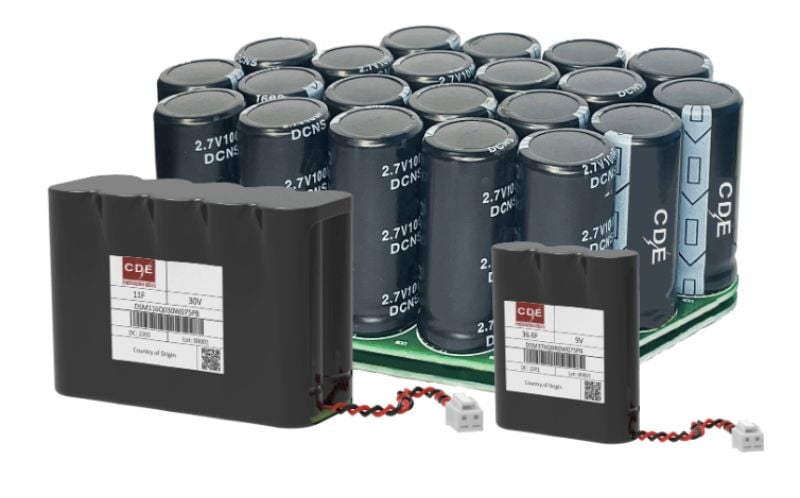
An example of Knowles Cornell Dublier brand supercapacitor modules.
DC link capacitors and supercapacitors can be used together to balance out their strengths and weaknesses. Because traditional DC link capacitors lack long-term energy storage capacity and batteries are slow to respond to power fluctuations, supercapacitors handle the fast, high-frequency spikes, leaving the underlying DC link system to handle steady-state power. For example, an EV fast charger may use a DC link capacitor to maintain a stable DC bus while a supercapacitor absorbs sudden power surges caused by changes in charging demand, helping to reduce stress on the power electronics and improve overall system stability.
Why Batteries Alone Can't Stabilize the Grid
Lithium-ion batteries remain the right tool for storing and dispatching energy over minutes or hours, and they aren't going away. But batteries rely on chemical reactions to move charge, and those reactions have response times measured in tens of milliseconds to seconds, which is slow relative to a grid event that needs a response within one or two AC cycles.
Capacitors fill that gap by taking the first hit from a disturbance, smoothing the spike long enough for the battery, or the rest of the grid's control loop, to catch up. Layering technologies this way—capacitors for the first cycles, batteries for the following seconds and minutes, and longer-duration storage for the hours beyond that—is what makes it possible for a single grid to handle both a sudden fault and a multi-day lull in wind production.
The 2016 Blue Cut Fire in Southern California is a useful illustration of what happens when that layered response isn't engineered correctly. A wildfire caused faults on the regional 500 kV transmission corridor. The North American Electric Reliability Corporation’s (NERC) subsequent investigation found that the primary cause of the outage was inverters incorrectly perceiving that grid frequency had fallen below 57 Hz, which triggered automatic tripping.
Many affected inverters also operated in a "momentary cessation" mode that stopped current injection entirely when the terminal voltage moved outside an acceptable range. The result was a loss of roughly 1,200 MW of solar generation. The episode revealed a design gap, exactly the kind of gap that well-engineered, capacitor-backed virtual inertia would have closed by giving inverters a fast enough energy source to ride through the disturbance instead of disconnecting.
What Wide-Bandgap Semiconductors Change
The growing role of capacitors in grid stability is only part of the story. Advances in power semiconductor technology are also changing how converters are designed, creating new performance requirements for the capacitors inside them. Wide-bandgap (WBG) semiconductors such as silicon carbide (SiC) and gallium nitride (GaN) are enabling power switches that are changing what's possible on the conversion side, and that has a direct effect on capacitor design.
SiC's critical electric field is higher than silicon, which lets designers build devices with thinner drift regions and lower on-resistance at a given voltage rating. This means converters can run at higher voltages and frequencies than silicon-based designs. It's also what makes the solid-state transformer (SST) practical.
An SST can replace a bulky, oil-filled magnetic transformer with a high-frequency power-electronic stage. That stage needs a capacitor that can handle the higher voltage and ripple frequency without the losses or aging that would come from running a conventional capacitor outside its intended range.
As converters move to switches designed with WBG semiconductors, capacitor selection has to shift as well. Dielectrics, equivalent series resistance, and ripple current ratings all need to be reconsidered for the new operating envelope rather than carried over from a legacy silicon design.
The Infrastructure Behind Electrification
These trends and changes are not limited to utility-scale generation. The same power conversion architectures found in grid-scale systems are increasingly appearing in motor drives, EV chargers, data center power supplies, and microgrid inverters, all of which depend on properly specified DC link and energy-storage capacitors.
The constraint on how fast this happens isn't really technology, though. Most of the engineering problems involved in electrifying industrial processes are already solved; what's actually slowing the pace are higher-level challenges such as grid interconnection queues, permitting, and the broader policy environment for new generation and transmission capacity. While capacitors won't fix these issues, they can help ensure that as more of the grid shifts to inverter-based resources, the system has the fast, physical energy reserve it needs to stay stable while the rest of the transition catches up.
All images used courtesy of Knowles Precision Devices
Related Content