Facebook
 Google
 GitHub
 Linkedin
Neutralized Salts Improve Stability in Perovskite Solar Cells
Lithuanian researchers stabilized inverted perovskite solar cells by converting an acidic component into a neutral salt, achieving high efficiency after 1,000 hours of use.
Perovskite cells convert sunlight efficiently, can be made thin and flexible, and cost less energy to produce than silicon modules, but poor long-term stability under moisture, heat, and oxygen has kept them from broad commercial adoption. Researchers at Kaunas University of Technology (KTU) in Lithuania have found a way to eliminate a major cause of perovskite solar cell degradation.
The KTU team, working with international partners, targeted degradation originating within the cell rather than the surrounding environment by converting an acidic hole-transport material into a chemically neutral salt. The study reports single-junction cells reaching 26.88% power conversion efficiency and unencapsulated devices retaining 80% of their initial output after 1,050 hours of continuous operation.
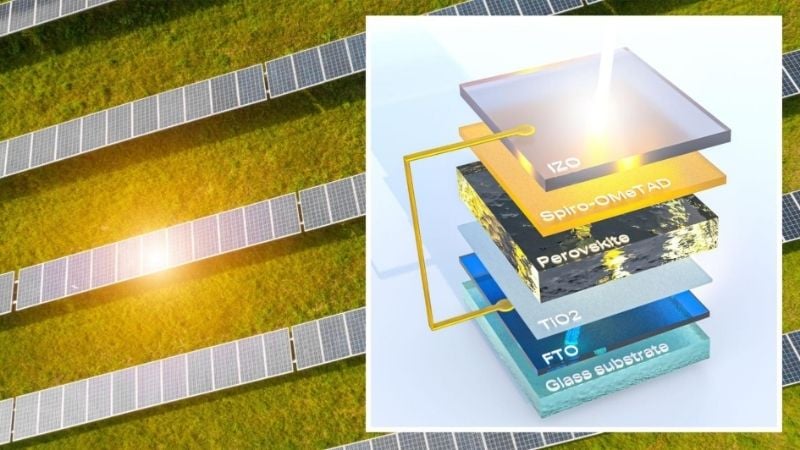
Perovskite solar cell. Image used courtesy of Adobe Stock
Neutralizing the Acid Problem
Inverted perovskite cells commonly use self-assembled monolayers (SAMs) such as 2PACz as the hole-transport layer between the transparent electrode and the perovskite film. The molecules anchor through an acidic phosphonic acid group. That acidity is the problem: it gradually corrodes adjacent layers, such as indium tin oxide and nickel oxide, seeding interfacial defects that impede charge transport.
The researchers proposed that the molecules’ acidic nature can gradually corrode adjacent layers. This creates defects at the interface, which hinder charge transport. In the study, the researchers neutralized the molecules' acidity by converting them into neutral salts, thereby creating an interface that enables solar cells to operate with greater stability and efficiency.
The team prepared a family of alkali-metal phosphonate salts, designated 2PACz-M (where M is lithium, sodium, potassium, rubidium, or cesium), through a simple acid-base neutralization. The potassium salt, 2PACz-K, performed best. Beyond removing the corrosive acidity, the salt increased the molecule's dipole moment, improved energy-level alignment for hole extraction, passivated under-coordinated lead defects at the buried interface, and bound to metal-oxide surfaces just as strongly as the parent compound.
The salts are also water-soluble, so the layer can be deposited from an aqueous solution rather than from toxic organic solvents. A water-processed device still achieved 25.37% efficiency.
Efficiency and Stability Results
The champion result came from a mixed monolayer combining 2PACz-K with the benchmark SAM Me-4PACz in a 1:4 molar ratio. The salt also solved a known weakness of Me-4PACz, which tends to aggregate, leaving patchy coverage on the electrode. Blending in 2PACz-K raised the measured surface coverage factor from 2.8% to 4.7%.
The resulting 1.55 eV inverted cell achieved 26.88% efficiency with a fill factor of 86.57%, against 24.90% for the best Me-4PACz control. The approach scaled, with a 29.7 cm2 eight-subcell module reaching 23.32%, and a two-terminal all-perovskite tandem hit 29.05%, which the researchers describe as among the highest values reported. In the wide-bandgap cells needed for tandems, a 1.67 eV device delivered a fill factor of 85.38%, equivalent to 98.9% of the Shockley-Queisser limit for that bandgap.
_performed_the_best.jpg)
Of the chemical compounds tested, the 2PACz-K (with potassium) performed the best. Image used courtesy of Yang et al.
Stability testing followed ISOS protocols. Under continuous one-sun illumination at maximum power point (ISOS-L-1), the unencapsulated mixed-SAM device kept 80% of its initial efficiency after 1,050 hours. Dark storage tests retained 95% after 1,020 hours, extrapolating to a T80 lifetime of roughly 3,900 hours, and the tandem device held 80% of its output through 450 hours of continuous maximum-power operation.
It’s worth noting some caveats, notably that the aging tests ran on unencapsulated devices in nitrogen. The longest lifetimes are extrapolations rather than measured endpoints, and the tandem figure comes from a reverse voltage scan without independent certification.
KTU has filed a patent application and is exploring the commercialization of the SAM salts. Additionally, a spin-off company, SantakaPV, is working to use perovskites for space applications, where the cells tolerate radiation doses that would disable silicon cells and offer a power-to-weight ratio the company puts at 10 to 20 times better than the multi-junction cells used on satellites today.
The study appeared in Nature Communications.