Facebook
 Google
 GitHub
 Linkedin
Moon Power: NASA Explores Fuel Cells for Artemis Missions
Regenerative fuel cells could provide long-term, lightweight energy storage to meet the astronauts’ energy needs on a moon base.
NASA is developing regenerative fuel cells (RFCs) as tall as a person and as large as a car for Artemis, the program that will take humans back to the moon. These RFCs could provide energy storage on the lunar surface for Artemis missions for the coming years and decades.
The fuel cells combine hydrogen and oxygen to produce water, heat, and electricity, then recharge by splitting water back into hydrogen and oxygen. The project has finished the development phase and is entering the real-world testing phase.
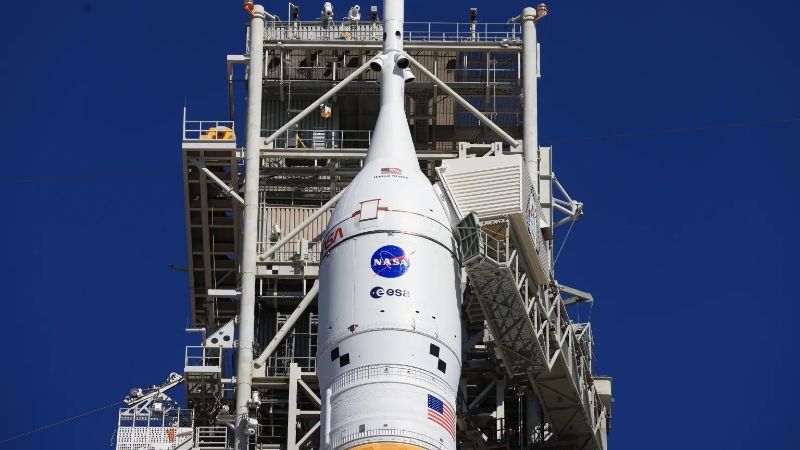
The Orion spacecraft that launched Artemis II in April. Image used courtesy of NASA
The Artemis Program
The Artemis program began in 2022 with Artemis I. Artemis II, in April 2026, which took four astronauts around the moon, became the first crewed lunar flight in 50 years.
Artemis III is scheduled for 2027 and will test commercial landers from SpaceX and Blue Origin in low Earth orbit, while Artemis IV in 2028 will attempt to be the first Artemis lunar landing with crews making it to the moon surface. Artemis V is the current final stage, during which NASA plans to develop a permanent moon base. This moon base will need power to establish a long-term presence on the moon, and this is where RFCs could come in.
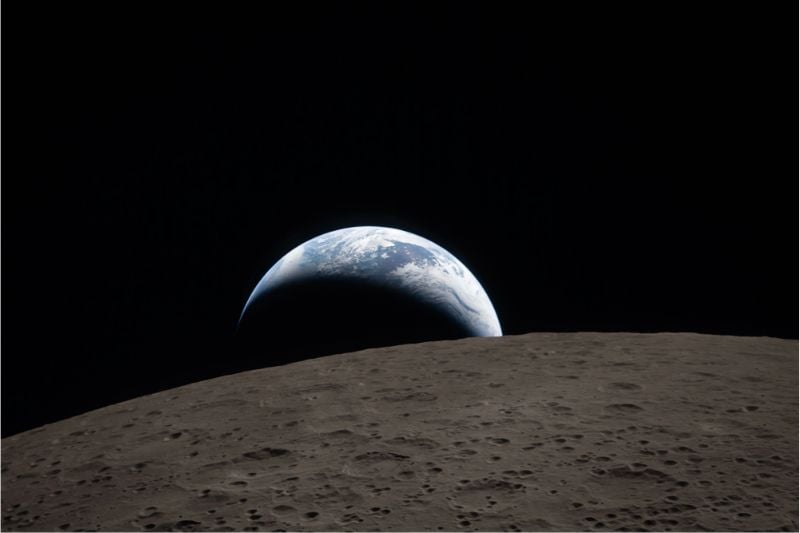
The moon’s surface with Earth on the horizon, taken from Artemis II. Image used courtesy of NASA
The Artemis Mission Fuel Cell
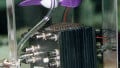
NASA described the fuel cell as “a tangle of tubes and wires spirals away from the system, where nearly 270 sensors and 1,000 components are nestled inside.” Yet, this collection of electronics may be the ideal technology for lunar bases, powering crew habitats, exploration rovers, lunar landers, in situ resource utilization applications, and many ancillary power systems that will keep a moon base running for long periods. Without a reliable energy source, long-term human habitation on the moon is not possible.
RFCs store the same amount of energy as batteries of comparable size, but they weigh much less. They also have recharging capability, meaning they could be self-sufficient with the resources available to astronauts on the moon and not reliant on regular supply deliveries from Earth.
The RFCs have been in development for over five years. Initial tests were completed in 2025 to understand the fundamental capabilities and operating mechanisms of the RFCs, as well as to make modifications to better suit the system to the harsh conditions of the moon. During the tests so far, once the researchers initiate the system, it operates on its own without further intervention.
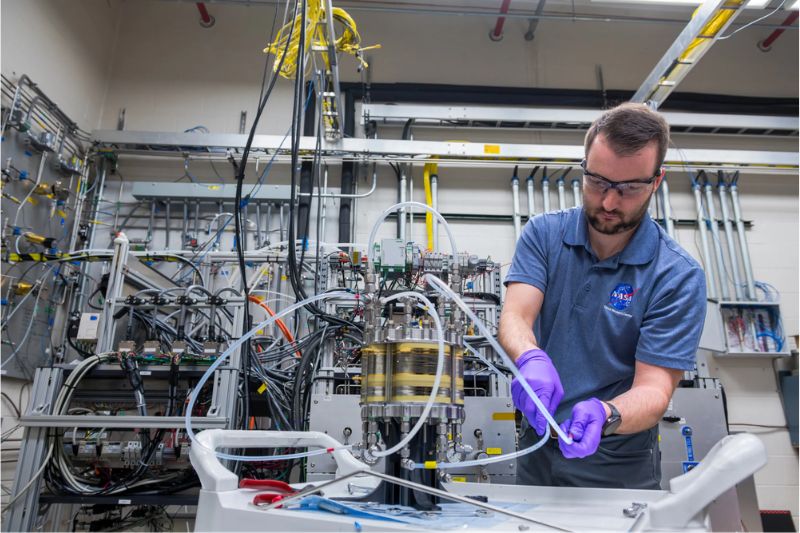
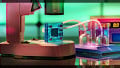
Testing the fuel cell in a lab. Image used courtesy of NASA
The NASA research team has now reached a major milestone as they prepare to operate the complete system, in which hydrogen and oxygen gases generated during the recharge process will be stored for the first time. The next tests should identify further technical and operational challenges and ensure that the system is progressing towards being a lunar-ready system.
Regenerative Fuel Cells Explained
An RFC is an energy storage device that operates like a rechargeable battery. RFCs can store more energy (or at least as much) as rechargeable batteries and have lower mass. RFCs contain a fuel cell, electrolyzer, fluids, and reactant storage subsystems. The RFC converts chemical potential energy into electrical energy by consuming hydrogen and oxygen gases, with heat and water as by-products.
RFCs can be charged again using external sources, such as solar cell arrays. During recharging, when energy from the source is transferred to the RFC, the fuel cell stack produces water, and the electrolyzer generates hydrogen and oxygen from it. The electrolyzer and fuel cells inside the RFCs at NASA use a proton exchange membrane to improve efficiency, since the average round-trip efficiency of RFCs is only 60% due to thermodynamic limitations.
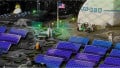
As the RFCs are planned for space exploration and powering lunar bases (and potentially other planetary body bases in the future), they are versatile enough to power critical systems during long-term operations, during the lunar nights, and in permanently shadowed crater areas.
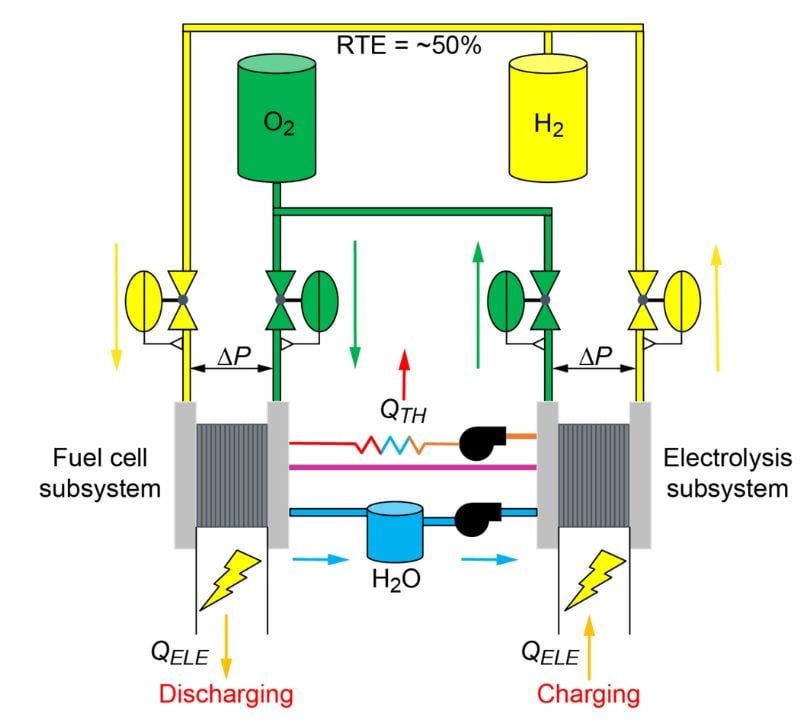
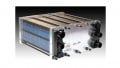
NASA’s design for the RFC. Image used courtesy of NASA
RFCs could be critical technology for these lunar bases, as conventional lithium-ion batteries don’t have sufficient specific energy (energy per unit mass) to meet lunar surface mission energy storage requirements within available mission mass budgets.
No technology has so far shown the potential to provide power through a full lunar night, but RFCs could do so, as they have much higher specific energy due to their lower mass. RFCs have 3.4X the energy storage capacity per unit mass compared to batteries (alongside their higher specific energy), making them feasible for powering critical systems. In contrast, battery energy storage systems, with their higher mass, would require a much larger footprint.
The upcoming tests will delve deeper into whether RFCs can provide power through a full lunar night when deployed in the field.
Preparing for Lunar Conditions
The next set of testing will build on the lessons learned from continued iterations of the RFC technology developed at NASA. While it’s not yet close to being deployed in actual missions, the next tests will examine how the RFC copes in real-world conditions, as this will give a better indication of its capabilities than the idealized lab conditions. NASA has said it wants to simulate operating on the lunar surface to demonstrate that the RFCs will function and provide reliable power under the harsh conditions there.