Facebook
 Google
 GitHub
 Linkedin
How Electronics Components Support Hydrogen Solutions
Which active components fit well into applications for green hydrogen systems?
This article is published by EEPower as part of an exclusive digital content partnership with Bodo’s Power Systems.
The basic process of hydrolysis is the same, whether it is implemented in a small-scale local production facility, such as a roadside hydrogen refueling station consuming less than 500 kW, or a bulk hydrogen manufacturing plant potentially consuming 20 MW or more. A single electrolysis cell, which separates water into hydrogen and oxygen, operates at a forward voltage of around 1.8 V - 1.9 V, depending on the temperature and the chemical additives used to enhance the electrolyte. Current densities in the electrolyte range up to 0.5 A/cm². A direct current of 1,000 A can drive a cell with an area of 2,000 cm², generating roughly 1 kg of gaseous hydrogen per day.
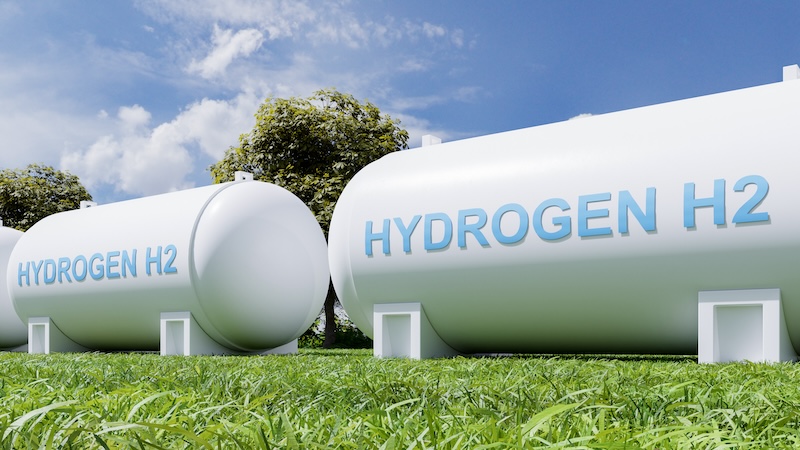
Image used courtesy of Adobe Stock
Given that this basic chemical process has been well understood for many years, where is the scope to achieve future cost reductions and efficiency improvements? Currently, the cost of hydrogen produced via electrolysis ranges from $4 to $7 per kilogram, depending on the electricity price and electrolyzer efficiency. The U.S. Department of Energy (DoE) has set a goal for this cost to fall to $2 per kilogram by 2025 and $1 per kilogram by 2030.
Achieving these cost reduction targets will require substantial improvements in electrolyzer efficiency as well as improved economies of scale resulting from the large-scale deployment of electrolysis plants.
Some of the efficiency gains for electrolysis plants will have to come from more efficient power conversion systems. And this is sharpening the industry’s focus on the improved component offerings from the main suppliers to high-voltage equipment manufacturers, such as Infineon and Littelfuse.
Electrolysis is a chemical operation, but it requires large amounts of electric power, either drawn from the grid or directly from wind turbines in so-called ‘AC/DC-coupled’ power systems or directly from solar farms and battery storage in DC/DC-coupled systems. The high-voltage power conversion equipment required to deliver the correct input to large electrolysis plants consuming megawatts of power has traditionally been the domain of a few giant global manufacturers such as ABB, Siemens, and Schneider Electric. The growth in demand for electrolysis plants is opening up opportunities not only for these incumbents but also for smaller companies that have expertise in high-voltage power equipment manufacturing.
In the high-voltage equipment market, established and new suppliers will be judged by their customers – the hydrolysis plant operators – on four crucial criteria:
- Power quality
- Efficiency
- Reliability
- Cost
This creates an opening for electronics component manufacturers to advance their position by providing products that help equipment manufacturers improve their products on any one or more of these criteria. This is leading to a new wave of innovation at the component level.
AC/DC-Coupled Systems: Thyristors and IGBT Switches
For instance, in AC-DC coupled power systems, electrolysis plants adopt a range of configurations of the power conversion system (Figure 1), typically based on either a diode/thyristor-rectifier topology or an IGBT-based active front end (AFE) topology. AFE rectifiers can be operated at a unity power factor and produce total harmonic distortion (THD) of less than 5%.

Figure 1. Typical hydrolyser plant configurations in AC/DC-coupled settings. Image used courtesy of Infineon and Bodo’s Power Systems [PDF]
For decades, the dominant topology in AC/DC-coupled electrolysis has been the thyristor-based 12- or 24-pulse system (Figure 2). The main benefits of these architectures are robustness, high-efficiency levels, and high current density. Thyristor rectifiers are particularly useful in high-power applications consuming more than 1 MW. Even high system power configurations operating at more than 50 MW can be efficiently implemented with an array of high-power thyristors and diode discs. Thyristor-based designs have been in operation in the field for decades, and the press-pack devices used in them offer superior power and thermal attributes.

Figure 2. A thyristor-controlled B12C rectifier driven by a dedicated transformer. Image used courtesy of Littelfuse and Bodo’s Power Systems [PDF]
In some industrial electrolyzers, the current flowing through the rectifier can range between 1.5 kA and 2.0 kA. For such high power systems, both Littelfuse and Infineon offer integrated power solutions called power stacks, power blocks, and power discs. Littelfuse offers the N1718NC200 phase-controlled thyristor capsule for up to 2.0 kA applications.
For high-voltage electrolyzers, Infineon supplies a component choice for any choice of topology. This includes AFE rectifiers, which can use its TRENCHSTOP 7 IGBT technology and/or CoolSiC MOSFETs at lower power levels up to 100 kW, and IGBT-based PrimePACK products at up to 5 MW.
Thyristor vs. IGBT: Pros and Cons
Efficiency: IGBT systems offer higher energy efficiency than thyristor rectifiers. In green hydrogen electrolysis, which is important to maximize efficiency, IGBTs can minimize energy loss during power conversion.
Current and voltage handling: Thyristor rectifiers are more suitable for large-scale hydrogen electrolysis plants as they can handle higher currents and voltages. Although IGBTs are efficient, thyristors excel at managing high power levels, making them ideal for extensive hydrogen production systems.
Control and precision: IGBTs provide more power control and precision than thyristors. They also provide greater flexibility in controlling voltage and current, ensuring the smooth and efficient operation of hydrogen electrolysis equipment.
As many countries work toward the achievement of ambitious net-zero emissions targets for 2050, the development of green hydrogen power systems and hydrogen fuel supplies is also gathering momentum. This reflects the lack of constraint on the use of hydrogen, the most abundant element available for human use.
The majority of hydrogen produced today is made by splitting carbon from methane, but that produces carbon emissions. Zero-emission ‘green hydrogen’ comes from electrolysis, using clean electricity (from wind, solar, or hydro sources) to split water into hydrogen and oxygen. Unlike batteries, which are unable to store large quantities of electricity for an extended period, hydrogen can be stored in large amounts for a long time. This makes it an ideal green storage solution for excess renewable energy.
Hydrogen has flexible uses: It can catalyze with oxygen to produce heat or be fed into a fuel cell to make electricity. In a fuel cell, hydrogen has the potential to provide clean power for domestic use, as well as manufacturing, transportation, and more. Hydrogen fuel can also complement wind and solar energy generation, providing a green energy storage solution to balance the intermittency of renewable sources.
Industry watchers are now forecasting strong growth in the hydrogen industry. The Hydrogen Insights 2024 report, published by the Hydrogen Council, shows that the global hydrogen project pipeline grew by a factor of seven between 2020 and May 2024, from 228 projects to 1,572 projects. Investment committed to projects at the final investment decision stage also grew from around $10bn across 102 projects in 2020 to $75bn across 434 projects in 2024.
China has stated the aim of having 50,000 hydrogen-powered vehicles on the road by 2025, while the European Union aims to produce 10 million tons of green hydrogen – powered by renewable energy sources – by 2030.
Installation and maintenance: IGBT systems are typically smaller and easier to install than thyristor rectifiers. However, thyristors offer excellent durability and require less maintenance, making them a cost-effective option for large-scale industrial hydrogen production plants.
Both IGBT- and thyristor rectifier-based topologies play a role in optimizing the efficiency and performance of green hydrogen electrolysis systems. Understanding the advantages of each technology can help the manufacturer choose the correct option for hydrogen production requirements.
DC/DC-Coupled Systems: Wide Bandgap Innovation
In DC/DC-coupled systems powered by solar energy and/or batteries, typical topologies used for power conversion in hydrolyzers are Interleaved buck and Dual active bridge (Figure 3). Here, component innovation helps power equipment manufacturers meet the market need for higher efficiency and reliability at lower system costs. For instance, Infineon is enabling manufacturers to take advantage of the superior electrical and thermal attributes of SiC MOSFETs with a new CoolSiC FET series, which offers a breakdown voltage rating of up to 2,000 V.

Figure 3. Topologies for conversion in hydrolysers’ DC/DC-coupled conversion systems. Image used courtesy of Infineon and Bodo’s Power Systems [PDF]
Supplied in an HCC package with 14 mm/5.5 mm creepage/clearance distances, the IMYH200RxxxM1H MOSFETs are available with on-resistance as low as 12 mΩ. The use of these devices in electrolysis gives benefits including:
- Low conduction and switching losses
- Low reverse-recovery loss
- Excellent thermal performance
- Robust body diode for hard commutation
While these discrete devices are suitable for electrolyzers operating at 10 kW - 100 kW, integrated modules are available for use in higher-power applications of 1 MW and more. Infineon has extended the capability of its PrimePACK 3+ modules with its latest IGBT7 family, which has devices with a high 2,300 V breakdown voltage rating.
The IGBT7 devices are rated for over-temperature operation and provide very high current density in their 247 mm x 89 mm x 38 mm form factor. For instance, the FF2400R12IP7 PrimePACK module supports currents up to 2.4 kA and voltages up to 1,200 V in an interleaved buck converter.
In the dual active bridge topology, Infineon solutions include the FF2000XTR33T2M1 SiC MOSFET module in an XHP package, supporting 3.3 kV operation and featuring on-resistance of just 2 mΩ, while the FF1800R23IE7 IGBT7 module provides 2.3 kV/1.8 kA ratings.
Hydrogen Market Growth
The aggressive hydrogen cost-reduction targets set by the US DoE reflect the role of hydrogen production as a key enabling technology for the adoption of hydrogen and fuel cell technologies in applications, including stationary power, portable power, and transportation.
The achievement of the 1:1:1 target–$1 for 1kg of hydrogen in one decade–will depend on advances in technology throughout the hydrolyser process, as well as expanding deployments to produce economies of scale.
Continual improvements in power component efficiency and the widening range of product and package options will give the manufacturers of power equipment for electrolysis plants greater scope to create value and enable the growth in this new fuel type to accelerate.
This article originally appeared in Bodo’s Power Systems [PDF] magazine.