Facebook
 Google
 GitHub
 Linkedin
Hydrogen-Fuel-Cell-Battery Combo Powers Siemens Train
A hybrid propulsion system combining hydrogen fuel cells and lithium-ion batteries will power Siemens’ latest emission-free trains.
While the lithium-ion battery (Li-ion) performs well for small passenger vehicles, adapting Li-ion tech for other vehicles and vessels, especially larger ones, faces persistent problems. Semi-trucks and cargo ships create high energy demands, requiring large, heavy Li-ion batteries that limit range, payload capacity, and cost-effectiveness.
The trucking industry has been exploring other options, including a hydrogen-based solution. The railway sector also seeks to push Li-ions past their limits to optimize train transportation. Saft, an industry leader in pioneering advanced battery solutions, has developed a Li-ion formulation that utilizes lithium titanate oxide (LTO) technology to replace the conventional graphite anode used in most Li-ions.
Combining Li-ion batteries with hydrogen power cells could lead to safer and more efficient trains that no longer require an overhead electrical supply.
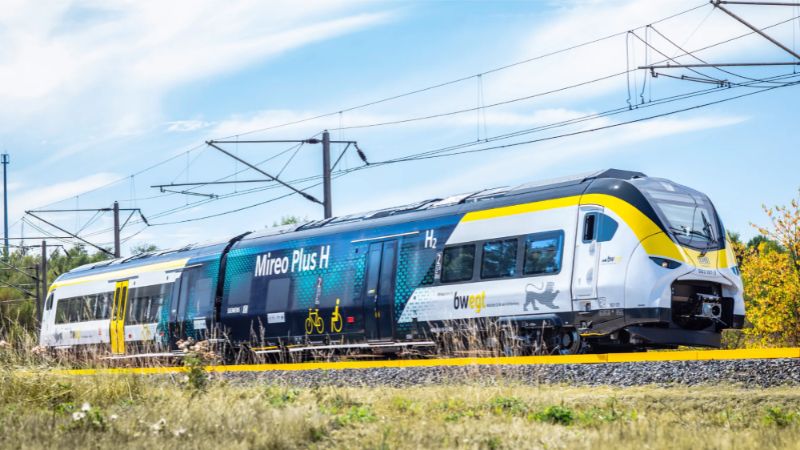
The Siemens Mireo Plus H train in operation. Image used courtesy of Siemens Mobility
Hydrogen Drawbacks and Li-ion Limits
For large vehicles and vessels, engineers are still pushing toward fuel solutions to replace the power of the conventional combustion engine. They must overcome power density, storage capabilities, and lifespan degradation challenges.
Powering a large vehicle like a train with hydrogen is environmentally advantageous because hydrogen fuel cells produce zero emissions. However, they have lower power density than other energy sources like diesel or Li-ions. This lower power density makes them less effective in high-power situations like rapid acceleration or overcoming steep gradients.
Converting hydrogen into electrical energy involves several steps, including the chemical reaction between hydrogen and oxygen to produce electricity, heat, and water. This conversion is less efficient in energy output per unit volume or mass compared to the direct electrochemical reactions in Li-ion batteries.
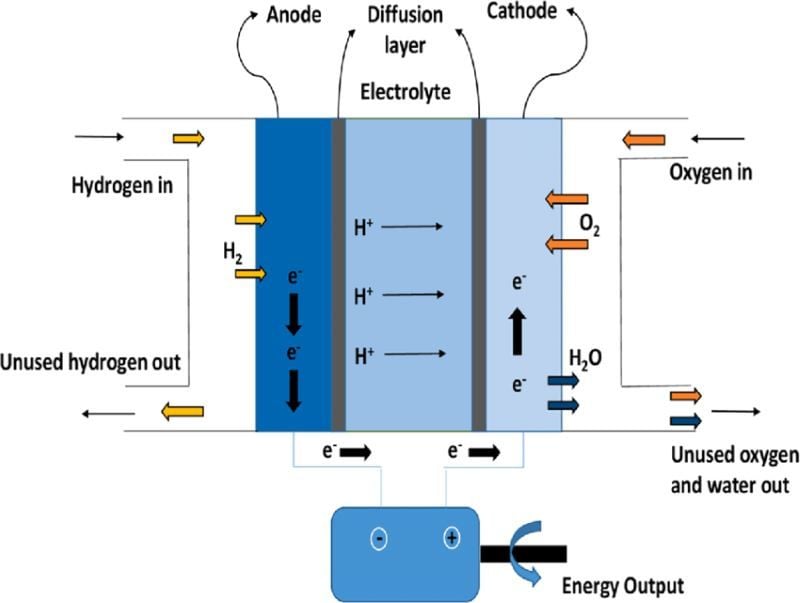
Diagram of a hydrogen-based fuel cell. Image used courtesy of Zore et al
Additionally, hydrogen storage is complex, requiring either high-pressure tanks or cryogenic systems to keep the hydrogen in liquid form. Both methods demand substantial space and incur energy losses. According to the U.S. Department of Energy, hydrogen gas storage requires high-pressure tanks with 350-700 bar or 5,000-10,000 psi tank pressure. Storing liquid hydrogen requires cryogenic temperatures because hydrogen’s boiling point at one-atmosphere pressure is -252.8°C. Besides these specific storage obstacles, hydrogen infrastructure is also limited, and green hydrogen production from renewable sources remains costly, which limits scalability for widespread rail applications.
Just as hydrogen alone is not an ideal fuel source for trains, exclusively using Li-ions also presents problems. Despite their high energy density, Li-ions can be prohibitively heavy and bulky, reducing the train's payload capacity. They also have relatively short lifespans in high-demand applications, where frequent charging and discharging cycles lead to performance degradation over time. Li-ion batteries also generate heat during operation, necessitating complex thermal management systems to prevent overheating and fire hazards. Li-ion technology is resource-intensive, relying on scarce materials like cobalt, which raises concerns about long-term sustainability and cost.
Even though these drawbacks show the limits of using hydrogen and Li-ion solutions independently in large-scale rail systems, combining them might create the next innovative step in train transport.
Supplementing Hydrogen Fuel Cells With LTO Traction Batteries
Siemens Mobility has pioneered a hybrid fuel system that maximizes hydrogen and Li-ion battery benefits. In partnership with battery-maker Saft, the Siemens Mireo Plus H trains will primarily rely on hydrogen cells for power, but they will also be outfitted with Li-ions.
These Li-ion batteries have left behind the conventional graphite anode for lithium titanate oxide (LTO) anodes. This swap gives the batteries a charge and discharge capability 10 times better than traditional Li-ions.
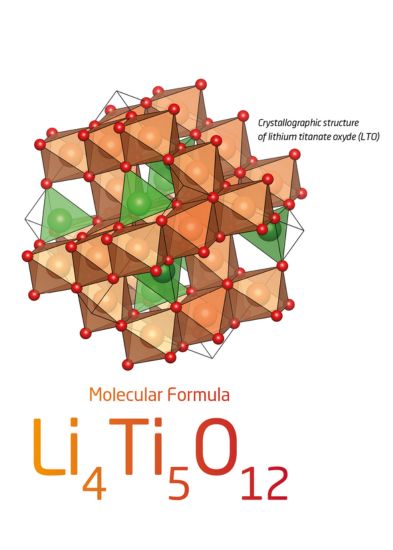
Lithium titanate oxide structure. Image used courtesy of Saft
LTO anodes offer several advantages over traditional graphite anodes in Li-ion batteries. LTO anodes have a higher cycle life, often lasting 10 times longer due to their structural stability, which reduces degradation during charge and discharge cycles. They also charge and discharge rapidly, enhancing performance in high-demand applications like trains. Additionally, LTO anodes are much safer as they have a higher operating voltage (~1.5V compared to ~0.1V for graphite), reducing the risk of lithium plating, which can cause short circuits and thermal runaway.
According to Saft, hydrogen remains the primary power source in the train, and these unique Li-ions are primarily used during acceleration periods to supplement the hydrogen power. They also help the trains achieve maximum efficiency while cruising, as these batteries perform load leveling and complement the hydrogen fuel cells.
This innovative hybrid, maximizing hydrogen and Li-ion battery benefits, is poised to transform the railway industry. The technology also has potential applications for automated guided vehicles that are invaluable in ocean, healthcare, and manufacturing environments.
Related Content