
 Facebook
 Google
 GitHub
 Linkedin
Moon Power: NASA Seeks Energy Solutions for Lunar Living
Living on the moon requires reliable energy. Two teams have developed power solutions to withstand harsh lunar conditions.
NASA has been looking to send another manned mission since 1972, when Apollo 17 first landed on the moon. Artemis III, planned for 2026, will be the first crewed lunar landing in over half a century. Future Artemis astronauts living on the moon’s surface will require robust technology to store energy and deliver reliable power throughout their stay.
The Artemis mission will establish a long-term human presence on the moon. Video used courtesy of NASA
To prepare for the mission, NASA held its Watts on the Moon Challenge, a competition inviting applicants to develop power and transmission innovations to enable long-duration moon landing missions and establish a long-term presence on the moon. The two winning teams, who will share a $1.5 million prize, created energy storage, management, and distribution solutions.
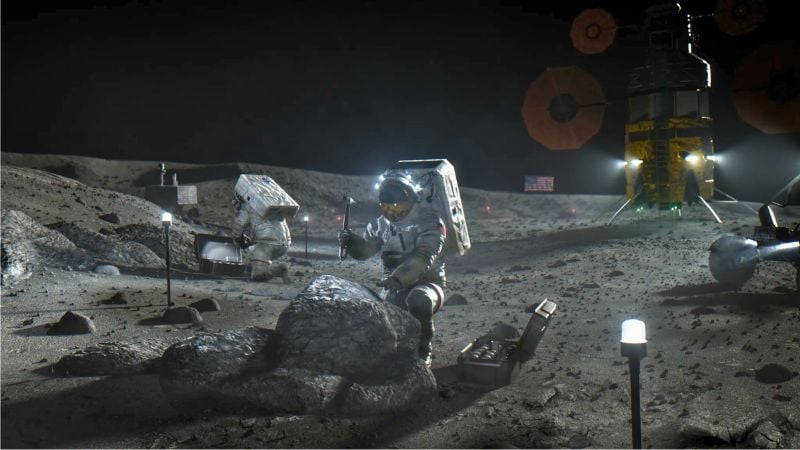
Rendering of the Artemis III moon mission. Image used courtesy of NASA
The Space Energy Challenges Driving the Competition
Under the Artemis program, NASA will use new and advanced technologies to explore more of the moon’s surface than ever before. Venturing into uncharted lunar lands will require many types of technology—from mining and construction equipment to habitats and research equipment—and all will need access to continuous and reliable power sources that can charge up while on the moon’s surface.
Solar energy is in abundance on the moon’s surface during the day. However, the moon experiences long nights of 350 consecutive hours and extreme temperature swings when it transitions from day to night. These are challenging environments for solar cells. So, the moon’s solar and renewable energy generation capabilities on the moon must be managed and distributed for continuous power. Advanced energy storage solutions will be required to tackle intermittency and resiliency, and finding these solutions was the basis for NASA’s Watts on the Moon competition.
Competition Tests Technology Effectiveness
In the Watts on the Moon final round, four teams refined their innovations to show it could be a potential space energy technology of the future. In the finale, all the teams developed full system prototypes. They were the first power transmission and energy storage prototypes to be tested in a vacuum chamber by NASA. The vacuum chamber mimicked the sub-zero temperatures and low pressures on the lunar surface—particularly in the permanently shadowed and cold region at the moon’s south pole—to test the robustness of the designs.
The vacuum chamber simulation showed each team’s power system capabilities and operability over six hours of daylight and 18 hours of darkness with the operator three kilometers away from the power source.
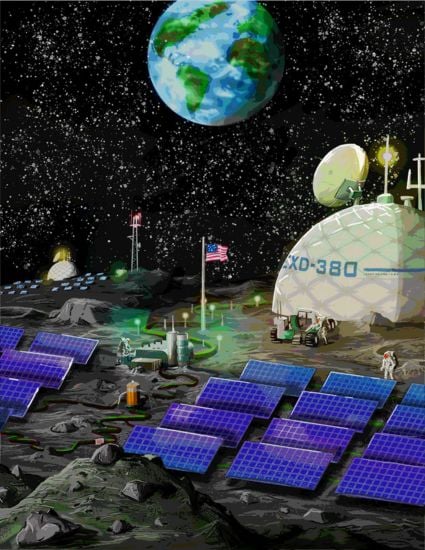
Artist’s concept of power on the moon. Image used courtesy of Sandia National Laboratories/Eric Lundin
The judges decided on a Total Effective System Mass (TESM) calculation. This calculation measured each power system’s effectiveness relative to its size and mass and the total energy it provided. The best-performing innovation was the one with the lowest TESM value.
Long-Range Lunar Power Solution
HELPS (High-Efficiency Long-Range Power Solution), from the University of California, Santa Barbara. won the competition by creating a low-mass, high-efficiency power system.
The HELPS technology can operate across a wide temperature range, meaning it could theoretically be used within lunar environments to distribute and manage energy during day and night. The innovation also possesses a special 800 V cable and uses energy stored in batteries at both ends of the transmission network. A variable radiation shield allows the system to better withstand the temperature changes on the moon’s surface. It can switch between dissipating excess heat during high power and conserving heat during cold periods.
The team subjected the power system to a final 48-hour test to ensure that their design met the energy storage, thermal, and transmission requirements to make it feasible for lunar exploration. The team will further reduce the system’s weight to achieve optimal efficiency.
High-Voltage Converter
The second-place team, Orbital Mining Corporation from Colorado, also completed the final 48-hour test with a high performance. The company developed a high-voltage DC-DC converter system that can remain operational throughout the cold and dark lunar nights. The high-voltage system uses a DC-wired transmission system with a low-mass cable and a lithium-ion battery bank.




Lunar power | System mass | Layer-0 architecture
800 V won Watts on the Moon. The voltage is not the lesson. NASA scored the full power architecture on one metric, Total Effective System Mass, against 350-hour nights, vacuum, thermal swings and remote operation. Transmission, storage and thermal tested together for 48 hours.
We build toward that method at NLEVEL: open, software-defined Layer-0 Real-time Energy Routing, agnostic to current type and nominal voltage, reconstructing the required physical state where and when needed.
Status: our demonstrator shows selected functions. Lunar and other application-specific validation remain open.
Space-power, energy-system and engineering teams: bring a bounded use case. We keep measured evidence, modeled assumptions and open validation work strictly separate.
One Standard. Any Vendor. Infinite Scaling.
Visit us at #OCPsummit26