Facebook
 Google
 GitHub
 Linkedin
Machine Learning Is Rewiring the Power Grid
How is machine learning improving renewable energy and grid management? A survey of use cases in energy systems sheds some light.
The grid is under growing strain as wind and solar claim a larger share of the power mix. These resources don’t produce consistent output, energy storage systems remain unpredictable, and demand patterns are harder to forecast. Replacing stable fossil fuel plants with intermittent generation has introduced new operational challenges that most grid infrastructure wasn’t originally designed to handle.
During this transition, more energy companies are turning to machine learning to improve solar output forecasting, manage grid frequency and voltage fluctuations, and support real-time system stability. Beyond forecasting, machine learning models can also detect faults, predict equipment failures, balance loads, and optimize energy storage.
Researchers from Malaysia's Sunway University and New Zealand's Massey University have mapped out how the energy sector is applying machine learning. Their study in Energy Informatics analyzed peer-reviewed papers published from 2019 to 2025, focusing on ML-driven solutions across energy domains.
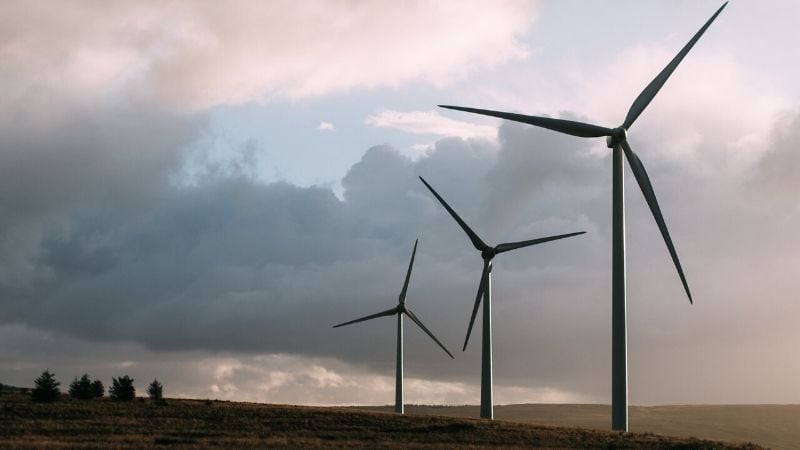
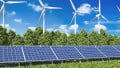
Wind turbines. Image used courtesy of Pixabay
Machine Learning Techniques
Unlike traditional models, machine learning adds value to energy forecasting and load management by identifying patterns in large, dynamic datasets. New machine learning techniques, combined with the growing use of IoT devices, provide real-time data that allows models to adapt to changing grid conditions, manage storage more efficiently, and optimize demand-side performance.
Machine learning fundamentally excels at pattern recognition and optimization. In energy systems, engineers use it to analyze historical and real-time data, forecast demand, detect anomalies, and automate control actions.
Machine learning models used in smart energy systems. Image used courtesy of Aslam et al.
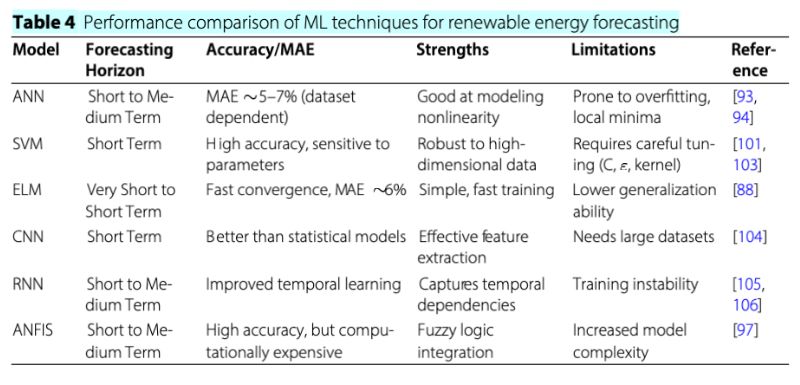
Engineers often use established machine learning models like support vector machines (SVMs) and artificial neural networks (ANNs), known for their accuracy and adaptability. ANN models are good at modeling nonlinearity, and SVMs offer high accuracy and parameter sensitivity.
The Energy Informatics paper also covers convolutional neural network (CNN) and recurrent neural network (RNN) models for solar PV forecasting. These deep learning architectures outperform traditional physical, statistical, and persistence models by learning complex patterns in time-series and spatial data, leading to more accurate predictions of PV output power under varying environmental conditions.
Deep learning extends traditional neural networks by using multiple hidden layers to capture complex, nonlinear relationships in data, making it effective in managing tasks like energy forecasting and grid control.
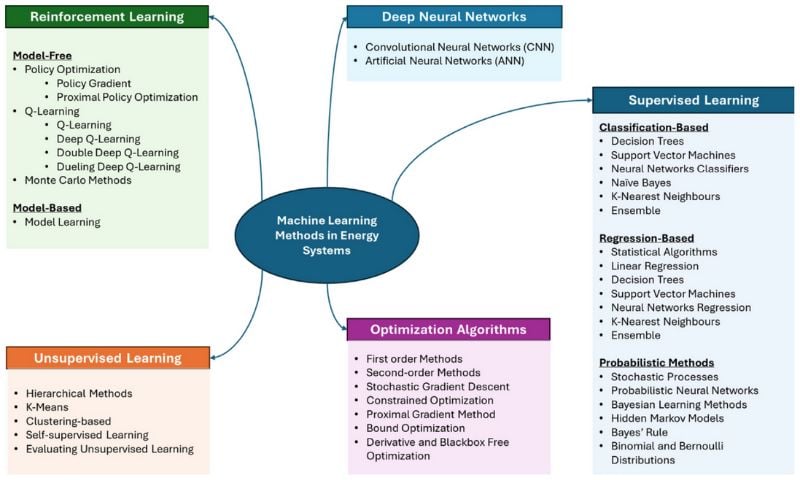
Machine learning techniques for renewable forecasting. Image used courtesy of Aslam et al.
Reinforcement learning (RL) supports adaptive, trial-and-error decision-making in dynamic environments, while deep reinforcement learning (DRL) combines RL with deep neural networks to enable real-time optimization in energy management and smart grid automation.
Standout Industry Applications
Machine learning supports a wide range of critical functions in energy systems: Predictive maintenance models detect early signs of equipment failure, reducing unplanned downtime and preventing cascading outages. Load forecasting models help operators plan short-term generation and dispatch by analyzing historical load data, weather conditions, and other variables.
The Energy Informatics study cites several private-sector examples of machine learning in energy systems. General Electric released its Digital Wind Farm platform in 2015, employing digital twin technology with embedded sensors and cloud-based analytics to simulate and optimize wind turbine performance under real wind conditions. This system could boost a wind farm's energy production by up to 20%.
The study also covers early machine learning tools like GridSense, developed by Switzerland-based Alpiq. The platform collects and processes data on grid demand, electricity pricing, and environmental conditions. By autonomously balancing flexible loads and integrating household batteries, GridSense supports predictive load balancing and ensures stable power delivery, particularly during peak demand periods.
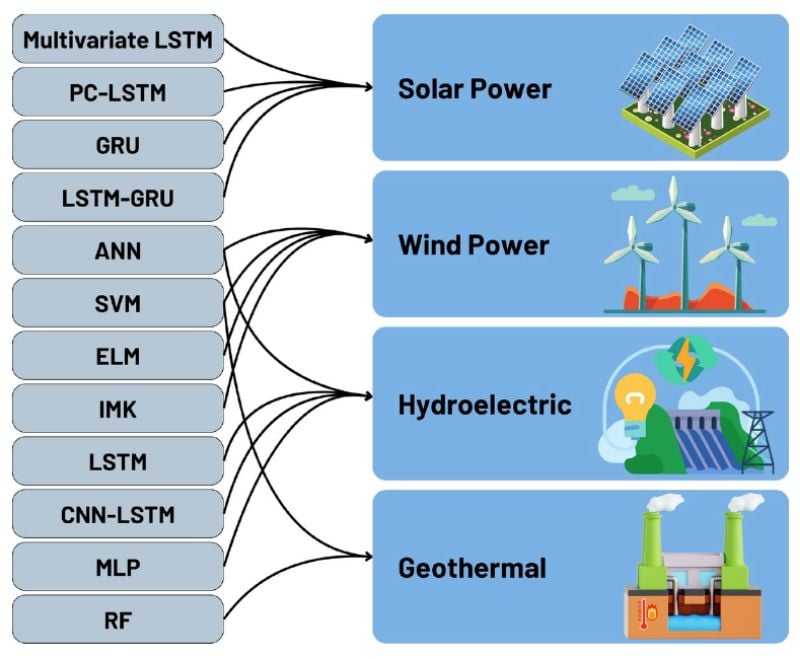
ML-based forecasting techniques for solar, wind, hydroelectric, and geothermal resources. Image used courtesy of Aslam et al.
Vermont Electric Power Company (VELCO) uses machine learning for hyper-local weather forecasting, enhancing the accuracy of solar and wind energy predictions.
In the energy storage domain, companies like Greensmith Energy have employed machine learning and advanced analytics to manage distributed storage systems and support renewable integration. The Greensmith Energy Management System, with its sixth iteration released in 2018, includes a library of algorithms to optimize dispatch, frequency regulation, and system balancing across grid-connected assets.
What’s Next for ML?
The researchers recommend several avenues for future research. Broader data sets are needed for wind and solar energy, grid behavior, and smart energy management. Additionally, the compatibility of AI and ML tools with legacy infrastructure remains a concern. Finally, as the grid digitizes, privacy and cybersecurity concerns require more oversight.