Facebook
 Google
 GitHub
 Linkedin
Location, Location, Location: It Matters in Renewable Development
MIT researchers unveil a new modeling approach for renewable site selection.
High-resolution weather data and energy system models can pinpoint optimal locations for wind and solar plants, according to a study in Cell Reports Sustainability. The study highlighted the importance of considering local variations in sunlight, wind patterns, energy demand, and geophysical characteristics when selecting sites.
Increasing the spatial resolution of energy system models can help identify cost-saving locations that alleviate planned generation capacities. Historically, these models rely on meteorological data at a 30- to 100-km resolution, aggregated into larger cities and states. However, a Massachusetts Institute of Technology team introduces a scaled approach incorporating weather and energy system models with sub-10-km data to determine the most effective sites for renewable installations.
Downscaled meteorological data predicted the most comprehensive cost reductions, more than typical resolutions over 30 km. The study concluded that the ideal ranges are 4-6 km for wind and 14-50 km for solar sites. To the best of the researchers’ knowledge, this is the first study combining kilometer-scale resolutions with weather inputs and energy models covering several regions (New England, Texas, and California).
Planners can maximize each region’s natural variability, such as nighttime wind supply and sunset duration, by combining weather and energy system optimization inputs. Spatial variability also adds value to existing climate and weather models, revealing opportunities to avoid land-use restrictions and minimize the wake effect, turbulence that reduces turbines’ aerodynamics and performance.
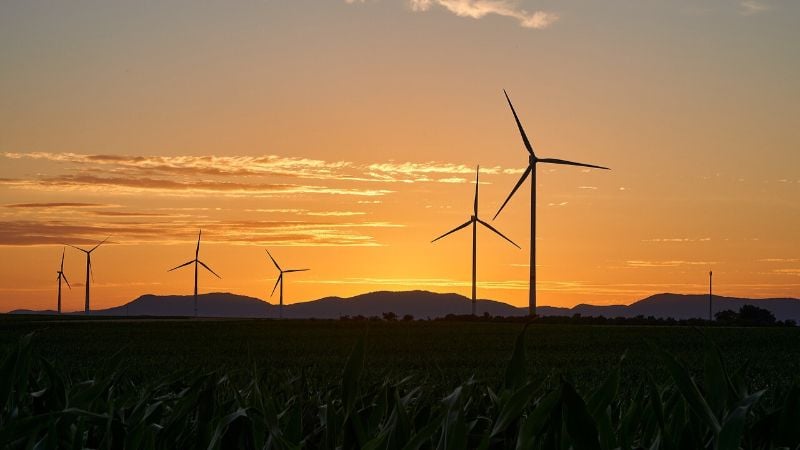
Wind turbines at sunset. Image used courtesy of Pixabay/Markus Distelrath
Location Considerations for Renewable Energy Facilities
Renewables’ share of the U.S. energy mix is growing, accounting for 21.4% of utility-scale electricity generation today (with 10% from wind and 3.9% from solar), according to the latest data from the Energy Information Administration. As more states transition to 100%-decarbonized energy, America’s regional grids will rely on wind, solar, and energy storage to meet growing demand.
Siting such resources in relevant locations is critical to maintaining resource-adequate power systems.
The MIT study analyzed three balancing authority operators with diverse climates and geophysical features: the Electric Reliability Council of Texas, ISO New England (ISO-NE), and California ISO (CAISO). Across these regions, wind and solar siting could exploit natural weather and geographic patterns to reduce costs and match supply and demand most efficiently.
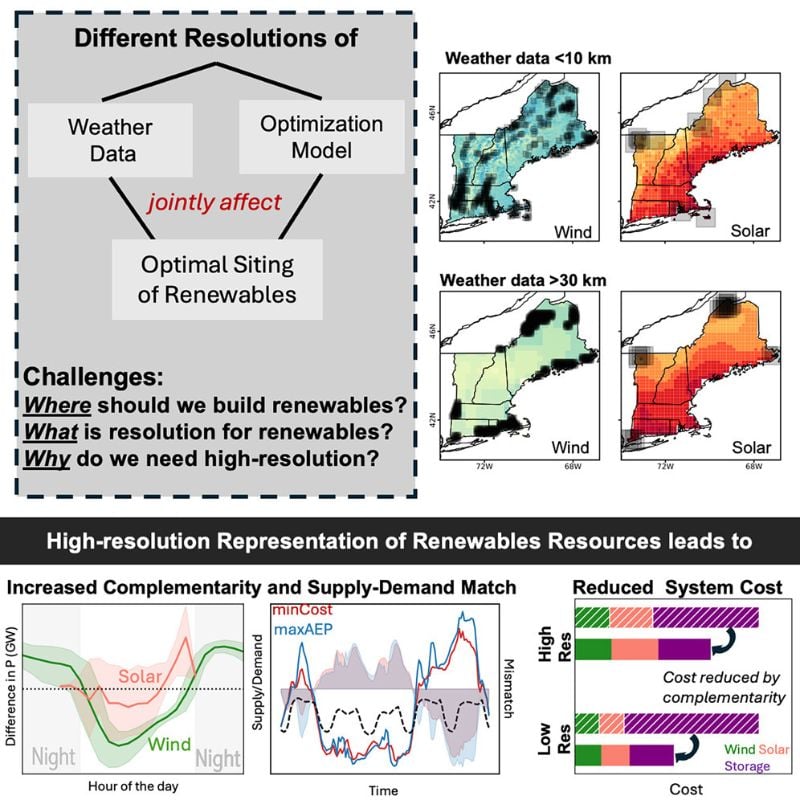
The researchers’ models and findings. Image used courtesy of Qiu et al.
Regional Variations Reveal Opportunities
Grids with a high share of renewables can benefit from spatial and temporal variations in climate and weather, tapping locations with high generation potential and tailoring supply based on net load demand. MIT’s modeling framework was informed by several energy system models and the National Renewable Energy Laboratory’s high-resolution meteorological tools, including km-scale data from the National Solar Radiation Database and the Wind Integration National Dataset.
The researchers unlocked unique insights for each region studied. For example, ERCOT could prioritize wind farms with high supply at night. The study identified local variations in afternoon wind supply, a case for locating installations along the state’s southeastern coastline to cover reduced afternoon supply in the northwest.
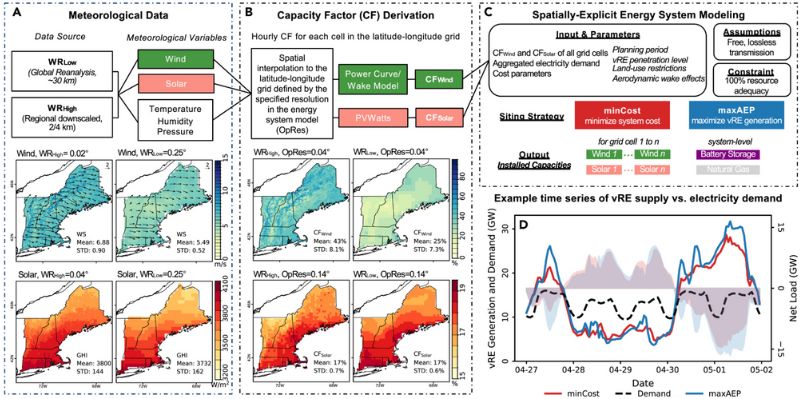
The researchers’ overall framework, with ISO-NE as an example. Image used courtesy of Qiu et al.
ERCOT has higher wind potential than ISO-NE and CAISO, especially at night. However, Texas has fewer sunlight hours, so planners should prioritize adding wind capacity in areas that can compensate for the solar shortfall in the afternoon.
For ISO-NE, the study modeled a 100%-decarbonized energy system with wind farms sited to maximize nighttime supply, targeting large spatial anomalies in night wind resources compared to regional averages.
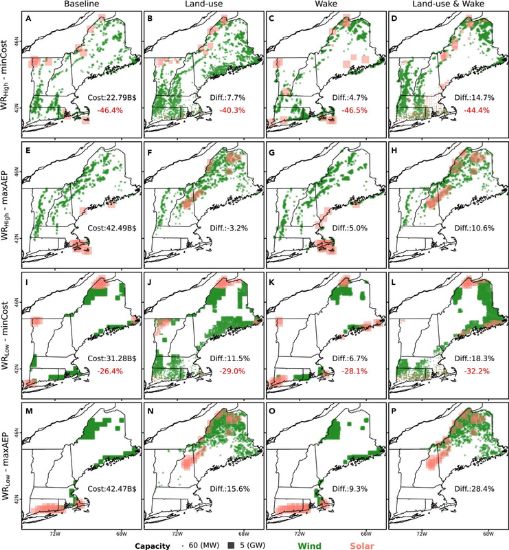
Impact of land-use restrictions and wake effect in ISO-NE’s system. Image used courtesy of Qiu et al.
Solar plants could be constructed further north or scattered along east-west locations to take advantage of sunrise solar supply and sunset hours for longer durations. This reduces load spikes in the evening when solar generation falls and demand rises. The researchers also found a similar pattern in CAISO’s system.