Facebook
 Google
 GitHub
 Linkedin
Lessons From California: Solar+Storage=Grid Resilience
Here’s how California overcame grid resilience issues during summer heatwaves.
Every summer from 2020 to 2022, California’s power grid has struggled to meet sudden demand spikes during record heatwaves. But this year, a substantial increase in battery storage capacity helped the state’s grid operator battle triple-digit temperatures with minimal impact.
California outputs more renewable energy than any other state but Texas. Solar, wind, geothermal, and hydroelectric resources account for 60.8% of its utility-scale electricity generation, according to the U.S. Energy Information Administration (EIA). Meanwhile, the state is phasing out fossil fuels, targeting 100% carbon-free power by 2045. Just one remaining coal plant supplies 57 MW of capacity today. And although natural gas still delivers 39% of net electricity generation, that share has declined since the 1990s.
Amid extreme heatwaves in the early 2020s, the California Independent System Operator (CAISO) scrambled to balance supply and demand with the inherent intermittency of wind and solar generation. Some days, the organization issued emergency alerts asking consumers to conserve electricity to avoid outages. Historically, fossil fuel resources lent a baseload power supply to manage load volatility in such events, but the state’s decarbonization plan left the grid in a precarious position.
Enter California’s massive energy storage expansion—a factor CAISO credits in its summer recovery this year. Statewide battery capacity rose from 500 MW in 2018 to 10.3 GW today, according to the California Energy Commission. Another 3.8 GW is scheduled to come online by late 2024.
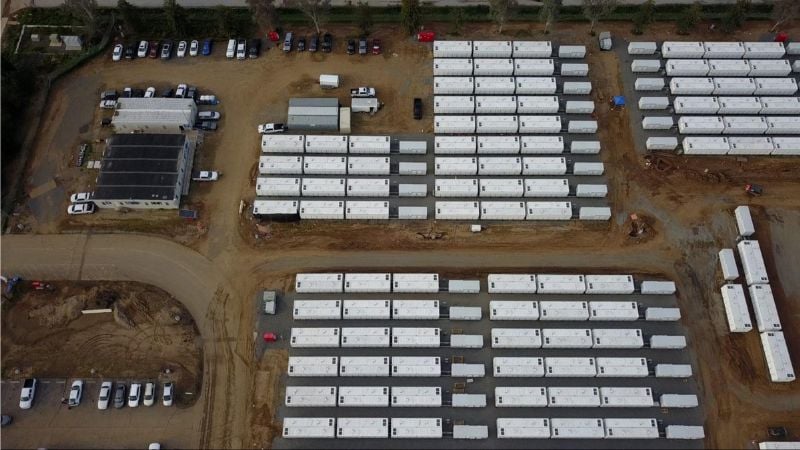
The 680 MW Nova Power Bank project is under construction in Menifee, California. Image used courtesy of Calpine
Balancing Renewables With Battery Storage
Over the last three years, California has steadily built up a nation-leading battery storage fleet to provide flexibility for smooth grid operations. Statewide construction activity dominates the national battery storage market.
At the same time, small-scale installations are also ramping up as more California residents are pairing battery storage with their solar panels. According to EIA data, these combinations comprised over half of all home solar additions as of April 2024, compared to just 20% in October 2023. In those six months, more than 40,000 battery installations added 232 MW of new capacity statewide.
CAISO tapped into this flexibility throughout a nearly two-week-long heatwave in 2024. Today, the operator has enough battery storage to match multiple natural gas plants operating at full power in peak hours. Even when demand peaked at 43.9 GW one day in July, CAISO maintained smooth operations without asking users to save electricity.
New Projects Boost Capacity
Most of California’s 10.3 GW of battery capacity today comes from utilities (8.7 GW), followed by residential customers with 1 GW and commercial facilities with 571 MW. State projections anticipate 52 GW of additional battery capacity will be needed by 2045.
California’s battery storage facilities are among the world’s largest, such as the 750 MW/3 GWh Moss Landing plant and the Edwards & Sanborn solar-plus-storage project combining 875 MW of PV with 3.2 GWh of batteries.
Utilities are procuring additional capacity. Pacific Gas & Electric has brought over 2 GW online. Another 772 MW is planned for this year and 687 MW for 2025, with over 3.5 GW contracted. San Diego Gas & Electric has more than doubled its utility-owned storage capacity in the last few years. The utility’s portfolio now includes 21 battery energy storage systems and microgrids totaling 335 MW, with nearly 50 MW under development. Southern California Edison also oversees 3 GW of capacity, with an additional 8 GW installed or procured.
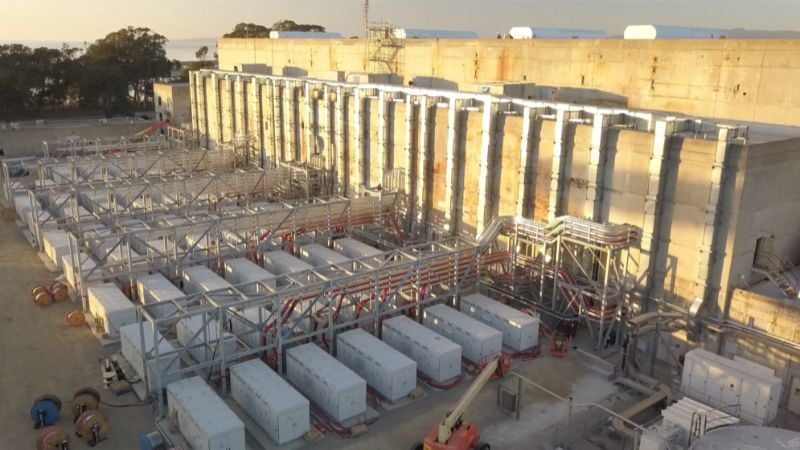
Vistra’s Moss Landing Energy Storage Facility is among California’s largest battery storage projects. Image used courtesy of Vistra Corp.
Southern California will soon host the 680 MW/2.7 GWh Nova Power Bank, one of the state’s largest standalone battery storage installations, at a decommissioned natural gas plant. The first phases will come online this year, with over 1,000 lithium-ion battery containers supplied by BYD. Upon completion, the site will serve 680,000 homes.
Another large development is Bellefield Solar and Energy Storage near Bakersfield, bringing 1 GW of solar and 1 GW of batteries online across two phases in 2025 and 2026.