Facebook
 Google
 GitHub
 Linkedin
Is AI the Answer to Managing EV Charging Loads?
Artificial intelligence and machine learning can make smart meter systems smarter, according to a new study.
Electric vehicles are stealth electricity users. Utilities usually don’t know exactly how many EVs are charging or when until a sudden energy demand shows up in their daily use patterns. EV adoption is growing fast—over 4.8 million in the U.S. today could grow to 78.5 million by 2035. How can utilities prepare for the addition of thousands or millions of EVs each year?
How do EVs affect the grid, and what can utilities do about it? Video used courtesy of Bidgley
Some tools are already available, such as smart meters and distributed energy management platforms. While these can give utilities a general idea of EV adoption and charging behavior, they often don’t present a clear picture.
However, when paired with artificial intelligence, advanced metering infrastructure (AMI) can pinpoint EVs and help utilities understand the present and future impacts on the grid.

How can AI help utilities handle EV growth? Image used courtesy of Adobe Stock
Where Are the EVs and When Are They Charging?
When people purchase EVs or businesses install EV chargers, they are not required to inform the local utilities. Often, the utility’s first clue is a sudden spike in electricity use in a certain area. However, conventional grid monitoring software cannot definitively identify the spike as an EV. The increased energy use could be another high-energy item, such as a heating/air conditioning system or home appliance.
Utilities have used other methods to determine the number and location of EVs and chargers, but each has drawbacks. Customer surveys are inaccurate because many people don’t respond, and collecting information from vehicle registrations is time-consuming.
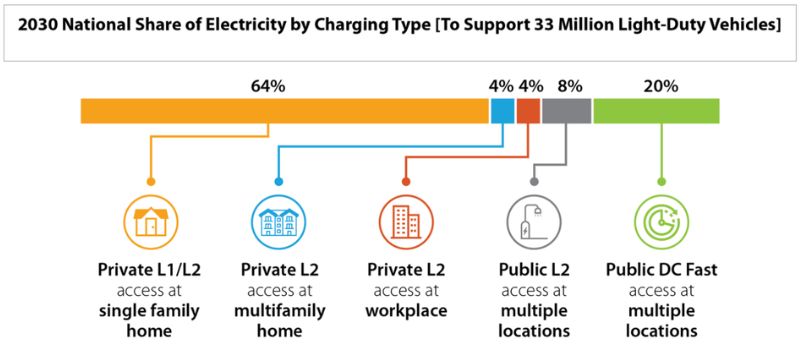
About 80% of all EV charging will be done at home by 2030. Image used courtesy of the Department of Energy
Smart meters can help identify charging activity, but analyzing the data to understand the grid impact is difficult. EV chargers vary in energy profile, depending on the vehicle and charger type. For example, plug-in hybrids have different loads than battery-electric vehicles, as do Level 1 and Level 2 chargers. Users can upgrade or change their vehicles or chargers at any time.
Yet, understanding EV charging behavior is essential to grid management. Usage patterns enable grid operators to better manage energy supply and demand to ensure stability. Utilities must also prioritize infrastructure upgrades and expansions. Pinpointing heavy-use areas and predicting growth can help utilities plan budgets.
How Can AI Help Ease Grid Response to Electrification?
AMI systems with artificial intelligence and machine learning can provide utilities with the information needed to prepare for EV growth, according to the Smart Electric Power Alliance (SEPA). SEPA partnered with Bidgely, a utility energy intelligence company, to investigate AI and ML use in grid management.
The report lists several advantages:
- Identifying EV users. AI can target specific users for customer outreach and inclusion in smart metering programs.
- Identifying EV charging times. AI can more accurately assess charging times.
- Understand EV charging patterns. AI analyzes data to find patterns in when, how, and how much users charge their EVs. This can help them forecast load, create programs to accommodate changes, and schedule grid updates.
- Creating a technology roadmap. AI can analyze hardware and software to help grid managers decide when and where to make investments and what the return on those investments might be.
- Changing customer programs. Utilities can better design programs to encourage users to manage charging habits.
_and_light-duty_vehicles_(LDVs)_by_state.jpg)
Predicted distribution of plug-in electric vehicles (PEVs) and light-duty vehicles (LDVs) by state. Image used courtesy of National Renewable Energy Laboratory
While AMI programs can find the data, AI and ML can analyze it faster and more efficiently, often rendering information in real time. They can handle more complex data, which is vital as the energy landscape changes.
SEPA’s report mentions that AI predictions have limitations. Utility companies should be prepared to manage risks by reviewing the accuracy of their data and exercising caution when sharing it with third parties.
Case Studies
SEPA reported two case studies performed with Bidgely’s AI-enhanced AMI.
Hydro One in Ontario used AMI data to target EV drivers for its demand-side program. In 24 hours, over 1,000 users enrolled. The grid operators used the AI software to estimate EV load, understand EV charging sides, and locate heavy EV use areas.
In Nevada, NV Energy also used AI-based AMI to manage its EV charging load. The utility’s area includes Las Vegas, where EV charging takes place 24/7, making it difficult to shift charging loads to off-peak hours. Yet, a trial of 50 heavy-use EV drivers achieved a load-shift potential of 2-4 kW per vehicle per charging incident. This is a 2.5 to 10 times improvement over the average of 0.2 to 0.8 kW per vehicle per event. NV Energy designed a 2025-2027 Transportation Electrification Plan to expand the trial to all customers.
AI, ML, and EVs
Renewable energy resources, behind-the-meter systems, demand-side management, and electric vehicles create a dynamic environment that requires new approaches to achieving grid stability. Advanced smart metering systems can help manage the growing EV load, but integrating AI and ML has distinct advantages. Utilities need accurate information in real time to optimize present services and plan for the future.