
 Facebook
 Google
 GitHub
 Linkedin
Innovative Catalyst Allows Battery Charging to 85% in 6 Minutes
Australian researchers have developed a lithium-ion pouch battery that uses an anion-reduction catalyst to allow silicon anodes to charge to 85% in just six minutes
As battery makers continue to compete to create the electric vehicle that can charge the fastest, researchers worldwide are innovating with alternative materials to the standard lithium-ion battery chemistry, such as sodium. Others, like researchers at Adelaide University, are working to perfect lithium-ion batteries by making slight alterations to the technology.
The Australian team has created a pouch battery that uses an anion-reduction catalyst to charge it to 85% in just 6 minutes and 91% in 10 minutes. The researchers focused entirely on the interface between the anode surface and the electrolyte.
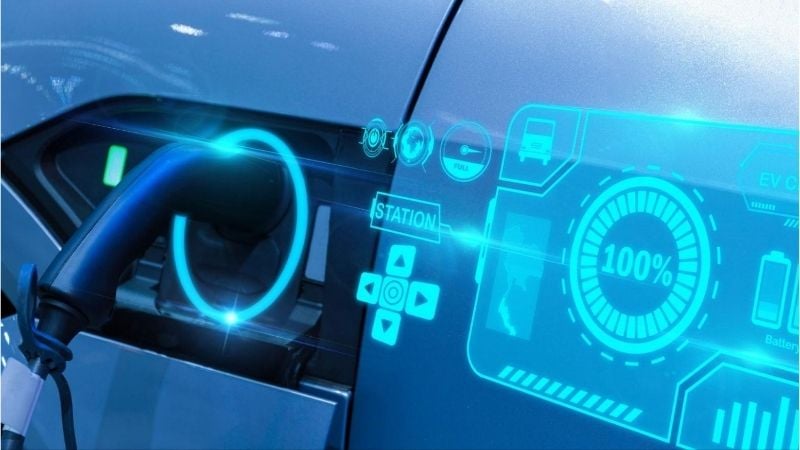
Researchers created an EV battery that charges in just 6 minutes. Image used courtesy of Adobe Stock
Using A Traditionally Difficult Anode: Silicon
Silicon anodes have long attracted interest for lithium-ion batteries because they offer a much higher energy density than current commercial anode materials. However, they undergo large volumetric changes during cycling, which quickly degrade the electrode structure and short-circuit the battery.
Battery makers have tried several alternatives to buffer this expansion, including silicon nanoparticles and nanoscale coatings. These improvements to silicon anodes have shown some success, but their practical use remains limited compared to other anodes due to inherent challenges.
During fast charging, silicon anodes experience large overpotentials and uncontrolled growth of the solid electrolyte interphase (SEI), increasing internal resistance. So, to attempt to create silicon batteries that can fast-charge, the researchers turned to anion-rich interfacial solvation structures (ISS).
Interfacial Anion Reduction Catalysis Brings Faster Charging Batteries
To make the silicon anodes more stable and efficient, researchers used an interfacial anion-reduction catalysis process in which catalytic centers—S vacancies (MoS2-x)—at the electrode surface attract bis(fluorosulfonyl)imide (FSI) anions against interfacial fields. This process lowered the reduction barriers and enabled the anions to act as nucleation sites to form inorganic SEI components.
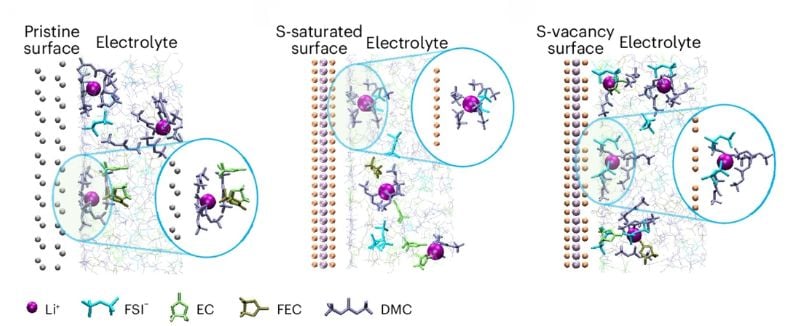
The silicon-anode surface interactions. Image used courtesy of Tu et al.
This created a predominantly inorganic, robust protective layer critical for fast charging, as it still allows for efficient lithium conductivity and protects the silicon anode’s stability over time. Specifically, the FSI― anions at the interface form contact ion pairs during charging, which create FSI―-rich ISS that promote FSI― reduction and the formation of ultrafine (less than 5nm) LiF grains at the interface. This leads to a LiF-rich SEI with rapid Li+ transport pathways.
This method differs from electrolyte engineering, which affects the entire electrolyte system, whereas this approach regulates reactions only at the electrolyte-electrode interface. The electronic conductivity remains high, as some electrolyte engineering approaches can trade off ionic conductivity for stability.
Pouch cells equipped with silicon-based anodes with this catalytic interface achieved the following:
- Average coulombic efficiency of ~99.94%
- 91.4% charging in 10 minutes at 10 C charging
- 85.3% charging in 6 minutes at 10 C charging (the commercial benchmarking for most charging is up to 80%, as beyond 80% state of charge, the charging becomes much slower)
- Energy density of 240.4 Wh kg-1 after 6 minutes of charging
The battery’s performance meets the US Advanced Battery Consortium (USABC) fast-charging benchmark and is important for addressing the interfacial limitations of alloy anodes for fast-charging applications. The researchers stated that they will now focus on scaling up the technology and testing its long-term performance under practical operating conditions.
Fast Charging Achieved but Not Yet Practical
While the charging capabilities are impressive, the cells still fall short of making a difference in commercial charging. First, pouch-level cells are better suited to phones and smaller electronics and could certainly be used for those purposes, but the study specifically referenced EVs, and much work will be needed to scale from a pouch cell to an EV battery pack.
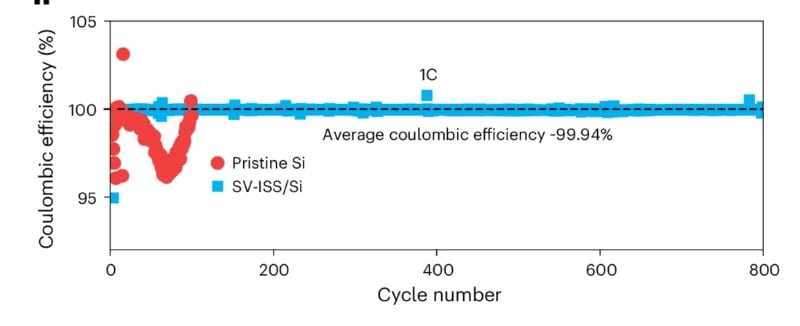
Coulombic efficiency comparison. Image used courtesy of Tu et al.
Secondly, the cells maintained a 72% capacity after 500 cycles at 6 C. So, while fast charging is possible with silicon anodes, long-term stability remains more challenging. In practical terms, once an EV battery pack reaches 70-80% state of charge, a new one is installed. So, if this battery could theoretically be scaled up to its current specs, it would only last 500 cycles before replacement.
For reference, the BYD blade battery 2.0, which can charge from 10-97% in under 9 minutes, has a cycle life of over 4000 cycles. This is the kind of benchmark that any new battery or fast charging technology is up against.
Although the study shows an innovative way to use silicon anodes, many years of further development are needed before this type of battery would be practical.










Overall efficiency and long life would seem to be a more important consideration than the fast charging performance. Given that many communication devices have a rather lower use to standby ratio,it seems that the fast charging performance is a somewhat artificial requirement. Perhaps a higher battery capacity would allow more operation time between charges, reducing the demand for such fast charging ability.