Facebook
 Google
 GitHub
 Linkedin
Finding the ‘Hidden Revenues’ of Renewable Energy Systems
Using a reliable efficiency index, researchers discovered that smart grids with renewable sources can save energy and costs.
Increasing energy demand and decarbonization goals are changing the energy landscape. Developing more robust and sustainable grid infrastructure has been primarily achieved through the integration of renewable energy sources and energy storage systems.
While including renewables is critical for reducing carbon emissions and improving grid resilience in down periods, their intermittent nature also causes operational efficiency and grid reliability challenges. Researchers from Islamic Azad University have developed an approach for optimizing key performance metrics for measuring energy efficiency within grid operations―the reliable efficiency index (REI).

Renewable energy system with storage. Image used courtesy of Adobe Stock
Balancing Technical Challenges with Economics
Integrating renewables into the grid is challenging due to their unpredictable power generation capabilities, as they all have peak and low generation capabilities depending on the local environmental conditions. Energy storage systems (ESS) help to mitigate this intermittent demand in microgrid environments by storing energy during peak periods and releasing it during low periods.
The energy industry must strike a balance between the technology’s reliability and its economic viability. Costs to integrate and manage new energy sources would ultimately be passed on to consumers if they are too high. Utility companies’ profitability vs. grid reliability is a complex dynamic.
Researchers have done little study on the hidden revenues of renewable integration, such as not paying fuel costs and lowering environmental emissions. Previous studies have introduced indexes for microgrids, but they have struggled to demonstrate the microgrid's efficiency based on its reliability and availability.
Optimizing the Reliable Efficiency Index
A study published in Nature used a holistic approach to examine the synergistic interactions and combined effects of renewable sources and energy storage systems. Researchers defined an efficiency metric to optimize the accessibility, profitability, environmental impact, and reliability of power grids across diverse energy scenarios.
The researchers investigated how renewables’ hidden revenues impact smart grids, focusing on reduced carbon emissions and fuel cost removal. They also explored system reliability enhancement strategies and economic considerations to develop a new REI model that can navigate the complexities of modern-day smart grids.
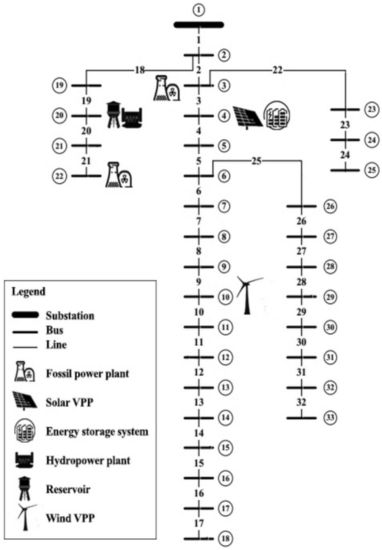
The studied system included conventional and renewable sources with energy storage systems. Image used courtesy of Alizadeh et al.
Within the optimization framework, the researchers used an epsilon-constrained method to optimize system operations, as this provided a level of uncertainty in both market conditions and RES outputs. The epsilon-constrained method allowed for optimal resource scheduling within smart grid operations, specifically geared toward improving the REI and overall profitability. The researchers used an AutoRegressive Integrated Moving Average model to generate different energy scenarios.
They applied the optimization method to simulations using the IEEE standard 33-bus radial distribution system in scenarios with and without renewable power plants. The overall model studied economic and environmental objectives, and because it included hidden revenues, the model provided actionable insights for grid operators, and policymakers could use.
Results Show Improvements in REI
The results from the simulations on the IEEE 33-bus distribution system showed a significant improvement in profitability, availability, and REI after both renewable sources and ESS were incorporated into the grid model. The optimization model also showed significant improvements in grid reliability and energy efficiency. Specifically, the optimization algorithm showed that the optimization model could balance economic and environmental factors, including:
- 171% increase in the REI
- 38% increase in profitability
- 154% increase in system availability
- Reduction in both carbon emissions and fuel costs
- Hidden revenues from fuel and emission savings of over $1.28 million per day
Future Plans to Build on the Model
Although the optimization model has generated promising results, the models were based on fixed RES locations and ideal market conditions, so they might not represent real-world scenarios. The study also excluded the long-term degradation effects of ESS. Future work will address these limitations using regulatory and market constraints, renewable and ESS placement, and ESS degradation. The researchers will also expand the model to include other distributed generators, such as tidal power and waste-to-energy plants. The researchers stated that the models will also be validated on larger systems to ensure their robustness in high-penetration scenarios.