Facebook
 Google
 GitHub
 Linkedin
‘Electrode-Agnostic’ Electrolyte Unlocks Energy Density
University of Wisconsin-Madison engineers have developed a mixed-solvent electrolyte system that stabilizes both reactive metal anodes and conventional cathodes.
Researchers at the University of Wisconsin-Madison have created a dual-solvent electrolyte that can stabilize both sides of a battery cell, potentially solving a long-standing challenge in electrochemical energy storage.
The study in Nature Communications presents an electrolyte formulation that supports anode-free sodium-metal batteries, while exhibiting the rare quality of being “electrode-agnostic.” It can simultaneously suppress dendrite growth at the anode and resist oxidative degradation at the cathode, offering a possible blueprint for safer, scalable, and more energy-dense batteries that extend beyond lithium-ion constraints.

Researchers propose a safer and more stable electrolyte for sodium-based batteries. Adapted from images used courtesy of Canva
Selective Solvation
The design strategy involves a rational blend of two ether-based solvents—2-methyltetrahydrofuran (2-MeTHF) and tetrahydrofuran (THF)—each selected for its preferential interfacial behavior. The team aimed to stabilize initially anode-free sodium-ion batteries, where sodium metal plating occurs directly onto a bare copper collector during the first charge. These systems are attractive due to reduced manufacturing complexity and increased energy density but suffer from interface instability and electrolyte decomposition.
Rather than searching for a single solvent that performs adequately across both electrodes, the researchers paired the two chemically compatible ethers, each optimized for one electrode. Through molecular dynamics simulations, they confirmed that 2-MeTHF, a bulkier, strongly coordinating solvent, dominates the first solvation shell around sodium ions, guiding interfacial chemistry at the anode. Conversely, the smaller THF molecules, which interact more weakly with sodium, preferentially enrich near the cathode.
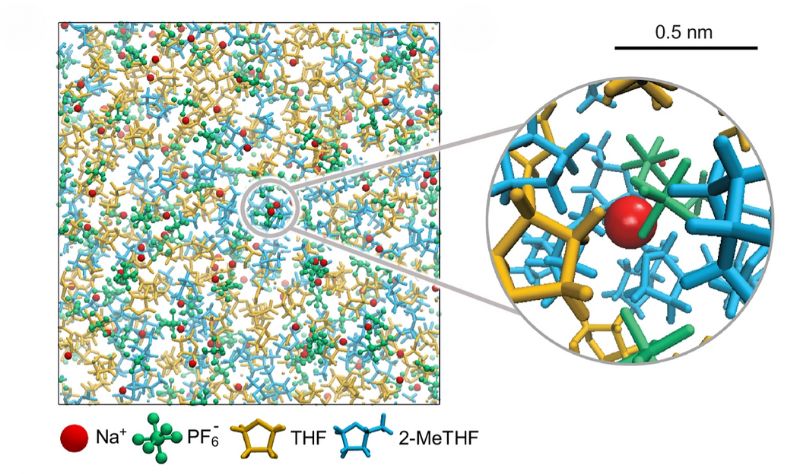
Solvent molecules with an oxygen atom within 0.5 nm of the Na+ ion. Image used courtesy of Xing et al.
This spatial separation of solvent roles creates a synergistic interphase environment. At the anode, 2-MeTHF facilitates the formation of a stable solid electrolyte interphase (SEI), suppressing dendrite growth and improving coulombic efficiency during sodium plating/stripping. At the cathode, THF mitigates oxidative decomposition and prolongs cycle life. The study noted that both solvents are ether-based and chemically stable with the NaFSI salt used, eliminating compatibility issues and allowing a robust electrolyte framework.
The electrolyte also exhibits low viscosity and high ionic conductivity, both essential for practical implementation in full cells. By managing the solvation structure dynamically during charge/discharge, the system adapts to changing electrochemical environments, which conventional single-solvent electrolytes struggle to do.
Performance Validation in Anode-Free Na Metal Cells
To validate the approach, the team built and cycled anode-free full cells using NaCrO2 as the cathode, a bare copper current collector as the anode, and their dual-solvent electrolyte. These cells demonstrated stable cycling for over 160 cycles, retaining 80% of their original capacity, and achieving high coulombic efficiencies (~99.4%), even under high areal capacity (2.2 mAh/cm2) conditions. Importantly, the SEI formed on the plated sodium was inorganic-rich and uniform, a structure known to resist cracking and dendritic growth.
By contrast, control cells using single-solvent electrolytes showed rapid degradation and short-circuiting, highlighting the limitations of traditional approaches when transitioning to anode-free or sodium-based architectures. The researchers also tested the electrolyte's tolerance across temperature ranges and current densities, finding consistent behavior.
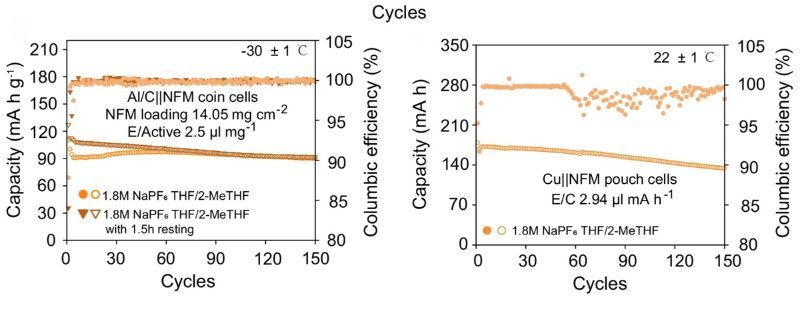
Cycling performance. Image used courtesy of Xing et al.
The electrolyte’s ability to support anode-free operation is especially significant. Traditional sodium-ion cells require pre-deposited anodes, adding manufacturing complexity and sacrificing energy density. In this configuration, sodium metal is plated in situ, minimizing inactive material and improving the fuel cell’s gravimetric performance.
This work’s implications extend beyond sodium-ion systems. By demonstrating that electrolyte function can be decoupled and spatially directed, the team presents a framework for supporting a variety of challenging anode chemistries (for example, lithium metal, silicon, or even multivalent ions) while maintaining compatibility with high-voltage cathodes. This could pave the way for electrolyte systems that can “adapt” to diverse electrode requirements, reducing the need for fully customized formulations in each battery architecture.
While further optimization is required for commercial adoption, this study provides a foundational electrolyte model for next-generation battery systems that aim to combine high energy density, recyclability, and cost efficiency.