Facebook
 Google
 GitHub
 Linkedin
Can Asahi Kasei’s Electrolyte Cure Cold Weather EV Blues?
Made from a common industrial chemical, the lithium-ion battery electrolyte improves low-temperature performance and extends battery life. The company unveiled the innovation at PCIM 2024.
Asahi Kasei has achieved proof of concept for a proprietary high-ionic conductive electrolyte for lithium-ion batteries.
The company claims its technological breakthrough will allow increased power output for lithium-ion batteries. The electrolyte increases performance at low temperatures while also improving durability at high temperatures. This allows smaller-sized battery packs to achieve the same performance while lower costs.
The Japanese multinational chemical and materials company unveiled its innovation just before the 2024 Power Conversion and Intelligent Motion (PCIM) conference in Nuremberg, Germany.

Could Asahi Kasei’s battery technology help electric vehicles perform better in cold weather? Image used courtesy of Adobe Stock
Ionic Conductivity
Asahi Kasei began researching electrolytes with high ionic conductivity to improve lithium-ion battery performance in 2010. The company’s researchers found that an organic compound called acetonitrile (AN), with the chemical formula CH3CN, could create an electrolyte solution with uniquely high ionic conductivities.
High ionic conductivity in electrolytes used for lithium-ion batteries offers several key advantages:
- Faster charging and discharging rates: Higher ionic conductivity allows lithium ions to move more rapidly between the electrodes during charging and discharging, enabling faster charge/discharge rates and higher power densities.
- Improved low-temperature performance: Electrolytes with high ionic conductivity can maintain sufficient ion mobility even at low temperatures, allowing lithium-ion batteries to operate effectively in cold environments.
- Higher energy density: Highly conductive electrolytes facilitate efficient lithium-ion transport, enabling the use of higher-capacity electrode materials, leading to increased energy density in lithium-ion batteries.
Due to acetonitrile’s very low viscosity, faster ion mobility and high ionic conductivity occur in the electrolyte solution. In addition, AN’s dielectric permittivity is moderate, enabling effective solvation and dissociation of lithium salts, leading to high concentrations of charge carriers and high ionic conductivity. AN also has a low solvating power, resulting in weakly solvated ions that can move more freely, contributing to high ionic conductivity.
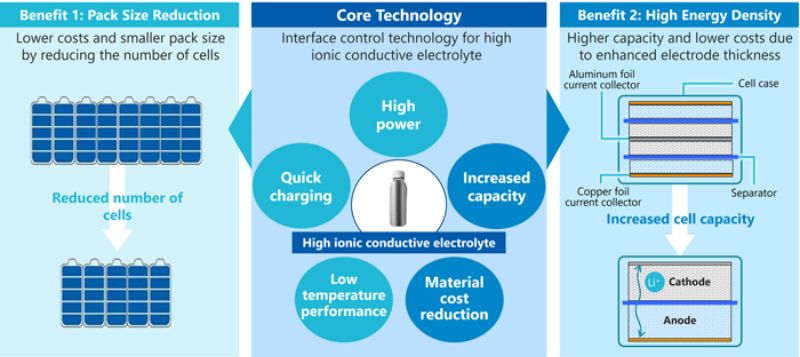
AN’s benefits. Image used courtesy of Asahi Kasei
AN is also readily available, as it has numerous industrial and practical uses, including in producing pesticides, perfumes, dyes, plastics, photographic films, and nail polish removers.
Proof of Concept
Using an experimental AN-based electrolyte in a test lithium-ion cylindrical prototype cell, Asahi researchers showed the electrolyte exhibited higher power at -40°C and twice the cycle life at 60°C before reaching a state of health of 80 percent when compared to cells made with conventional commercial electrolytes.
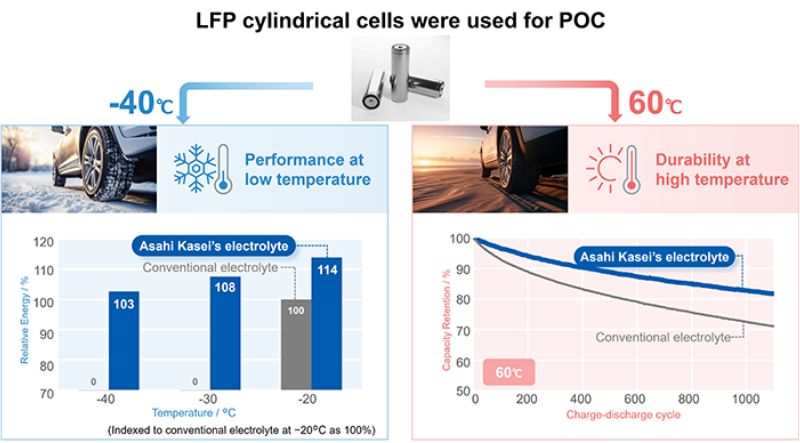
AN-based electrolyte’s performance. Image used courtesy of Asahi Kasei
AN electrolytes’ high ionic conductivity provides a key advantage, enabling faster charging and discharging rates, improved low-temperature performance, and the potential for higher energy-density lithium-ion batteries. The higher energy density could allow smaller, lower-cost lithium-ion battery packs that still provide the same performance level in an electric vehicle or battery energy storage system. Asahi says commercialization of the AN-based electrolyte is targeted for 2025.