Facebook
 Google
 GitHub
 Linkedin
Designing SiC Power Modules for EV Motor Drives
How can pinfin designs affect electric vehicle performance?
Increasing the motor drive systems’ power density is key to improving EV performance. Silicon carbide (SiC) power modules, which Tesla has already used, could potentially double the power density. SiC devices have a high-temperature resistance, low losses, and can operate at high frequencies.
Even though SiC devices have seen some use, improvements must be made in heat dissipation properties if they are to be used on a larger scale. Various device designs are emerging with improved thermal dissipation in SiC motor drive systems.
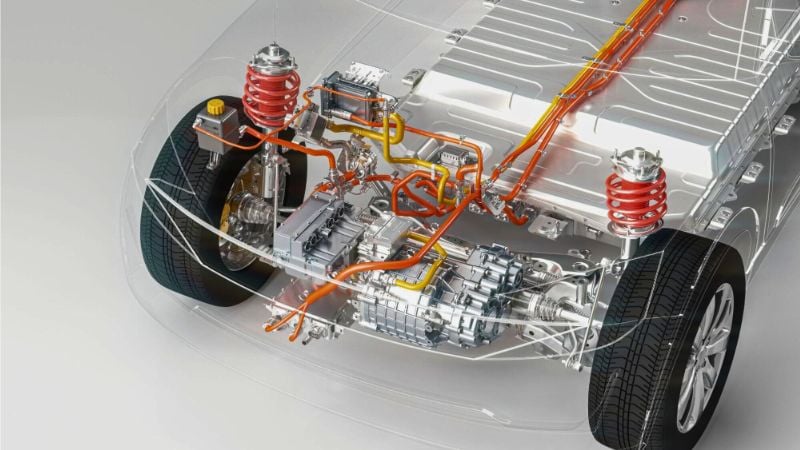
EV chassis and motor. Image used courtesy of Adobe Stock
SiC in EV Thermal Design
Heat dissipation systems are responsible for much of the weight and volume in power electronics devices. Hence, optimizing SiC’s thermal design is essential for ensuring a high power density in motor drive systems.
Motor drive systems combine liquid cooling, natural convection cooling, and forced air cooling mechanisms, whereas power electronics primarily use liquid cooling. Researchers are seeking more adaptive cooling solutions for SiC power modules in EVs that meet the changing thermal demands during different driving conditions.
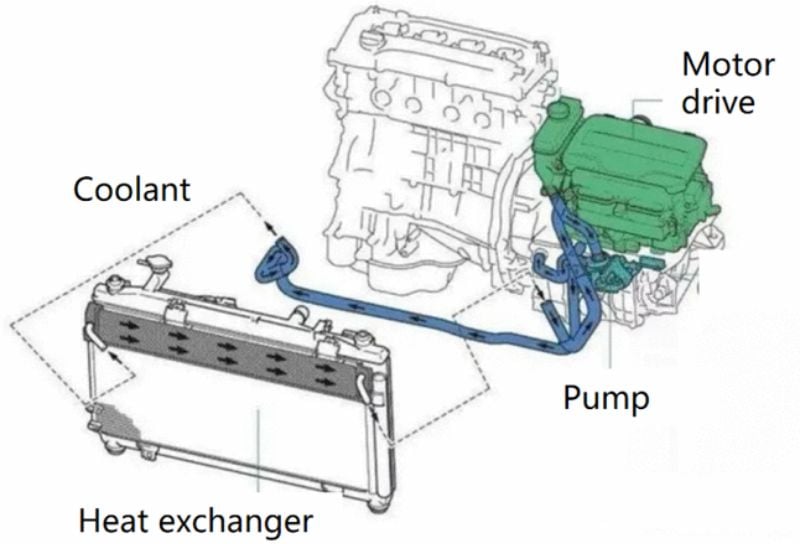
Typical design for EV cooling systems. Image used courtesy of Ning et al.
The main interest for SiCs in EV motor drives is in the inverters within the power modules due to their high breakdown voltage and high temperature tolerance. The inverters can cope with EV power systems’ increasing demands to improve performance and reliability. Thermal design in EVs covers the heat dissipation requirements during driving cycles and under different temperature conditions to ensure that any new inverter technology operates within safe temperature limits and does not overheat.
Many SiC commercial products in motor drives have used pinfin heat sinks. These contain multiple cylindrical or pin-like protrusions that increase the contact area between the cooling medium and the heat sink as it flows over the heat sink surface. This approach improves heat exchange efficiency. New pinfin configurations are helping to further improve SiC power modules’ thermal dissipation efficiency in EV motor drives.
Pinfin Design Considerations
Many SiC power modules use a regular pinfin design in which all the pins are spaced evenly and regularly apart from each other. This design changes within the pins’ geometric dimensions, mainly focusing on a change in shape, size, angle, rotation, and height of the individual pins.
Changing the individual pins has been approached from multiple angles to improve dissipation by increasing the surface area where heat transfer can occur. While this has been implemented in many designs, increasing the pins’ diameters also increases the resistance of the cooling medium.
_and_double-sided_(b).jpg)
Pinfin designs are single-sided (a) and double-sided (b). Image used courtesy of Ning et al.
Many pinfin designs rely on water pumps and can’t provide an infinite fluid pressure. The regular and densely packed pins can reduce the water pressure and lower the effectiveness of convective heat dissipation. Designs must balance the coolant pressure and the size of the heat dissipation areas (i.e., the size and shape of the pins).
Irregular Pinfin Design
Irregular pinfin design is a newer approach building on the improvements regular pinfin designs gained for dissipating heat in SiC power modules. Irregular pinfin designs provide thermal management capabilities from non-uniform heat sources. Thermally optimized fin layouts reduce the pressure drop from the coolant while possessing a better heat transfer efficiency than regular pinfin designs.
The pins’ shape and arrangement directly affect the fluid’s flow path, determining the heat transfer areas and the thermal load on the surrounding pins. This allows different temperature distributions for different power module systems with other requirements―making it a more adaptive thermal design approach for EVs’ changing needs than the more regular SiC pinfin designs.
However, while they have a greater thermal dissipation potential than regular pinfin arrangements, they are more complex to design and manufacture. The optimization process for a specific design requires complex numerical simulations and advanced algorithms, which take up considerable computational resources. Thermal design must make a trade-off between more complex designs that are higher performing vs. designs with a good (but not as high) thermal performance but an easier manufacturing route using more traditional manufacturing techniques.
Physics-Based Modeling Drives Thermal Design
Motor drive systems’ advanced thermal designs are open to investigation due to advanced physics-based models, such as computational fluid dynamics (CFD), finite difference methods (FDM), and the Lattice Boltzmann method (LBM). CFD is helping to fine-tune inverter heat sink designs to meet EV inverters’ dynamic thermal management requirements in different driving conditions. FDM calculates and optimizes the heat dissipation performance of different pinfin arrangements. LBM is the technique evaluating the heat transfer and pressure drop properties of differing pinfin layouts.