Facebook
 Google
 GitHub
 Linkedin
Breaking Through Biofouling To Enable Underwater Solar
A nano-particle coating could boost underwater solar panels’ efficiency.
Underwater solar panels have been developing slowly due to challenges associated with biofouling and maintenance obstacles. The longer solar panels stay submerged, the more they become covered in algae, barnacles, and other sea microbes looking for a safe surface to land on.
Technical University of Denmark engineers have shown how a unique coating formula can prevent biofouling while optimizing transparency so that the coating does not compromise solar absorption. This coating can drastically improve the performance of uncrewed underwater vehicles (UUV) and solar-powered autonomous underwater vehicles (AUVs), which are used for long missions at sea where refueling is impossible. The U.S. Navy sponsored the research.
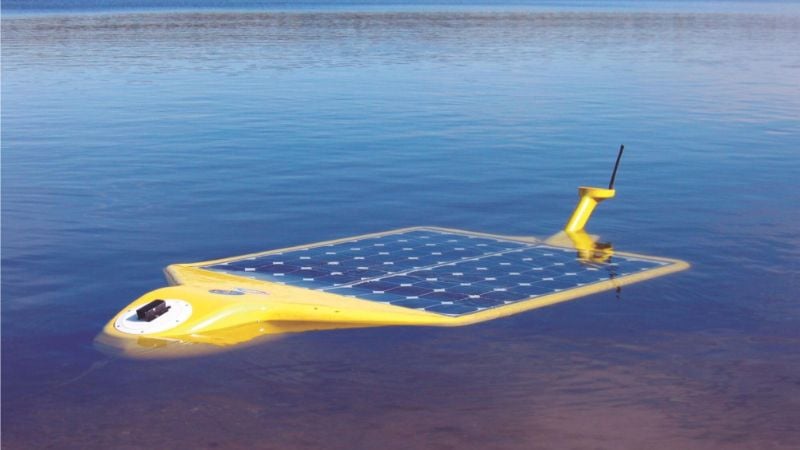
Autonomous underwater vehicle powered by solar. Image used courtesy of National Science Foundation
The Biofouling Barrier for Underwater Solar Panel Performance
Underwater solar panels are promising in capturing the sun's power in marine environments, but they face significant challenges with biofouling, maintenance, and transparency preservation.
Biofouling is common for any equipment that operates in water, such as wastewater treatment plant machinery. Submerged equipment applications like underwater solar panels are subject to unusually tenacious accumulation of organisms like algae, barnacles, and bacteria. Static platforms are at unusually high risk for fouling that can compromise functionality, and even UUVs and AUVs are prone to accumulation despite the friction generated by their mobility. Biofouling reduces light penetration and increases surface roughness, decreasing the overall energy output and making submerged solar panels suboptimal energy solutions.
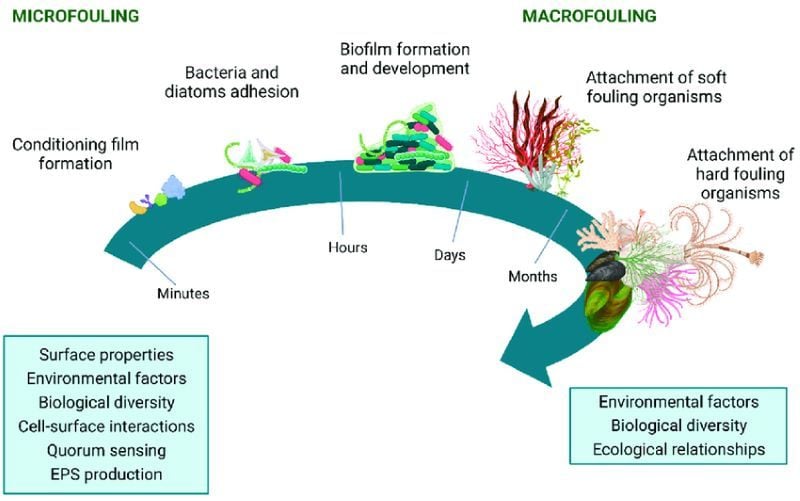
Biofouling process stages in marine environments. Image used courtesy of Romeu and Mergulhão
Underwater solar panel maintenance is also problematic. Panels deployed in marine environments require frequent cleaning and mechanical intervention to remove biofouling, increasing operational costs. Even when maintenance is consistently performed, underwater environments can accelerate panel material corrosion and mechanical wear. Advanced coatings like antifouling materials have been developed, but these tend to degrade over time, making long-term deployment challenging.
Another key challenge is maintaining transparency, as water absorbs sunlight at varying wavelengths, and sediment or organic matter can cloud the water, further reducing efficiency. Deploying underwater solar panels is already limited to very shallow depths. More than 50% of visible light energy is absorbed within the first 10 meters of water depth. Even minimal biofouling can compound the struggle to successfully capture the sun's power when even shallow ocean depths blunt it.
The Efficacy of Nano-Sized Seawater Soluble Pigments
Technical University of Denmark scientists have developed a coating to prevent biofouling while preserving transparency so the solar panels can readily absorb the light.
The formula’s unique component is nano-sized seawater-soluble pigments in a fast-polishing binder. The pigment size is the secret to the coating’s efficacy. The nano pigments have higher particle density than larger-sized pigments, so the polishing effect happens faster.
In this context, the polishing effect refers to the coating’s gradual erosion or breakdown when exposed to seawater, a controlled and beneficial process. The coating incorporates nano-sized seawater-soluble pigments and a biocide within a fast-polishing binder system. When the coating comes into contact with seawater, the pigments dissolve, creating a porous layer that allows seawater to diffuse into the coating. This triggers the release of biocidal compounds, which help prevent biofouling. The researchers ran a 12-week trial and found that the SA-R binder exhibited the most effective fouling protection.
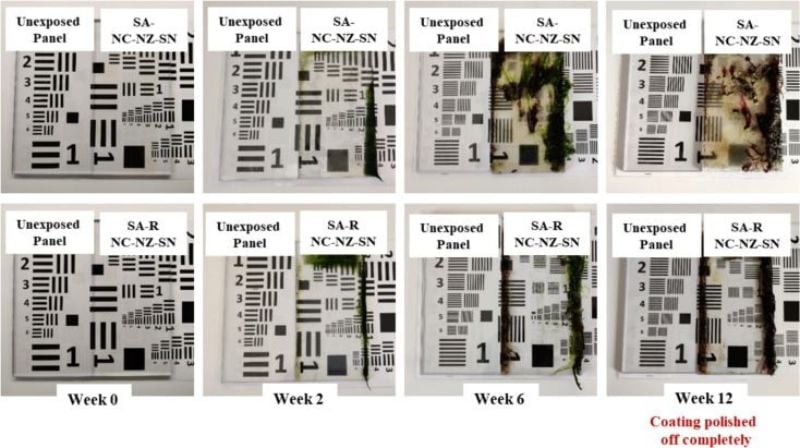
Comparing fouling results across the 12-week testing period. Image used courtesy of Rajagopalan and Kiil
As the seawater continues to interact with the binder, it causes hydrolysis, a chemical reaction that slowly erodes the material. This erosion is key to the self-polishing mechanism. As the coating’s top layer wears away, it exposes fresh layers underneath, which contain more biocidal compounds and pigments. This constant renewal ensures the coating maintains its antifouling properties over time without requiring mechanical cleaning.
After initial testing in Denmark, researchers ran additional trials in Florida. They found that the solar panels could maintain nearly 100% functionality for 13 weeks.
Implications
The potential impact could be broader than optimizing UUV and AUV performance. If underwater solar panels can stay fouling-free, we might see a new race to install solar panels in marine environments-—and they won’t even need mechanical cleaning.