Facebook
 Google
 GitHub
 Linkedin
An Energy Drink? Turning Coffee Waste into Sustainable Fuel
Korean researchers developed a 90-second Flame Plasma Pyrolysis method to convert wet coffee grounds into sustainable biochar fuel.
Meeting the surging global energy demand is prompting scientists to consider unconventional solutions that are efficient and sustainable. Researchers from the Korea Institute of Geoscience and Mineral Resources (KIGAM) are turning to trash. They found a way to shift garbage from an environmental burden to a reliable, renewable power source.
The KIGAM team transformed everyday waste—coffee grounds—into high-value fuel by developing Flame Plasma Pyrolysis (FPP) technology to convert wet spent grounds into biochar in just 90 seconds, without any need for drying or oil removal processes.
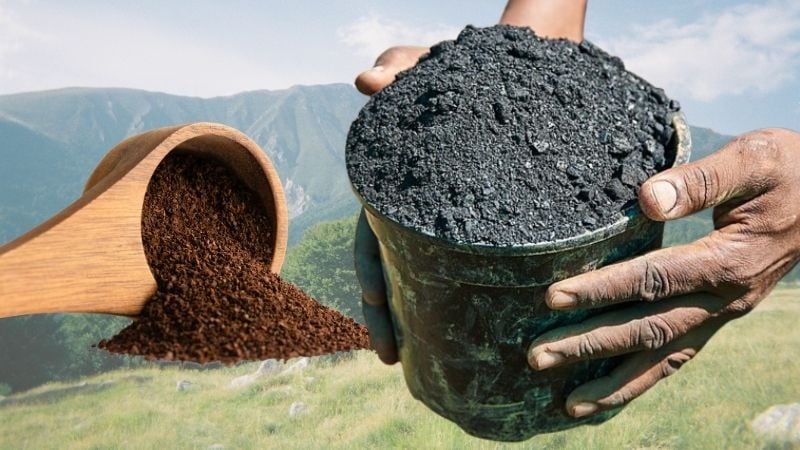
Can coffee grounds produce reliable biochar? Adapted from image used courtesy of Wikimedia Commons
Reducing Waste
Over 10 million tons of spent coffee grounds are generated each year by consumers around the world. The majority of this waste ends up in landfills or is incinerated, producing greenhouse gases. The waste can also leach out and pollute the soil.
Coffee grounds have potential energy because of their high carbon content and calorific value. However, because used grounds have a high moisture content, they have been difficult to process into secondary products, as they typically require expensive, energy-intensive pre-drying processes.
The techniques currently used, torrefaction and conventional pyrolysis, require long residence times and energy-intensive drying. Fast pyrolysis requires dry biomass feedstock, so it is not feasible, and hydrothermal carbonization needs residence times up to 6 hours under extremely high pressures, which makes the conversion both complex and expensive. Instead, the KIGAM team sought a more suitable approach for high-moisture (55-60%) biomass.
Flame Pyrolysis Technology Behind the Conversion
The research team’s FPP directly treated the coffee biomass, with a 55% moisture content, under atmospheric-pressure plasma conditions. The plasma technology combined high energy density with rapid kinetics to convert the coffee biomass into solid fuel.
The FPP process generated plasma flame jets around 800–900°C (1,472–1,652°F) by combusting liquefied petroleum gas in compressed air. Unlike other pyrolysis techniques that have been tried in the past, no pre-drying stage is needed, and the coffee grounds can be processed in their natural wet state.
The high thermal energy and intense heat flux generated during the combustion process vaporize any moisture trapped inside the particles of the coffee grounds. This creates a pressure buildup that triggers microscopic explosions, which promotes carbonization and generates a highly porous solid carbon material with a peak specific surface area of 115.4 m2/g.
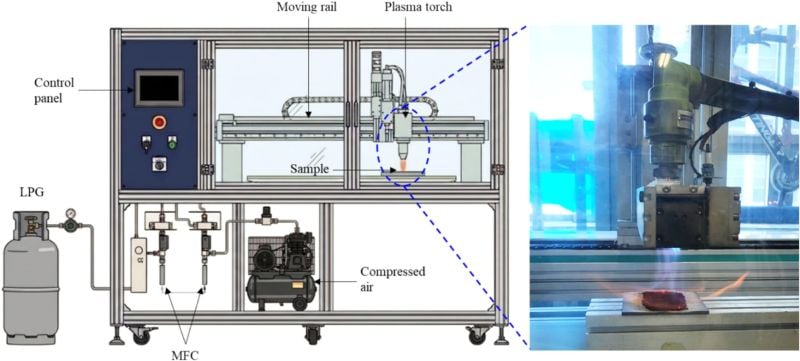
The researchers used an atmospheric-pressure flame plasma system. Image used courtesy of Park et al.
In most other methods, moisture is a barrier, but in FPP, it becomes a steam-activation agent that increases the conversion reaction rate. While the process has been trialed on wet coffee grounds, it could be a more universal method as a sustainable and energy-efficient pathway (combustion-generated plasma is less energy-intensive than electricity-intensive plasma) for converting high-moisture organic waste.
FFP is relatively inexpensive and doesn’t involve some of the complex and technical bottlenecks of other techniques. It is also much faster, taking only 90 seconds for conversion. In comparison, HTC will typically take 1-6 hours, making FPP up to 240 times faster. The FPP process also has a 20-fold reduction in treatment time—30 minutes on average—compared to torrefaction, which is around 30 minutes on average.
The Biochar Fuel
The researchers found that the 90-second conversion of coffee ground biomass into carbon biochar resulted in a mass reduction of 83.3% (including moisture removal).
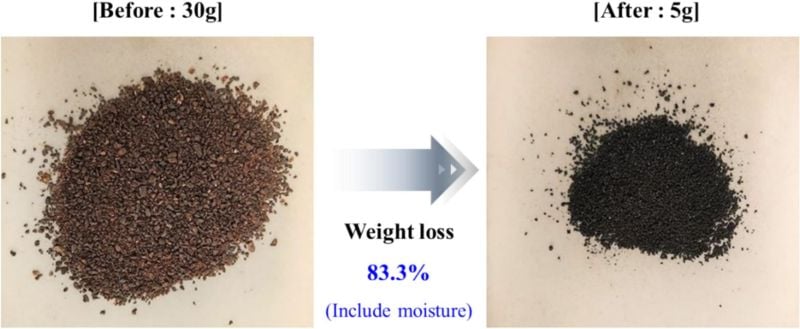
Thirty-gram samples of wet biomass turned into 5 g of biochar. Image used courtesy of Park et al.
The biochar exhibited a heating value of 29.0 MJ/kg. This is around 33% higher than the original coffee grounds—which have a heating value of 21.8 MJ/kg—and is comparable to anthracite coal.
The FPP conversion to biochar induced several other performance improvements, including:
- Increasing the fixed carbon content from 15.6% to 46.2%, an almost threefold increase
- Removal of all sulfur compounds from the material, preventing the release of sulfur oxide emissions during combustion
- An increase in the specific area of the material from 1.5 m2/g to 115.4 m2/g, making it suitable as an activated carbon precursor or adsorption material
- Minimal release of secondary pollutants such as smoke and tar during the conversion process
The Potential for Waste-to-Energy Systems
While this study focused on converting coffee waste, the conversion process could apply to various other high-moisture organic wastes, such as food waste, sewage sludge, and agricultural residues. The compact process design and ultrafast processing time make it highly suited to decentralized, on-site waste-to-energy facilities, since transportation and drying costs can limit the amount of valuable material these sites can recover.