Facebook
 Google
 GitHub
 Linkedin
Hydrogen Buzz: Soda Cans, Saltwater, and Coffee
MIT engineers have introduced a fast and sustainable approach to hydrogen fuel production using aluminum, saltwater, and coffee grounds.
Hydrogen fuel is touted as a promising alternative to fossil fuels. It has high energy density and produces no harmful emissions. Unfortunately, traditional hydrogen production methods often rely on fossil fuels or require significant energy input, directly conflicting with their value proposition as a sustainable energy source. For this reason, scientists have been exploring various approaches to generating hydrogen more efficiently.
Watch this overview of hydrogen uses and research. Video used courtesy of National Renewable Energy Laboratory
Scientists at the Massachusetts Institute of Technology (MIT) have created a novel method to produce hydrogen fuel using common materials in an unexpected combination. The approach could reduce environmental worries and provide lower-cost hydrogen.
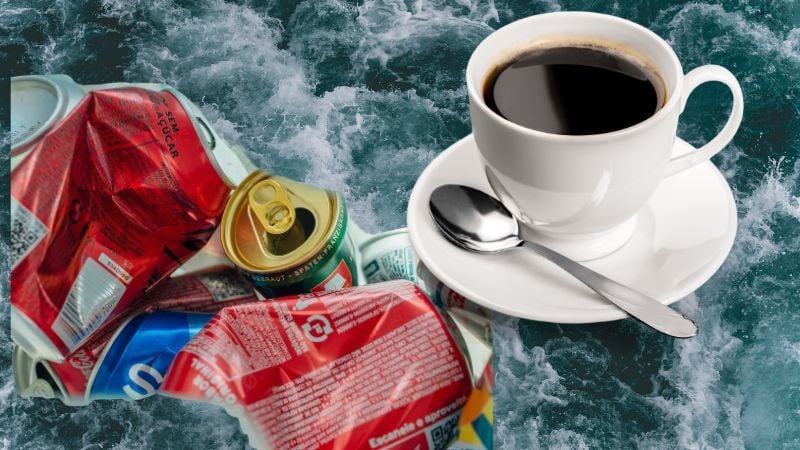
Can discarded soda cans, caffeine, and seawater make hydrogen? Image adapted from images used courtesy of Canva and Unsplash
Hydrogen’s Impact
Hydrogen exists only in compounds like water and organic materials despite being the Earth’s most abundant element.
It is often portrayed as an environmentally clean fuel because water is the only byproduct of its combustion. In the transportation sector, hydrogen fuel cell vehicles can replace conventional gasoline and diesel engines to eliminate tailpipe emissions. In industrial applications, hydrogen can replace fossil fuels in high-temperature processes to reduce carbon emissions from traditionally energy-intensive industries.
However, the environmental impact of hydrogen depends on how it is generated.

The applications of hydrogen and its cycle. Image courtesy of Osman et al.
Most hydrogen production results from steam reforming natural gas, a fossil fuel, which releases carbon dioxide as a by-product. This CO2 contributes to global warming and climate change, meaning hydrogen from fossil fuels has a similar environmental impact as burning fossil fuels directly. While electrolysis using renewable energy offers a clean alternative, it is more expensive and less efficient at scale.
Hydrogen's role in achieving a net-zero future has become increasingly important, driving research and investment in more efficient methods.
MIT's Seawater-Powered Hydrogen Reactor
The MIT engineers developed a method to produce hydrogen fuel using aluminum from recycled soda cans, seawater, and caffeine.
The process involves dropping pretreated, pebble-sized aluminum pellets into filtered seawater. Aluminum can produce hydrogen with water, but only when pure. Contact with air forms an oxide layer blocking the reaction, so soda cans don’t normally release hydrogen in water. In the team’s method, the aluminum is pretreated with a rare-metal alloy of gallium and indium, which acts as an "activator" by removing the oxide layer that typically prevents aluminum from reacting with water. When the pretreated aluminum pellets are introduced to seawater, they naturally produce hydrogen gas.
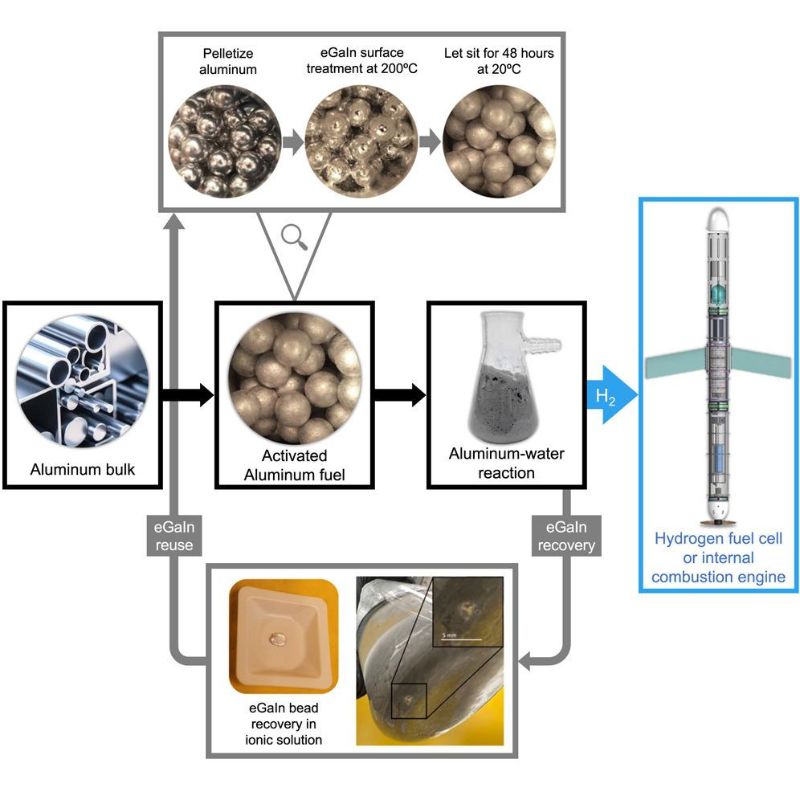
The overview of the complete process. Image courtesy of Kombargi et al.
In early experiments, researchers discovered adding coffee grounds accelerated the reaction. They switched to a low concentration of imidazole, an active ingredient in caffeine. Imidazole reduces the reaction time from two hours to just five minutes for the same hydrogen yield.
The process is designed to be sustainable, as the salt ions in seawater attract and recover the gallium-indium alloy for reuse. One pretreated aluminum pellet can produce 400 milliliters of hydrogen in five minutes, with 1 gram of pellets generating 1.3 liters of hydrogen in the same timeframe. The researchers are also developing a small reactor for maritime applications, which could hold about 40 pounds of aluminum pellets and power a small underwater glider for approximately 30 days.
Hydrogen Fuel Era
Overall, MIT’s system offers several advantages over traditional hydrogen fuel methods, including on-demand production and eliminating the need to carry pressurized hydrogen tanks. Readily available seawater and recycled aluminum make it a potentially cost-effective and environmentally friendly solution.
While initially targeted at marine and underwater vehicles, the researchers envision future applications in trucks, trains, and possibly aircraft, with potential modifications to extract water from ambient humidity for hydrogen production in non-maritime environments.
Related Content