Facebook
 Google
 GitHub
 Linkedin
Turning the Tide: 2 Projects Advancing Tidal Energy Tech
Two new tidal energy projects in Japan and the Faroe Islands represent significant upgrades in tidal generation technology.
Grid-connected solar and wind energy are naturally variable in production and need support from energy storage systems and smart grid technology to meet continuous demand. In contrast, tidal energy is a constant, predictable renewable energy source. Tidal forces are more powerful than wind and steadier than solar. So, why have tidal power developments lagged behind?
Watch the delivery and installation of a tidal kite. Video used courtesy of Minesto
Several tidal energy systems are operating worldwide, but significant challenges, including costs and technology, have slowed their adoption. That could be changing. Two new tidal projects represent substantial advancements in technology and energy generation. In Japan, the country’s first grid-connected tidal system began operations and will generate as much as 1.1. MW of energy. Across the world in Denmark’s Faroe Islands, a tidal kite will provide the islands with 100% renewable energy by 2030.
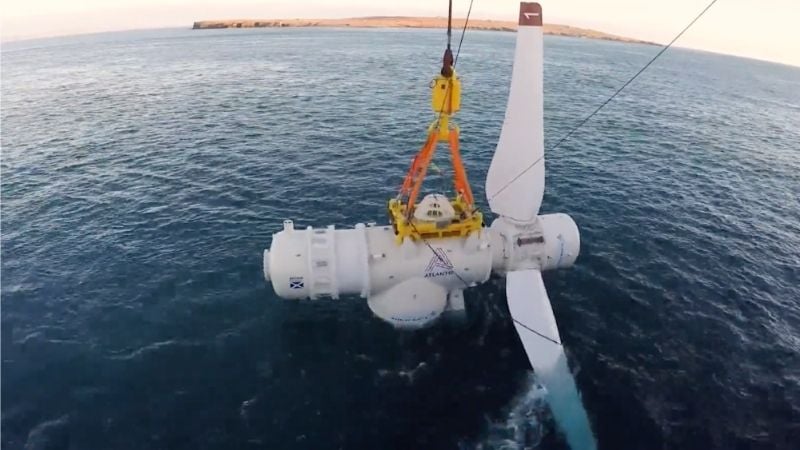
Tidal turbine. Image used courtesy of Proteus Marine Renewables
Japan’s Tidal Turbine
In Japan, a tidal turbine will create its first megawatt-scale, grid-connected tidal system. In February, Proteus Marine Renewables installed its AR1100 tidal turbine in the turbulent tidal whirlpools of the Naru Strait. The system will generate 1.1 MW of energy in the Goto Islands west of Nagasaki.
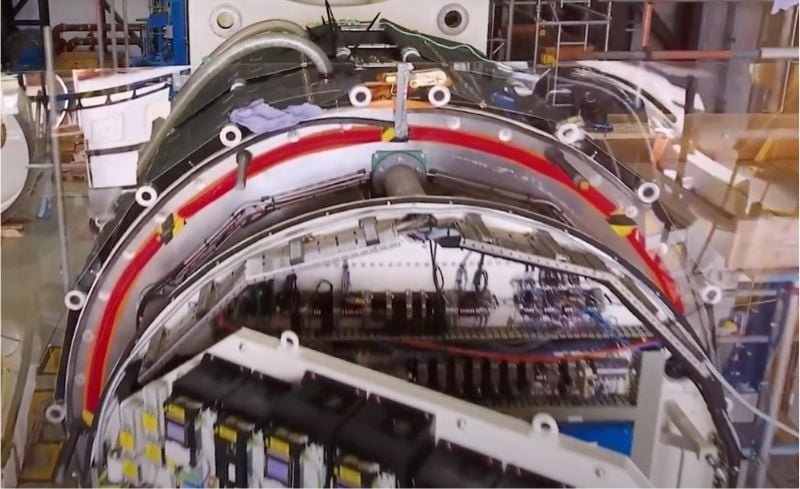
Electronics inside the tidal turbine. Image used courtesy of Proteus Marine Renewables
The AR1100 turbine uses a horizontal-axis rotor with three blades. An electromechanical pitch system within the turbine hub controls the blade angles to optimize energy harvesting. An electrically actuated, hydraulic locking yaw mechanism can rotate the nacelle so the turbine faces the incoming tide. A drivetrain transmits the mechanical power from the rotor to a permanent magnet generator.
The AR1100 improves on the AR500 pilot, which was installed in the Naru Strait in 2021. It generated 500 kW and maintained 97% turbine availability. Proteus worked with Kyuden Mirai Energy to increase capacity to 1.1 MW.
Faroe Islands’ Tidal Kite
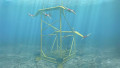
In the Faroe Islands, Minesto’s first 1.2 MW tidal kite, the Dragon 12, was added to the Hetsfjord Dragon Farm project in February. The subsea kite is 12 meters wide and weighs 28 tons. It’s anchored to the seabed with a tether, where the tidal flow moves it in a figure-eight pattern.
The Dragon 12 is 10 times the size and performance of the existing 100 kW Dragon 4, which was installed in 2023.
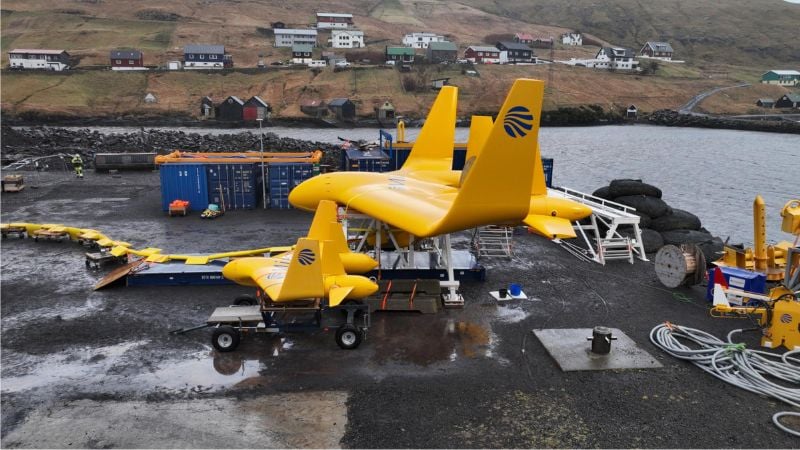
Dragon 12 (right) compared to the Dragon 4. Image used courtesy of Minesto
An array of six Dragon 12 kites, providing 10 MW of capacity, will comprise the project’s first phase. The Hetsfjord Farm’s full build-out will use 24 Dragon 12 kites, providing the Faroe Islands with 100% renewable energy by 2030.
Types of Tidal Power Generators
Several tidal power systems operate worldwide. The oldest, the Rance Tidal Power Station in France, opened in 1966 as the world’s first and generates 240 MW of electricity. The largest, the Sihwa Lake Tidal Power Station in South Korea, produces 254 MW of electricity. Other plants are located in Canada, China, and Russia. Both use the tidal barrage method of harvesting tidal power.
A tidal barrage is one of three prevalent technologies in tidal energy. It resembles a dam and is usually constructed across a river, estuary, or narrow bay. Turbines within the barrage generate electricity during incoming and outgoing tides.
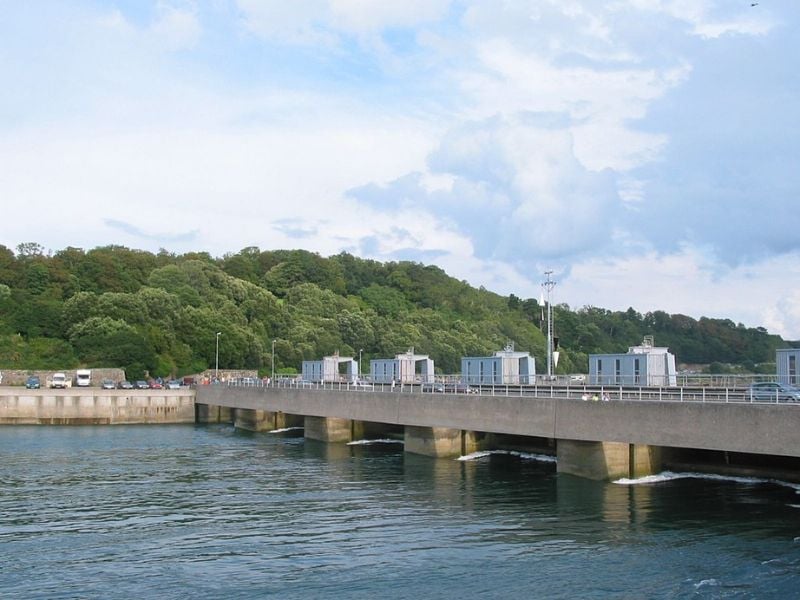
Tidal barrage on the Rance River in France. Image used courtesy of Wikimedia Commons
Tidal turbines are more flexible, as they can be installed anywhere tidal forces are strong. They resemble small wind turbines and operate in much the same way: the tides turn a rotor to generate electricity. They are usually used in an array of several turbines.
Tidal kites float within the water but are tethered to a fixed point, often the seabed. They use a hydrodynamic wing, allowing them to “fly” through the water. An attached turbine generates the electricity. The kite’s motion increases the water speed, allowing use in locations with slower currents.
A fourth technology, tidal lagoons, is in experimental stages. They work similarly to barrages but use retaining walls to retain some of the incoming tidal water to release during outgoing tides, which increases energy production.