Facebook
 Google
 GitHub
 Linkedin
MIT, GE Vernova Team Up to Expand Sustainable Energy
The partnership will merge MIT’s world-class education and research with GE’s industry experience and facilities.
Both industry and academia are concerned about sustainability in energy development. Academic researchers can find it hard to enact real change when confined to an abstract academic world. In industry, it can be difficult to incite real change and innovation without PhD-level researchers and talent.
To merge these worlds, MIT and GE Vernova have launched a five-year, $50 million alliance to jointly develop scalable, sustainable energy systems. The partnership will bring together students, faculty, and industry professionals to focus on renewable energy education, research, and applications.

Studying offshore wind turbine airflow. Image used courtesy of MIT/Liew et al.
MIT and GE’s Collaboration
The MIT-GE Vernova Energy and Climate Alliance targets three primary engineering domains: electrification, decarbonization, and renewables acceleration. Within these groups, the initiative will fund approximately 12 research projects annually focusing on architecting clean energy systems to compete with carbon-intensive baselines. For example, researchers will address challenges such as long-duration energy storage, distributed system resilience, and integrating advanced nuclear, solar, wind, and hydrogen power within grid-scale infrastructures.
GE Vernova will contribute direct research sponsorships, eight endowed fellowships, and ten student internships designed to integrate academic talent with the company’s global engineering operations. These initiatives will run through MIT’s School of Engineering, with a joint steering committee managing project selection.
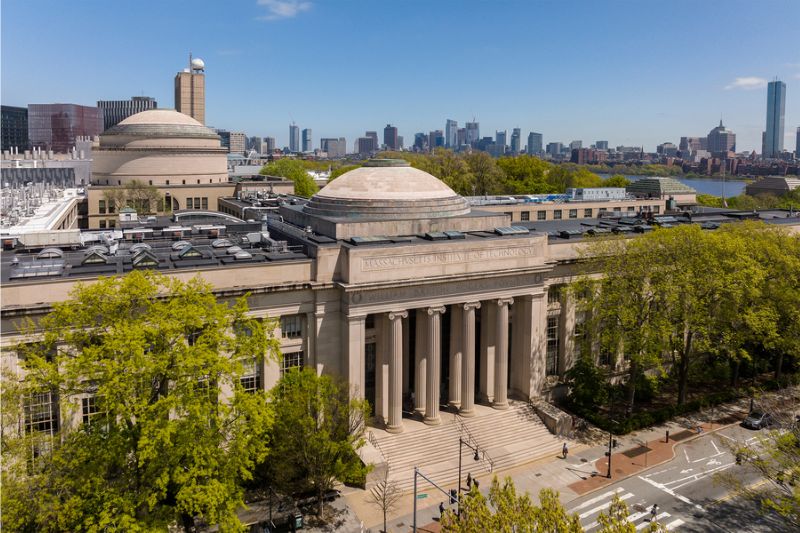
An MIT educational building. Image used courtesy of MIT
Beyond funding, GE Vernova will join MIT consortia and membership programs and provide experiential education through MIT’s NEET program. The goal is for students to gain exposure to GE Vernova’s factory and laboratory environments to contextualize their research within large-scale industrial frameworks. Additional projects under the alliance will fall within MIT’s Human Insight Collaborative, which studies how energy technologies and cybersecurity systems impact human behavior and societal structures.
MIT’s Climate Project
On a broader level, MIT is committed to sustainability research and development via The Climate Project.
Rather than following traditional academic paths, MIT will organize its resources into the pillars of Climate Missions, Climate Frontier Projects, and Climate HQ. Each pillar integrates technical, organizational, and translational capabilities to accelerate progress on complex climate challenges and facilitate faster deployment of impactful solutions.
The Climate Missions are a series of missions that target a domain central to global climate outcomes, such as decarbonizing energy and industry, restoring atmospheric balance, or advancing resilient urban infrastructure. These missions operate as cross-functional engineering ecosystems tasked with identifying bottlenecks, mapping global progress, and selecting strategic projects with potential for systemic impact. Projects are chosen based on their ability to address unresolved technical constraints or their potential to open new scalable pathways.
Climate Frontier Projects focus on “MIT-hard” problems that require advanced systems thinking and the integration of research, engineering, and policy. These projects intend to define clear milestones, partner with end-users, and prioritize scalability and field validation. Generally, the projects may span component-level prototyping, large-scale data collection, or deployment-ready system architecture design.
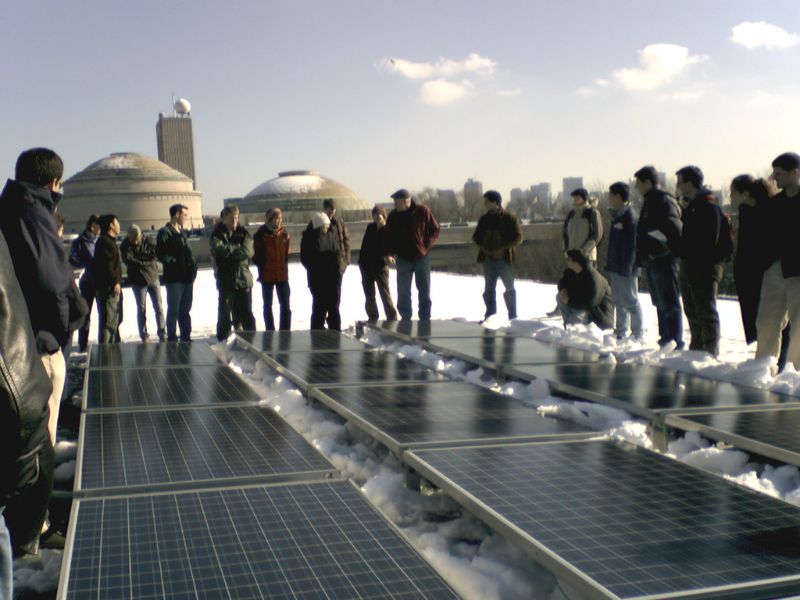
Rooftop solar on an MIT building. Image used courtesy of MIT
Finally, Climate HQ seeks to coordinate education, internal infrastructure, and external communication via student fellowships, faculty hiring, and the MIT Climate Corps. It also facilitates public outreach through platforms like MIT Technology Review and online learning initiatives. The HQ acts as a command center and advocates for a permanent physical space dedicated to climate collaboration.
Toward Sustainability
Ultimately, the MIT-GE alliance aligns MIT’s algorithmic, materials, and systems-level research capabilities with GE Vernova’s execution pipeline for manufacturing and deployment of low-carbon grid infrastructure. In that sense, the partnership complements MIT’s broader Climate Project by channeling industrial scale-up capabilities into high-impact research.