Facebook
 Google
 GitHub
 Linkedin
Have You Heard About IoT-Enabled Electric Vehicles?
Electric vehicles become efficient power sources when equipped with Internet of Things devices.
Major advancements in high-power battery technologies and faster charging infrastructure have accelerated electric vehicle use and development. Charging infrastructure, both public and private, has advanced locally and nationally.
EVs have also intersected with the Internet of Things (IoT), primarily through vehicle-to-grid (V2G) approaches. The IoT facilitates better interaction between EVs and the power grid, primarily through more efficient load management and demand response. Specifically, the IoT helps to optimize energy consumption and improve grid demand through real-time monitoring that provides a better control over charging processes.
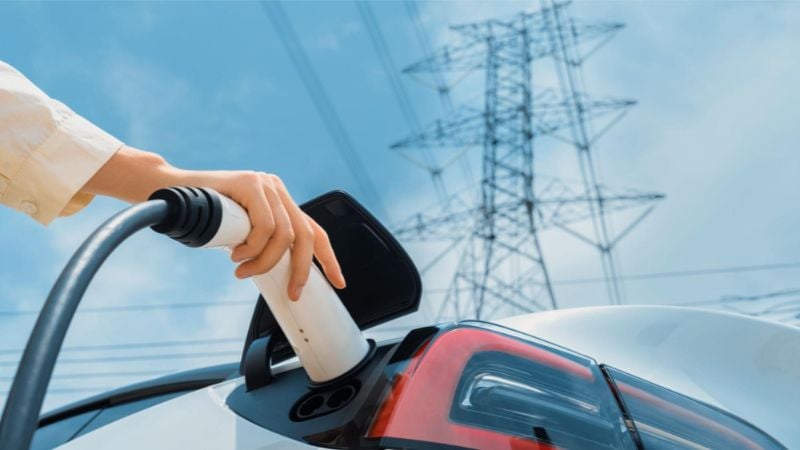
V2G charging connects an EV to the power grid. Image used courtesy of Adobe Stock
Connecting EVs to the Grid
EVs cause intermittent energy drains on the grid. Unlike many energy management methods relying on peak loads, EVs cause non-coincident peaks in various locations as they charge at different charging stations. EVs’ unique and non-uniform charging patterns can cause large and localized changes in energy demand. When too many EVs draw power simultaneously, unexpected demand could destabilize local grids.
Integrating IoT with EVs leads to enhanced load management and demand response capabilities. The IoT can facilitate a better interaction between the EVs and the grid to better manage these large and localized energy spikes.
IoT-enabled smart grids can be used for the real-time monitoring and control of EV charging processes to optimize the energy output from the grid based on local demand and availability. This approach reduces grid load during peak demand periods. It also assists in peak shaving and improves the grid’s overall stability when charging EVs. The IoT is essentially helping to better stabilize the grid in the wake of rapid EV growth to ensure that EVs still get charged up, but the impacts on the grid are minimal.
V2G Is Key for IoT
V2G enables EVs to interact with the power grid bidirectionally—that is, they can take charge from the grid and supply it back to the grid from their batteries. The IoT can control this complex interaction based on energy supply and demand. For EVs that are part of V2G networks, energy is transferred from EVs during peak demand periods and emergencies, and the EV is charged during off-peak times. The IoT provides much better communication and control to manage this process.
V2G initiatives help to stabilize the grid and enable better energy management. Still, they also allow EV owners to financially benefit from additional revenue streams when the energy is supplied to the grid.
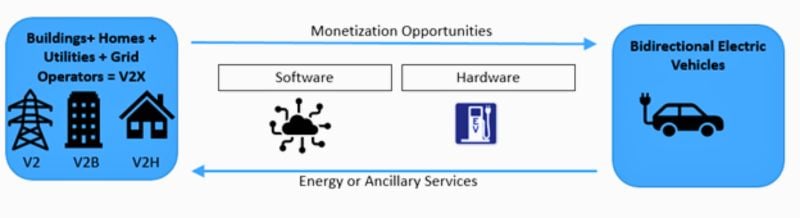
V2G charging benefits the grid and EV owners. Image used courtesy of the Department of Energy
Integrating the IoT into V2G provides much greater control over the EV’s battery management system by delivering automated battery management capabilities and real-time updates on the local energy demands.
Cybersecurity Still a Potential Risk
Like any digitally connected network, EVs and V2G technologies are susceptible to cyberattacks because they provide more potential entry points for hackers without longstanding safety protocols. Data transmitted between the EV and the grid are susceptible to hacking. Therefore, V2G systems using IoT must be implemented with robust cybersecurity measures. Otherwise, hackers could access the EV owner’s data and access a gateway into the wider digital grid network.
Improving the protection of V2G systems requires resilient control strategies. One example is using distributed load frequency control to combat issues in the IoT network, such as cyberattacks and sensor faults. Fuzzy load frequency is another control method to mitigate the impact of cross-layer denial-of-service attacks on EVs and V2G systems. Another example is the resilient distributed frequency estimation strategy that enhances load frequency regulation during cyberattacks.
The Future of IoT-Enabled EVs
Still, improvements must be made, such as ensuring interoperability and standardizing communication protocols between EVs and IoT devices. To protect the data transferred between EVs and the grid, more robust cybersecurity measures are needed. Finally, there is potential for the future integration of artificial intelligence alongside the IoT for EV energy management to improve the decision-making process further and potentially provide predictive maintenance capabilities.