Facebook
 Google
 GitHub
 Linkedin
Why Is Your Product’s Carbon Footprint Important?
Knowing your product's carbon footprint is important. We caught up with Infineon to explain why.
This article is published by EEPower as part of an exclusive digital content partnership with Bodo’s Power Systems.
An environmentally conscious semiconductor manufacturer must provide more than just products to enable greener solutions. We spoke with Dr. Peter Wawer, Division President of Green Industrial Power (GIP) at Infineon, to understand why the Product Carbon Footprint (PCF) is highly important and how design engineers can benefit from knowing the PCF.
Image used courtesy of Adobe Stock
What does Product Carbon Footprint exactly mean?
Peter Wawer, GIP Division President: Infineon’s Product Carbon Footprint sets a new level of transparency, enabling customers to increase transparency on their carbon footprint and supply chain. By revealing our PCF metrics, we’re extending the visibility of our CO2 emissions reduction efforts, providing transparency from our corporate actions down to the individual product level.

Dr. Peter Wawer, GIP Division President at Infineon. Image used courtesy of Bodo’s Power Systems [PDF]
Why does Infineon provide Product Carbon Footprint information about its products?
Wawer: As a leader in sustainability, we are driving the vision of a net-zero society and empowering our customers for their product carbon footprint calculations and decarbonization efforts. We are leading in carbon transparency to reduce carbon emissions even more effectively.
This is another step in Infineon’s journey to drive decarbonization and digitalization with customers and partners. Moreover, the effort supports informed decision-making for customers to leverage additional potential for reducing emissions along the value chain and advancing customers’ own sustainability goals. With the PCF, customers gain deeper insights into their carbon footprint, fostering more effective strategies for CO2 emissions reduction.
For which products do you provide PCF information?
Wawer: The Product Carbon Footprint covers scope 1 and 2 emissions and scope three emissions from suppliers and manufacturing partners, all the way to the customer’s gate. Detailed information for 17 representative products from Infineon’s wide portfolio is available at www.infineon.com/pcf. Furthermore, we provide PCF data for about half of our portfolio on customer request, with a clear commitment to addressing the whole product portfolio as soon as possible.
What is the methodology behind the Product Carbon Footprint?
Wawer: No industry standard for PCF calculations is available yet. That’s why we have developed our robust methodology to allocate the carbon footprint. It is based on international standards like the Greenhouse Gas Protocol and ISO 14067 to provide a most accurate and comparable picture, including all relevant emissions from raw material supply, own production, energy, and transportation. The Product Carbon Footprint covers scope 1 and 2 emissions and scope three emissions from suppliers and manufacturing partners, all the way to the customer’s gate.
Does Infineon also offer data for a full Life Cycle Assessment?
Wawer: Infineon reports the PCF “from cradle to gate,” meaning from raw material extraction, manufacturing, and internal transportation to the customer’s gate, as this is the part of the product lifecycle on which we have the most accurate data. The PCF data Infineon provides customers includes detailed information on the manufacturing process, transport, and material level. Influence factors include weight, chip size, number of layers, and material used. So, the PCF covers scope one and scope two emissions (direct emissions), as well as scope three upstream emissions from our suppliers and manufacturing partners. The use and recycling phase is harder to determine for Infineon as both depend on the specific use case of the end product utilizing our components, the recycling path, etc., and we do not have clear visibility into this part of the lifecycle. In other words, we lack reliable data to calculate a credible full Life Cycle Assessment (LCA).
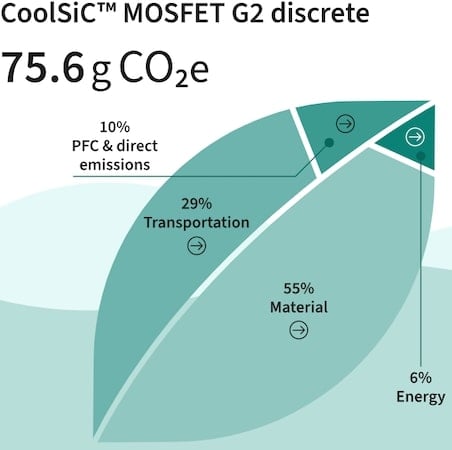
A discrete component of Infineon’s CoolSiC MOSFETs Generation 2 family produces 75.6 g of CO2 emissions reflecting transportation, direct emissions, material, and energy consumed to manufacture the device. Image used courtesy of Bodo’s Power Systems [PDF]
What is Infineon’s strategy in terms of carbon neutrality?
Wawer: Our climate strategy is founded on two pillars: continuous reduction of its emissions and the active contribution Infineon and its products and solutions make to climate protection thanks to better resource management. Energy efficiency, intelligent PFC abatement concepts, and reducing CO2 emissions have long been core elements of Infineon’s business model.
The PCF advancement propels our decarbonization efforts through adequate solutions and compliments our earlier pledge to achieve carbon neutrality by 2030 for direct emissions (scopes 1 and 2) and our commitment to set a science-based target encompassing supply chain emissions (scope 3).
Overall, Infineon’s products deliver a 34 times ecological net benefit, totaling more than 110 million tons of CO2 equivalents. In other words, our products' emission savings during their lifetime are estimated to be 34 times higher than the emissions needed for their production.
How does carbon neutrality benefit design engineers, the products they work on, and their companies?
Wawer: By revealing our PCF metrics, we’re extending the visibility of our CO2 emissions reduction efforts, demonstrating transparency from our corporate actions down to the individual product level. This enables our customers to gain deeper insights into their carbon footprint, fostering more effective strategies for their own CO2 emissions reduction and enabling conscious and educated purchasing decisions along the value chain.
Achieving carbon neutrality is not an easy task. Where should companies get started, and how should they proceed?
Wawer: Making life greener should be part of every company’s mission; it is paramount for all industries. We want to actively contribute to global CO2 reduction and the implementation of the targets set out in the Paris Climate Agreement.
Infineon’s approach is as follows: Avoiding direct emissions and further reducing energy consumption. Purchasing green electricity with guarantees of origin for unavoidable emissions. Compensate the smallest part with certificates that combine development support and CO2 reduction.
What role do power electronics play in achieving carbon neutrality?
Wawer: Continuous improvement of power semiconductors and systems helps reduce losses and, therefore, improves the system's overall efficiency. In other words, less electrical energy is turned into heat and wasted. To give you an example, Infineon helps to make solar inverters smaller, lighter, and more powerful, getting more out of photovoltaic with advanced semiconductors based on materials like silicon carbide (SiC). Our devices help to convert the DC produced by solar panels into AC that can be fed into a public grid or used in industrial, consumer, and mobility applications—with the highest efficiency and fewer conversion losses, allowing for higher currents and reduced heat loss, enabling higher power density and smaller form factors for inverters.
This article originally appeared in Bodo’s Power Systems [PDF] magazine.