Facebook
 Google
 GitHub
 Linkedin
SiC Power Stack Evaluation Kit: Accelerate Inverter Development
This article examines an evaluation kit to shorten time-to-market for SiC inverters.
This article is published by EEPower as part of an exclusive digital content partnership with Bodo’s Power Systems.
Time is money: this aphorism also applies to the electrical engineering and electronics industry. Many companies strive to optimize their development cycles in order to lower their production costs. However, that is easier said than done, in view of the numerous steps that make up a development process for power electronic components.
To facilitate the work of inverter manufacturers, electronic design engineers, and system integrators, Mersen has developed a SiC Power Stack evaluation kit. The comprehensive offer is suitable for use in the production of DC high-power charging stations as well as for planning DC smart grids and microgrids and any industrial applications. The kit allows developers to easily test the various components of their planned inverter and adapt them for optimal compatibility with the exact requirements of the application. Afterward, Mersen can adapt, tweak, modify, and manufacture the customized power stacks on request.
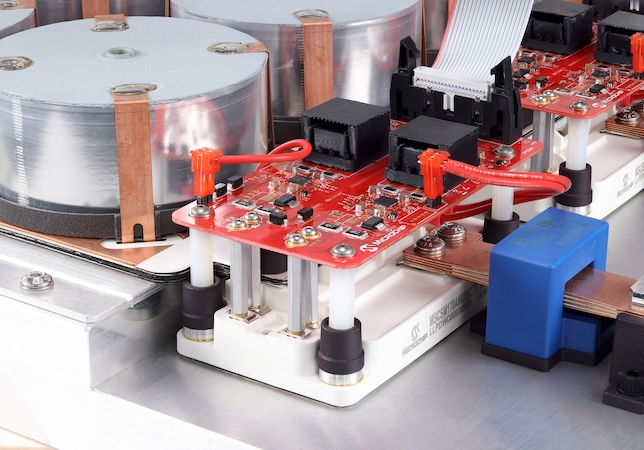
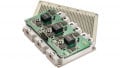
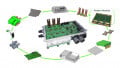
Figure 1. The power stack evaluation kits are equipped with the latest generation selected components. Image used courtesy of Bodo’s Power Systems [PDF] and Mersen
Components for High Performance
The standard evaluation kit is designed as a bi-directional DCAC 3-phase topology delivering up to 150 kVA. It includes three Microchip 1200 V SiC MOSFET half-bridge modules, digital gate drivers, current sensors, a DC link capacitor, and a low-L DC link bus bar. Thermal management of the evaluation kit is achieved by water cooling.
Regarding the components we use in our custom-designed stacks, Mersen is not limited to a particular brand. The suppliers are selected based on customer preferences and technical requirements.
Inverter design engineers require cost-optimized power stacks with increased power density (kW/liter) and low conversion losses, as well as a compact design for optimal application integration.
Mersen has decades of experience in the development of power electronic components for power stacks, such as bus bars, capacitors, heat sinks, and electric fuses. The development of an evaluation kit was the next logical step.

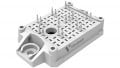
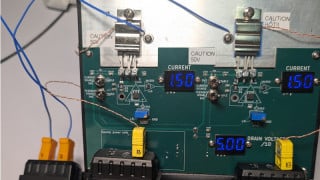
Figure 2. The core of the 150 kVA evaluation kit includes three 1200 V SiC MOSFET half-bridge modules. Image used courtesy of Bodo’s Power Systems [PDF] and Mersen
Simultaneous Design of Multiple Components
Mersen has offered the evaluation kit for inverters since 2022. It is designed for uncomplicated and cost-effective development of application-specific power converters. Bus bars, capacitors, gate drivers, and SiC power modules can be selected and designed in a single, cost-effective step.
“The simultaneous development of several critical components speeds up the time-to-market process for inverters considerably,” says Dr. Philippe Roussel, Vice President of the Power Stack Product Line at Mersen. "This is the main advantage of the evaluation kit. Mersen’s engineers support users on request in adapting and optimizing the design of their power stack – with respect to the form factor, power, and topology, for example. The key component suppliers can also be involved in the development process, contributing their expertise to the optimization of the inverters."
Total Customization Approach
No pre-defined technical bricks. Mersen is agnostic towards your choice of circuit topology (3-level, NPC, bi-directional, DC-DC boost/buck, back-to-back, etc.), semiconductor technology (SiC, GaN, Silicon, etc.), and power modules type (single 3-phase, H-bridge, single leg, single switch, etc.) and package. Customers can come up with their own designs as they are. The specialists from Mersen then offer a high degree of customization to optimize and develop their “custom” power stack.
The experts can study any request for bespoke specifications, including customization on dimensions, footprint, geometry, cooling type (air, liquid, heat-pipe, etc.), power range, current rating, switching frequency Fsw, voltage (modules 1.2 kV, 1.7 kV, 3.3 kV or more), AC filtering, etc.

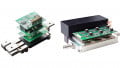
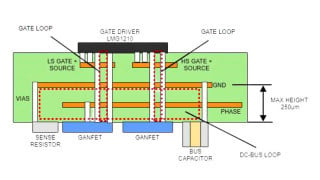
Figure 3. The power stack evaluation kits can be custom-configured to match any technical requirements. Image used courtesy of Bodo’s Power Systems [PDF] and Mersen
Simulation and Testing
Mersen uses state-of-the-art simulation programs to optimize the mechanical, thermal, electrical, and electromagnetic properties of power stacks. With these tools, the various multi-physical interactions between all the components can be taken into account in advance. This allows optimal compatibility of the single components of each power stack.

Figure 4. Power stacks are used, for example, in fast DC charging stations for electric vehicles. Image used courtesy of Adobe Stock
Extensive tests follow the design process. Mersen’s experts also provide testing support for inverter manufacturers if needed. The company operates 18 research and development centers around the globe, including two competence centers for design, assembly, and test services in the United States and Europe. Off-load in-circuit (ICT) and on-load tests are conducted here under real conditions.
This article originally appeared in Bodo’s Power Systems [PDF] magazine.
Related Content