Facebook
 Google
 GitHub
 Linkedin
What We Can Learn From Five California Microgrids
Learn how California microgrids offer resilience and cost savings for critical facilities like data centers, using hybrid renewable systems (solar, storage, fuel cells) to maintain power during grid outages.
US data center demand will rise to 75.8 GW in 2026, according to 451 Research (which is part of S&P Global). This represents the total power demand for IT equipment, cooling, lighting and other uses. This growth is substantial: In 2025, utility power provided to hyperscale, leased and crypto-mining data centers was 61.8 GW. The 2026 forecast of 75.8 GW represents approximately 23% growth from 2025 levels.
This follows a 22% increase in 2025 over 2024. For broader context, the US had about 25 GW of operating data centers in 2024—according to Bloom Energy. These predictions are driven primarily by AI workload growth, with a small number of companies—such as the top 5 hyperscalers -- now projected to spend significantly on infrastructure expansion. Check out the Sources sidebar at the end of this article for more details on these predictions.
What is a Microgrid?
In order to address the vast power required to energize these datacenters, microgrids are being built. A microgrid is a group of interconnected loads and distributed energy resources that acts as a single controllable entity with respect to the grid. It can connect and disconnect from the grid to operate in grid-connected or island mode. Microgrids can improve customer reliability and resilience to grid disturbances.
Advanced microgrids enable local power generation assets—including traditional generators, renewables, and storage—to keep the local grid running even when the larger grid experiences interruptions or, for remote areas, where there is no connection to the larger grid. In addition, advanced microgrids allow local assets to work together to save costs, extend duration of energy supplies, and produce revenue via market participation.
What follows are short profiles of five California-based microgrids. These help to illustrate how they work—and what results they deliver to many types of facilities, including datacenters.
1—Blue Lake Rancheria (BLR) Microgrid
In Humboldt County, on Northern California BLR tribal reservation, sits a system which started as a around 420 kW solar PV array, paired with a battery energy storage system of around 500 kW / 950 kWh. It was later expanded to approximately 1,150 kW / 1,950 kWh storage. The system includes a microgrid management system (acting as the controller); protective relaying, which serve as points of common coupling. It has the ability to island from the grid, via a computer-controlled breaker.
It is connected to PG&E’s distribution grid (12.5 kV), with control over a campus of approximately 6 buildings—including the government offices, a hotel/casino, and other structures. It serves as a vital piece of the infrastructure needed for the delivery of reliable critical services: water, sewage, emergency shelter.
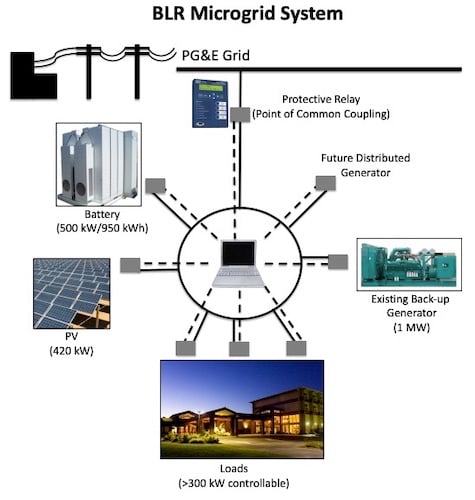
Components of the BLR microgrid system. Image used courtesy of Blue Lake Rancheria.
Its resiliency was demonstrated during the 2019 statewide outage, when it was able, during that multi‐day event, to keep delivering power-hungry critical services up and running. Over time, this system has resulted in significant reductions in greenhouse gas emissions, plus annual savings on electricity costs in the hundreds of thousands of dollars. It now serves as a model for other tribal / rural / community microgrids. The nested/community microgrid expansion (“Microgrid 2.0”) is intended to replicate some of its functions on larger circuits. Check out their filing with Calif. Energy Commission.
While the current system can island, its backup duration depends upon solar input and stored energy. Truly long‐duration events or low solar periods reduce their independence. All microgrid deployments, even smaller-scale, have nontrivial capital costs. And they have both technical and regulatory complexity in interconnection, in protective relaying, and in tariff arrangements. As with many renewable‐storage microgrids, weather (solar availability) constrains operations unless supplemented with other generation.
2—Borrego Springs Microgrid
Located in San Diego County, the Borrego Springs microgrid (owned and operated by SDG&E) integrates two battery storage systems, a large solar field (third‐party owned), two generators, and an ultracapacitor, with smart grid / automated switching infrastructure. Before the microgrid arrived, the town was served by a single transmission line; hence it was vulnerable.
The microgrid adds local generation and storage so critical facilities (fire, police, etc.) can be supplied during line failures or outages In order to transition toward 100% clean energy, upgrades have been made.
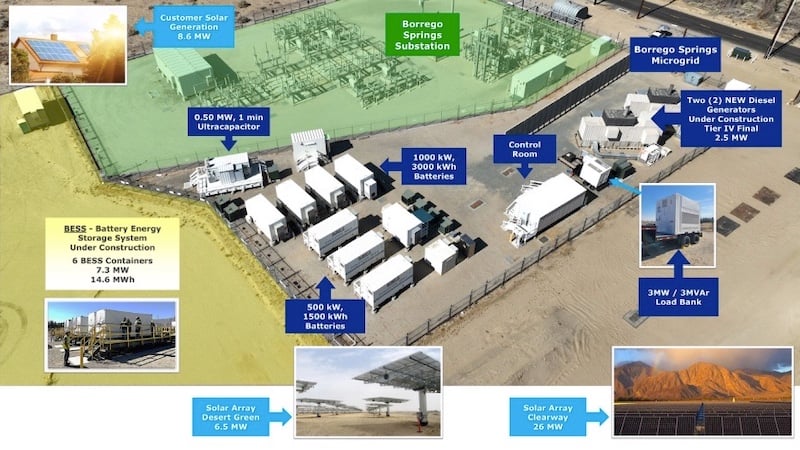
Layout of the Borrego Springs Microgrid. Image used courtesy of San Diego Gas & Electric Company (SDGE).
Most importantly, these include improved inverters and energy management / control systems to manage voltage issues and fluctuations from solar. Critical resilience for a remote town is, for the locals, a godsend. The town’s location makes it particularly vulnerable. Local generation plus local storage helps avoid a total outage.
Because of the substantial focus on solar, Borrego Springs is a testbed for managing variability, inverter control, and storage dispatch. The upgrades aim for 100% clean energy operation during islanded mode. As of today, the moves in that direction are promising. However, electric power quality issues (such as voltage swings and solar variability) are real, especially under high solar output and low load.
These require sophisticated control / inverter design. (The project is limited by three realities: storage, solar generation, and weather. It’s noteworthy that generator backup is part of the system to meet critical load when solar is insufficient.
3—Redwood Coast Airport Microgrid
Located in California’s northern Humboldt County, this front‐of‐meter multi‐customer microgrid was designed to serve the airport, the Coast Guard, and some others. (PG&E Corporation Investors) The project’s approximately 2.2 MW solar PV, DC is coupled to a 2 MW / 9 MWh battery storage system (using Tesla Megapacks). This microgrid’s control system is fitted with protection/isolation devices. It’s capable to island in case of grid outage. PG&E owns & operates the microgrid circuit and controls during islanded operations.
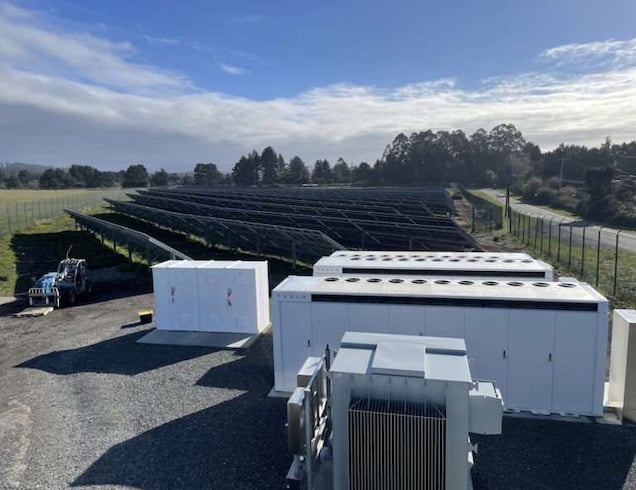
A sky high view of the Redwood Coast Airport Microgrid. Image used courtesy of PG&E.
RCAM uses no fossil fuels in its regular generation, which helps the company comply with the emissions reductions mandates from CEC and CARB. RCAM serves as a blueprint for other multi‐customer, front‐of‐meter microgrids in California. However, cost is an issue: Large scale solar + storage + protections + interconnection is expensive.
As a result, cost‐recovery/tariff arrangements are needed. Storage of 9 MWh is good, but for longer outages or low solar days, limitations will appear. Solar variability is a challenge, of course. When connected to the larger grid, RCAM’s system has to maintain power quality, safety, and regulatory compliance. The transitions between grid‐connected and islanded modes must be very robust.
4—Calistoga Resiliency Center
Located in the Northern California town of Calistoga, one of the key centers of Napa County. CRC has a novel hybrid design combining lithium-ion battery storage + hydrogen fuel cells. With around 293 MWh of storage, it has peak output of approximately 8.5 MW during Public Safety Power Shutoff events. It’s been designed for continuous supply for at least 48 hours.
Their energy management system, employing VaultOS, means that it’s technology‐agnostic: supporting black-start and grid‐forming, orchestrating performance across subsystems, managing when connected to PG&E’s grid and when islanded. 48-hour continuous operation during PSPS is a strong benchmark.
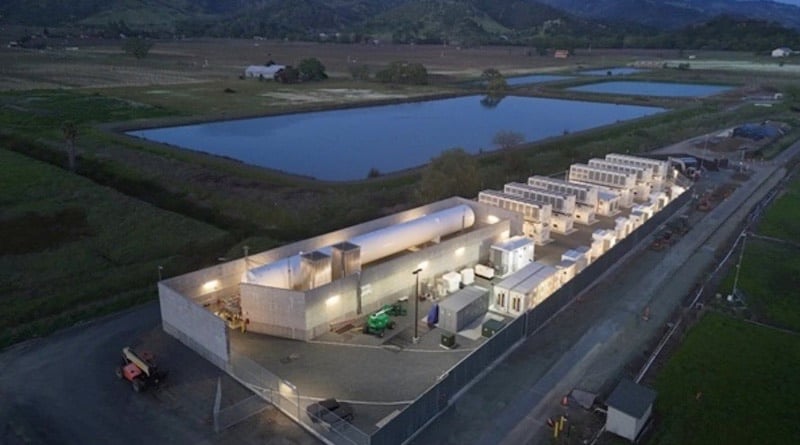
Calistoga Resiliency Center (CRC). Image used courtesy of City of Calistoga, CA.
In addition, hydrogen fuel cells extend duration beyond what batteries alone can do. CRC requires a reliable supply of hydrogen. The storage of hydrogen and fuel cells adds more layers of complexity, safety, and cost. If hydrogen is produced offsite, transport or onsite production costs are added on top. Such hybrid systems are more complex, with more components requiring their own maintenance, safety protocols, etc. While it's a sturdy system, it may be harder for smaller communities to replicate CRC—due to upfront costs and technical demands.
5—City of San Diego—Multiple Facility Microgrids
Located on San Diego city government facilities) Distributed facility microgrids such as this one operate across multiple sites, in this case 8 sites in total: fire stations, police stations, recreation centers. It combines 930 kW PV solar, and 2,175 MWh of battery storage.
Their facilities can island during outages. The system includes controls that allow shift of loads, dynamic switching, etc. Instead of one big microgrid, their approach involves many smaller ones in critical civic facilities—to help spread risk and improve local resilience at multiple points.
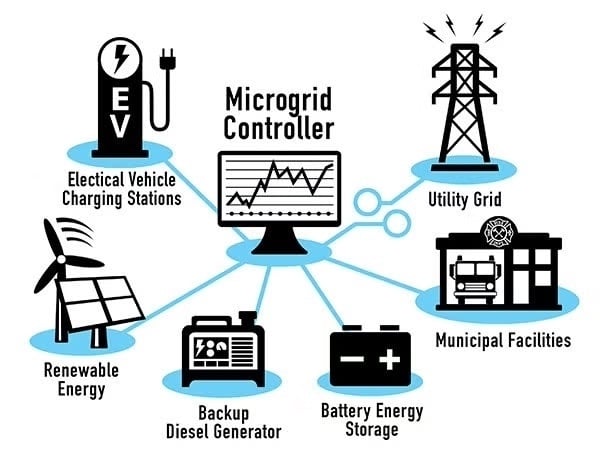
San Diego’s composition of its microgrids. Image used courtesy of the City of San Diego.
Among the key features are climate mitigation (solar + storage); EV infrastructure; lower utility bills; peak demand management. Because these 8 facilities are spread out, the system gives opportunities for replicating similar setups in similar civic buildings. However, the individual storage for each facility is modest when compared to what might be needed for long outages.
Having multiple sites means more complex management, and it could possibly mean less economies of scale than one large, centralized microgrid. Costs here will have to be recovered via ratepayers or budgets. This means that both regulatory and financial frameworks will need more clarity.
Sources Sidebar
Provided here are links to multiple organizations making forecasts for this sector.
451 Research / S&P Global
The primary source for the 75.8 GW 2026 figure cited in the article is published in their report: "Datacenter Services & Infrastructure Market Monitor & Forecast" (September 2025).
FMI Corporation
The report "North American Engineering and Construction Industry Overview" forecasts data center construction to increase 24.9% in 2026, following a 33.4% increase in 2025.
Precedence Research
Projects the US data center market at USD 134.77 billion in 2025 and growing to USD 393.14 billion by 2035, with a CAGR of 11.30%.
Bain & Company
Forecasted global data center capacity demand would reach 163 GW by 2030, twice today's demand.
JLL (Jones Lang LaSalle)
Published the "2026 Global Data Center Outlook.” Predicts nearly 100 GW of new data centers will be added between 2026 and 2030.