Facebook
 Google
 GitHub
 Linkedin
What Will Stop Google From Guzzling AI Energy?
Google’s energy consumption has skyrocketed with artificial intelligence. Here, we dive into how the tech giant can offset its data center footprint.
Google’s electricity consumption is increasing significantly with the artificial intelligence (AI) boom. The California-based tech giant is increasingly looking to renewables to offset its growing data center footprint.
AI and renewable energy. Video used courtesy of NVIDIA
This expansion comes as large tech companies aim to slash their carbon emissions while maintaining energy-intensive cloud server infrastructure—a complicated balance in the race to bring new AI software online before the next competitor. The International Energy Agency (IEA) estimates electricity consumption from data centers, AI, and cryptocurrency could double over the next few years, with servers expected to guzzle 1,000 TWh in 2026 compared to 460 TWh in 2022.
As Google incorporates AI products like Gemini into its cloud and search tools, the company could incur a tenfold spike in electricity requirements. Google processes about 9 billion searches daily, each with an average demand of 0.3 Wh. Meeting the level of dominant AI technologies like OpenAI’s ChatGPT, which averages 2.9 Wh per request, would require a nearly 10 TWh increase in annual electricity.
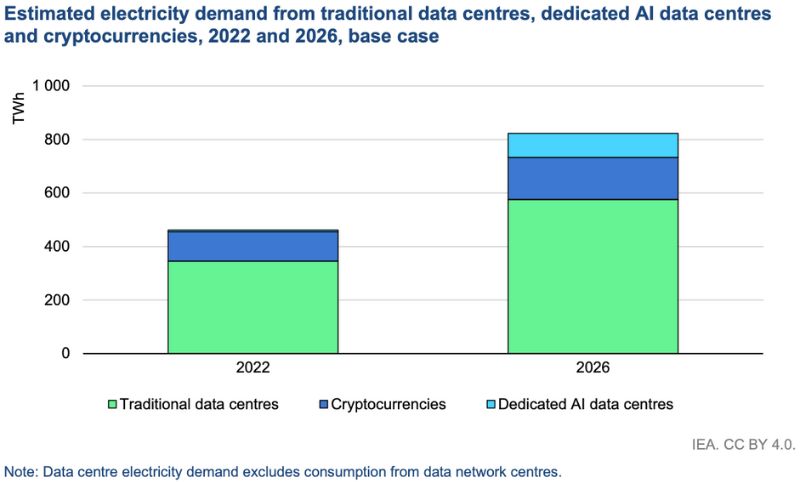
Data center electricity demand projections. Image used courtesy of the IEA (Page 35)
Beefing Up Renewables for Taiwan Cloud Hub
Taiwan, where Google has a sizable cloud services presence, is a critical priority in cutting its data center emissions. Fossil fuels produced most of Taiwan’s electricity in 2023, with renewables only representing 9.5% and nuclear accounting for 6.3%. Energy and industrial markets—including Google’s cloud facilities—were significant end users. Taiwan also leads the world in energy-intensive semiconductor production; its foundries claim about two-thirds of the market.
Against this backdrop, Google will add a large-scale 1 GW solar project to power its data centers and offices in Taiwan. The company partnered with finance giant BlackRock to invest an undisclosed sum in the latter’s portfolio company, New Green Power (NGP), a leading solar developer with over 500 MW of projects across Taiwan and Japan.
In addition to financing projects, Google will procure up to 300 MW of solar energy via power purchase agreements and renewable certificates from the Taiwanese government. This expands upon the 115 existing clean energy contracts Google has signed over the last 13 years to secure 14 GW, which roughly translates to 36 million solar panels. It also procured 4 GW in 2023 alone, more than in any other year.
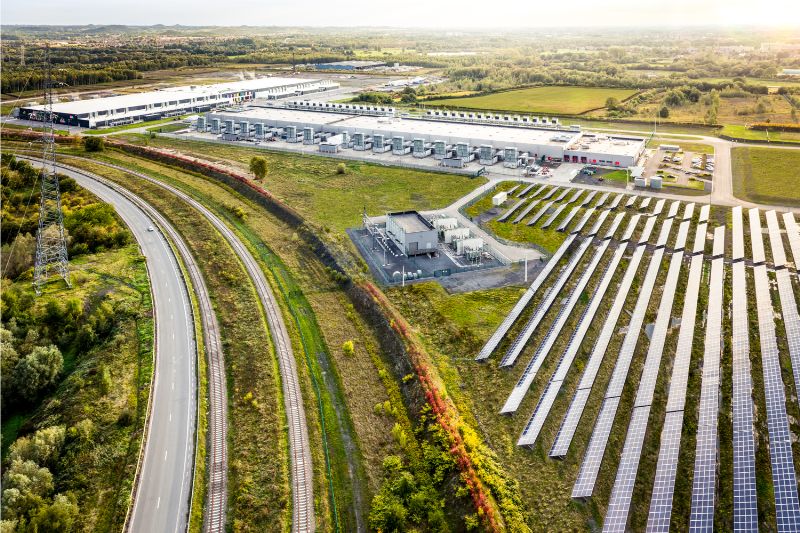
Google’s solar-powered data center in St. Ghislain, Belgium. Image used courtesy of Google
Google has struggled to square its environmental goals with fossil fuel-dependent operations in hard-to-decarbonize regions like Asia-Pacific, where renewables remain sparse in the grid. According to regional averages documented in its latest Environmental Report, carbon-free resources only comprise 12% of the energy consumed at Google’s Asia-Pacific data centers. Comparatively, other regions fare higher, such as Latin America (91%), Central North America (91%), and Europe, the Middle East and Africa (83%).
Emissions Grow Despite Clean Energy Expansion
Targeting net-zero emissions across its operations by 2030, Google has spent years expanding its renewable capacity both before and during the current AI boom. However, its 2024 Environmental Report reveals persistent challenges. Although Google reported an average of 64% carbon-free energy across its data centers and offices last year, its total greenhouse gas (GHG) footprint grew by 13%—mainly due to rising data center energy consumption and supply chain emissions.
Of the nearly 26 TWh Google consumed last year, 15.7 TWh was sourced from renewables. Most came from power purchase agreements, followed by 68.3 GWh of renewable diesel and other clean fuels for server backup power and another 10.7 GWh from on-site solar and wind installations.
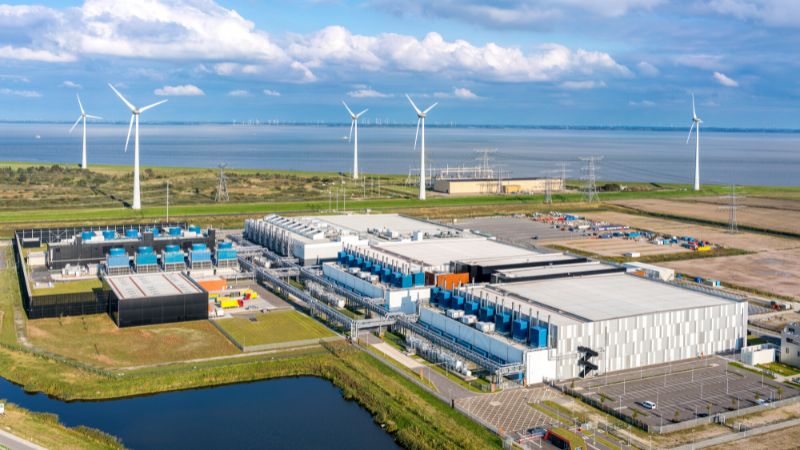
An on-site wind farm powers a Google data center in the Netherlands. Image used courtesy of Google
Google is among the largest corporate clean energy buyers, with 996 MW of off-site wind and solar projects reported by BloombergNEF. Separately, it has invested billions to bring 4.5 GW of renewable projects online since 2010. These initiatives aim to decarbonize the energy mix in Google’s operating regions, thereby reducing its overall GHG footprint.
Despite these efforts, Google’s Scope 2 emissions increased by 37% in 2023 due to data center demands outpacing its ability to bring more clean energy projects online, particularly at its U.S. and Asia-Pacific facilities. The report cited the early termination of energy contracts before commissioning. This is common in the U.S., where 2.5 TW of renewable projects remain stuck in the ever-growing interconnection backlog. Developers often pull projects after years of waiting in the queue.
Carbon-Free Data Centers in the U.S.
Despite long lead times between Google’s investments and GHG emissions reductions, Google continues to build up its renewable capacity across the U.S. This summer, it teamed up with Berkshire Hathaway Energy subsidiary NV Energy to secure electricity for a data center in Nevada. The long-term agreement submitted to the Public Utilities Commission of Nevada would serve Google’s carbon-free supply needs on an hourly cloud-matching basis, drawing power from an enhanced geothermal plant that opened last year.
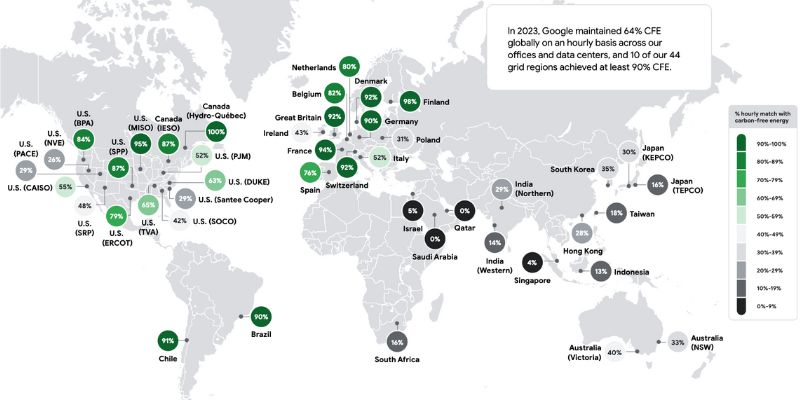
Percentages of carbon-free energy (“CFE,” as abbreviated) in each region where Google has a data center presence, including third-party facilities. Image used courtesy of Google (Page 37, Figure 20)
Google has made similar moves in recent months, including a partnership to build battery-powered microgrids for its U.S. data centers. Another facility under development in Arizona will be powered by 400 MW of solar, wind, and battery storage across three plants.