Facebook
 Google
 GitHub
 Linkedin
Time-Shifting Energy Use Could Shrink Carbon Emissions
University of Texas Dallas engineers have found that coordinating electricity consumption with renewable energy production can substantially reduce carbon emissions.
The pathway to a decarbonized power grid usually focuses on energy supply. In other words, how many gigawatts of solar, wind, or storage can be deployed to displace fossil fuel generation?
However, researchers led by the University of Texas at Dallas have shown that demand-side timing can be just as important. The team outlined how carefully aligning consumption with renewable output allows households, businesses, and utilities to reduce emissions without lowering total energy use.
The team worked with Harvard University and Nantum AI to design a model integrating real-time greenhouse gas (GHG) intensity data with demand scheduling. Instead of simply reducing peak load, the approach targets the carbon profile of the marginal kilowatt-hour, revealing when grid electricity is cleanest and when it is dirtiest.
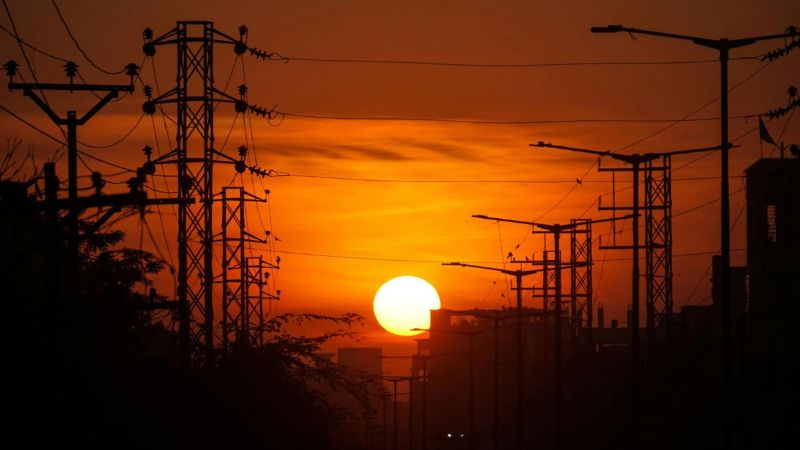
Timing energy use can reduce GHG emissions. Image used courtesy of Pexels
Modeling Grid Carbon Intensity
Power grids are complex systems where the dispatch order and resource availability constantly change. Grid operators usually dispatch renewable sources first because their marginal cost and emissions are near zero. As demand rises, fossil generation is layered in, typically natural gas turbines first, followed by coal in regions where it is still prevalent. The grid’s carbon intensity, measured in kilograms of carbon dioxide per kilowatt-hour, can fluctuate dramatically from one hour to the next.
The UT Dallas model calculates these fluctuations by combining generation data with emissions factors for each fuel type. It then overlays typical demand patterns (residential, commercial, and industrial) to determine how shifting loads by a few hours alters the carbon outcome. Crucially, the model runs simulations not just daily, but over entire years, capturing seasonal renewable availability such as stronger wind in winter or peak hydro flows in spring.
For example, California’s solar-heavy grid experiences a carbon intensity drop around midday when photovoltaic output surges, but it rises again in the late afternoon as demand peaks and gas plants ramp up. Conversely, wind often dominates overnight in the Midwest, making evening and early morning the lowest-intensity windows.
_and_diversity_index_(right).jpg)
Renewable energy share (left) and diversity index (right). Image used courtesy of Li et al
Demand-Side Flexibility as a Decarbonization Tool
The study modeled three regional grids with distinct supply mixes. In the Northwest, where hydropower makes up about 30% of annual generation, the carbon intensity is already lower, but emissions reductions still accumulate when consumers align with hydro-rich periods. The benefits of shifting demand are more pronounced in California, where solar dominates but gas fills evening peaks.
The analysis found that annual optimization yields up to 33% more emissions reduction than short-term, day-to-day strategies. For instance, if a load-shifting program cut emissions by 10% under conventional planning, the same program informed by annualized carbon data could achieve a 13.3% reduction. That improvement came from accounting for seasonal patterns that short-term models overlook.
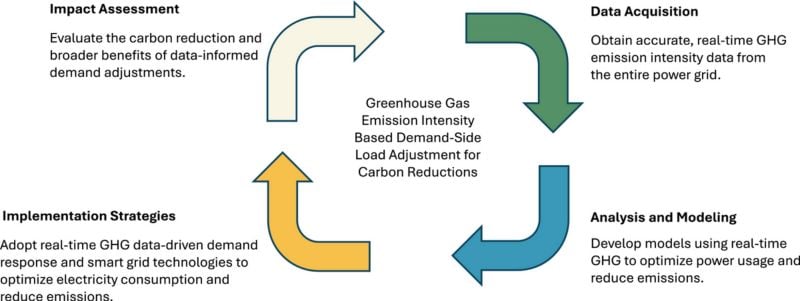
Model for demand-side load regulation for carbon reductions. Image used courtesy of Li et al
The research concluded that significant system-level emissions reductions are possible even with small shifts in demand. The study modeled scenarios where only 5% of total electricity consumption was shifted to lower-intensity times. Even this modest adjustment, when aggregated across millions of households and thousands of businesses, had measurable effects on annual carbon output.
The findings position demand-side flexibility as a complement to renewable buildout. Instead of waiting for new wind farms or solar installations to come online, utilities could leverage existing behavioral and technological tools such as smart thermostats to “follow the renewables” already on the grid.
Implementation Challenges Remain
The biggest challenge lies in communication and automation. For consumers to act on carbon-intensity signals, utilities would need to publish them clearly, ideally in real time. This could be done through mobile apps, in-home energy dashboards, or integration into smart devices. Appliances and electric vehicle chargers would then need control logic that can schedule operation within cleaner windows, similar to responding to time-of-use pricing.
Another hurdle is alignment with grid reliability requirements. Demand cannot simply shift arbitrarily; it must follow operating constraints such as ramp rates and reserve margins. AI forecasting and optimization become critical here. By predicting renewable availability and grid conditions, AI can smooth demand shifting without destabilizing the system.
The study also suggests that policies should incentivize utilities to include emissions intensity in their demand-response programs, not just price, moving from cost-driven load control to carbon-aware load control.
The study appeared in Cell Reports Sustainability.