Facebook
 Google
 GitHub
 Linkedin
Can Hydrogen Replace Natural Gas in Power Plants?
Research projects target stronger materials and hot gas path components for turbines using hydrogen-containing fuels.
Power plants using natural gas could soon get a boost from green hydrogen. Eleven universities will embark on projects to improve hydrogen-fueled gas turbine performance in harsh environments and high temperatures. Their research could support the adoption of green hydrogen in gas turbines.
A 60% hydrogen blend fired this turbine. Video used courtesy of Hanwha Group
Green hydrogen is made with electrolysis powered by renewable energy resources, producing no emissions except water. Integrating low-carbon hydrogen fuels into existing natural gas units would reduce the plants’ carbon footprints.
The projects are funded by an $8.8 million Department of Energy (DOE) grant.
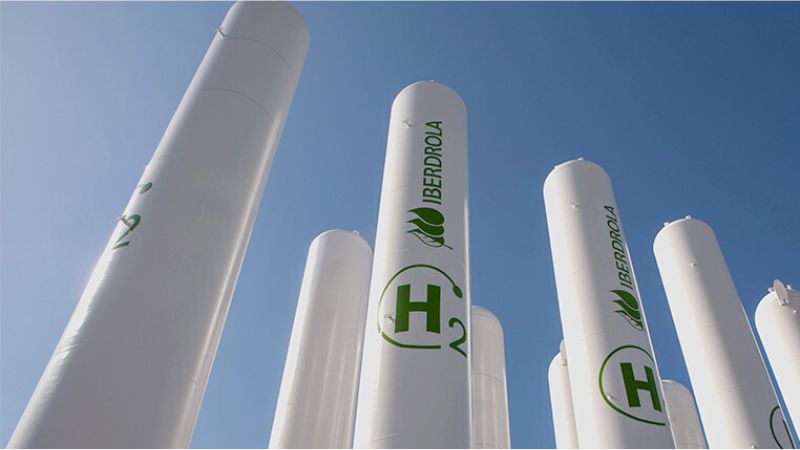
Iberdrola’s hydrogen tanks. Image used courtesy of Iberdrola
Despite Progress, Hydrogen Problems Remain
Some utilities are already retrofitting units for hydrogen fuel. In Florida, Duke Energy’s DeBary Hydrogen Project is converting an 83 MW 7E gas turbine to operate on 100% hydrogen, liquid fuel, natural gas, or a hydrogen-natural gas blend. A solar-powered electrolyzer will produce the hydrogen on-site. Once operational this year, it will be among the first plants to produce and store green hydrogen for peaking power functions. According to the Energy Information Administration, hydrogen-gas co-firing is being tested at five other plants in the U.S., and three new facilities intend to incorporate hydrogen capabilities.
The DOE estimates hydrogen could help decarbonize one-fourth of global energy-related carbon emissions. Hydrogen-gas integration would benefit the nation’s natural gas fleet, which accounted for 43% of utility-scale electricity generation in 2023 (1,802 billion kWh). Since they’re naturally fuel-flexible, gas turbines can be configured to operate on green hydrogen or similar fuels. However, the scope of that upgrade depends on the hydrogen concentration and the turbine’s initial configuration.
Still, limitations in materials and component design remain a significant performance challenge. Gas turbine efficiency generally corresponds to the inlet temperature: hotter operations are more efficient. However, standard materials restrict the operational temperature of today’s gas turbines, especially for components in the hot gas path, such as turbine blades, nozzles, and shrouds. Turbine blades are particularly vulnerable because they must withstand the highest temperatures and stresses.
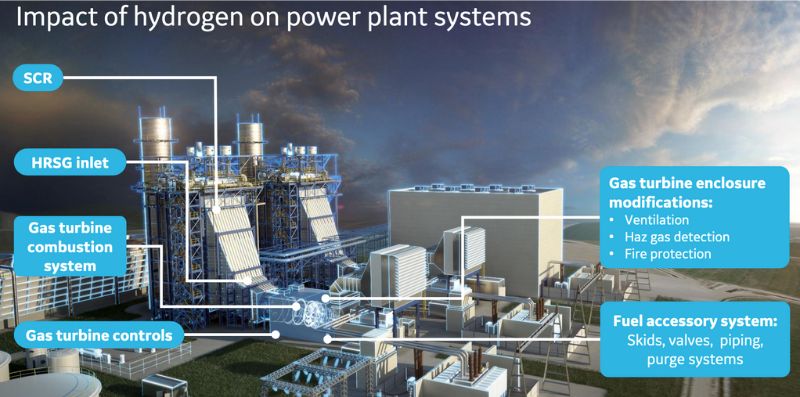
The impact of hydrogen integration at power plants. Image used courtesy of General Electric (Slide 14)
Hot Gas Path Design for Hydrogen Turbines
One of the three focus areas in the DOE’s grant program targets hot gas path materials with flexibility for 100% natural gas to 100% hydrogen fuels. These materials should withstand high temperatures, such as turbine inlets exceeding 1,700°C (3,100°F).
Texas A&M University’s Engineering Experiment Station will study the life-limiting degradation mechanisms of conventional and new hot gas path materials under hydrogen-fired conditions. The researchers will experiment with the high water vapor content of the combustion gas, applying increased local heat and mass transfer.
Texas A&M researchers will evaluate a thermal barrier coating (TBC) using a nickel-based superalloy and an alloy-coating system under simulated turbine conditions, comparing natural gas and hydrogen fuels under high heat and mass transfer. This study aims to identify alternatives to today’s turbine blade coatings, which mainly use single-crystal nickel- or cobalt-based superalloys with limited efficiency gains.
With kinetic scaling models, the researchers will study the long-term durability of hot gas path materials to identify the best refractory high entropy alloy (RHEA) coating system for hydrogen-fueled turbines. The team will use a RHEA substrate developed through ULTIMATE, a DOE program supporting ultra-high-temperature materials that allow turbines to operate continuously at 1,300°C in standalone tests. With advanced coatings, gas turbine inlet temperatures could reach at least 1,800°C.
Advanced Cooling Systems
The DOE’s next focus area targets advanced cooling architectures and components enabling flexibility in natural gas and hydrogen fuels. The projects will select materials and cooling designs to be mass-produced for gas turbines operating with a turbine inlet temperature exceeding 1,704°C.
Pennsylvania State University will test environmental barrier coating (EBC)-based ceramic matrix composites (CMCs) in hot-section components. These materials could unlock significant gains in maximum cycle temperatures for hydrogen combustion, thus boosting the cycle efficiency. The researchers will also explore methods to manufacture CMCs with EBCs for combustion liners with effusion cooling in various fuel compositions, including 100% natural gas and 100% methane. High-speed infrared imaging will evaluate the method’s impact on heat transfer and effusion cooling.
The team will use field-assisted sintering technology—a new way to manufacture EBC-coated CMCs—to identify cooling opportunities. They’ll test the ceramic components in a combustion facility accommodating high-hydrogen flame conditions.
Pennsylvania State University will also work with GE Aerospace Research to transfer the findings to industry applications.
Mitigating Stress in Hydrogen Rotating Detonation Engines
Rotating detonation combustion (RDC) brings a unique opportunity for engine designers because it improves cycle efficiency with higher-temperature turbine inlets and unlocks pressure gains via combustion. However, detonative combustion is inherently unstable, and its harsh environment imposes significant mechanical stresses.
Maximizing the cycle output of a conventional gas turbine would ideally apply the highest combustion and inlet gas temperature (over 1,704°C) without causing material failure. However, given RDC’s instability, high spatially averaged inlet temperatures could cause higher intermittent heat inside the combustor. High-pressure pulses from detonation also induce mechanical stresses that are otherwise avoided in steady gas turbine combustion.
The long-term mechanical and thermal effects on surrounding materials in the hot gas path are poorly understood. While TBCs could provide higher inlet temperatures in hot gas paths, existing research on component impacts along the downstream path is limited.
Purdue University will address challenges in RDC’s harsh conditions, including the large and unsteady pressure and temperature gradients that reduce structural integrity.
The project will demonstrate an RDC combustor-transition element and nozzle guide vane in Rolls-Royce’s M250 turboshaft, one of the world’s most popular engines for civil and military helicopters. The researchers will operate the engine for several hours to validate safe rotating blades in RDC conditions.
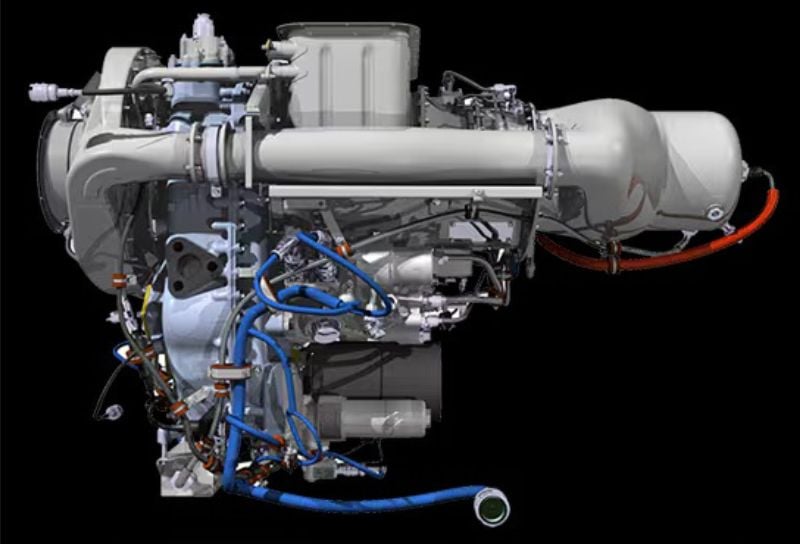
The M250 turboshaft engine. Image used courtesy of Rolls-Royce
Purdue University’s goals are twofold. The team will develop material characterization tools to identify candidates resilient to RDC stresses, considering their effects on TBCs and other materials. They’ll also devise advanced thermal management methods for fluid-thermal-structural analysis in RDC environments, utilizing high-precision sensors and finite element simulations.