Facebook
 Google
 GitHub
 Linkedin
Texas Trouble: Energy Needs Outpace Grid Improvements
Texas won’t have enough electricity to meet demand unless it adds more grid infrastructure and upgrades power plants, a University of Houston white paper warns.
Texas produces more energy than any other U.S. state, but it’s also on track to consume more power than ever. Data centers are booming across the state, gobbling up energy with generative AI services and cryptomining. Industry is electrifying, electric vehicles are proliferating, and weather extremes are leading to higher heating and cooling needs.
Energy demand in Texas is likely to double by 2035 or even reach as high as 360% in some scenarios, according to a University of Houston white paper. However, the existing infrastructure can’t keep up, particularly in areas with data centers. Unless the state invests in developing more capacity and transmission, Texans could be left in the dark.
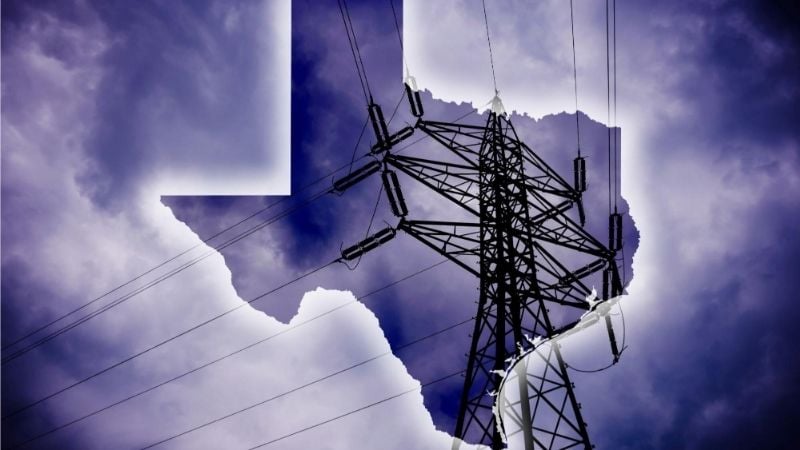
Can Texas prevent a future energy crisis? Image used courtesy of Adobe Stock
Electricity Generation vs. Consumption
Texas has no problems producing energy. The state is the largest oil and natural gas producer and creates about 26% the country’s wind energy. It is second only to California in solar generation. Natural gas is the biggest energy source (40.3%), followed by wind (29%), coal and lignite (12.3%), nuclear (10.2%), and solar (7.7%).
While coal is dwindling, natural gas remains a major energy source, and new capacity is added yearly. The state produces so much natural gas that it exports a portion.
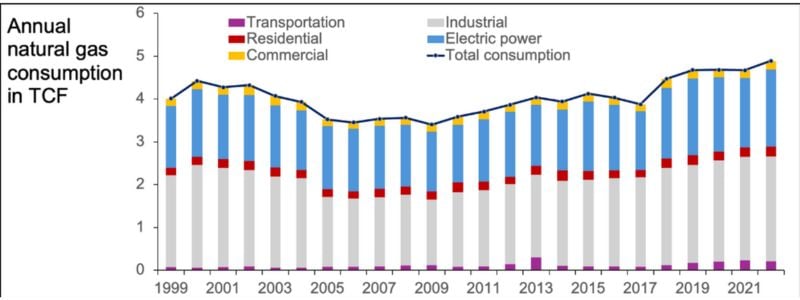
Natural gas consumption. Image used courtesy of University of Houston
Battery energy storage systems are also increasing, either stand-alone or with renewables. Storage systems and the state’s 65 natural gas peaker plants are intended to handle seasonal spikes. Other distributed energy resources (DER), such as industrial cogeneration, are also rising.
Yet, Texas is also a major energy consumer, using about one-seventh of the country’s total energy. Its industry alone accounts for around 24% of industrial energy use nationwide. Data center growth will increase consumption substantially. The Electric Reliability Council of Texas (ERCOT) has already approved data center projects that could increase energy consumption by 40% to 115%, or from 670 TWh to 1,030 TWh.
The Data Center Dilemma
Texas has about 300 data centers, and many more are under development. Most are in highly populated urban areas in the Southeast, where industrial and commercial activity is intense and electric vehicles are numerous. New data centers are under development in the Southeast, the West, and the Far West, with an “unprecedented increase in large-load interconnection requests” for grid connection, the report states.
If connection proceeds as expected, the energy demand will increase from 2,500 MW to nearly 5,500 MW by 2028, creating an energy deficit. While several factors remain uncertain, the deficit—the difference between available energy and consumption—could reach as high as 40 GW by 2035. The UH report stated the most likely shortage would be 27 GW by 2035.
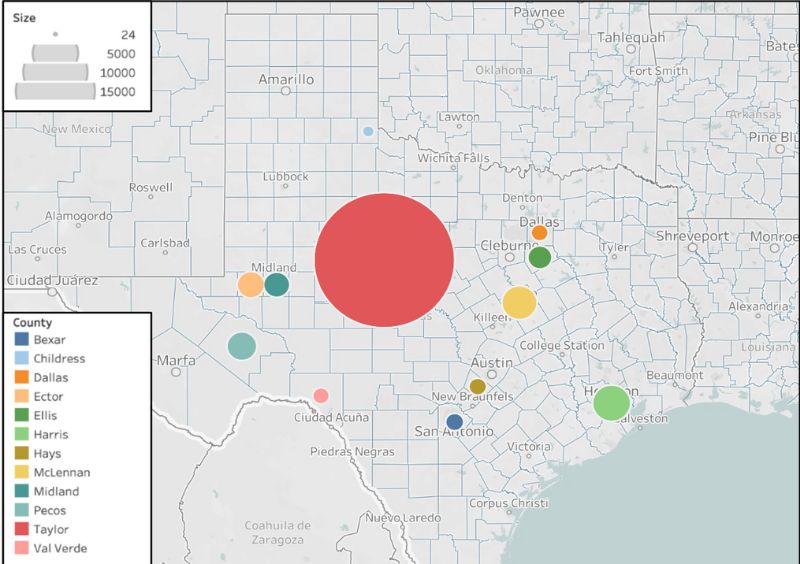
Planned data centers. The circle size represents the expected power requirements. Image used courtesy of University of Houston
A “mismatch between supply and demand centers” makes the problem worse, according to the UH study. Future data center developments will shift the energy burden to less-populated North, West, and Far West areas, with limited natural gas pipelines and transmission infrastructure. The report states that Texas must invest in expanding this energy infrastructure and speed up capacity expansions to fill the gap.
Keeping Texas’ Lights on Amid Uncertainty
The UH researchers considered unpredictable factors that could either increase or decrease projected energy changes. New generation and data center projects could be cancelled, delayed, or fail to receive ERCOT approval. International corporations favor renewable energy, but these projects may be vulnerable to changes in government policies. Construction plans can be delayed or scrapped due to tariffs, supply chain problems, or rising costs.
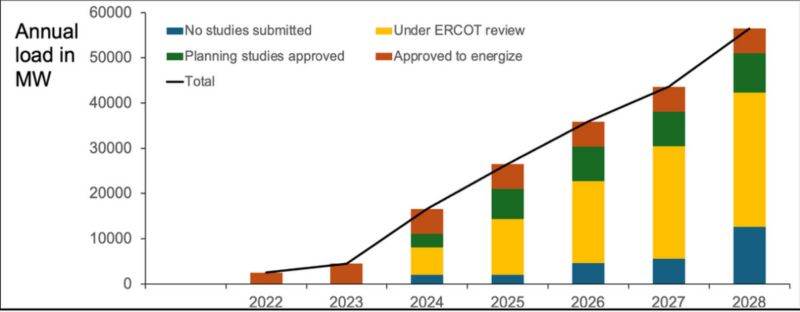
Projected load growth, based on ERCOT data. Image used courtesy of University of Houston
Increasing energy efficiency on all levels—generation, transmission, and use—can help slow the deficit. Distributed energy resources and renewable energy systems can also lessen the problem. Still, the growth rate of DER, localized renewable energy, and EV adoption can be difficult to predict.
In every scenario the researchers considered, they predicted that the state will experience an energy deficit within the next decade that threatens grid reliability and could lead to more widespread shortages and outages.
“Doing nothing is not an option,” the researchers concluded.