Facebook
 Google
 GitHub
 Linkedin
Studies Target Structural Failure in Lithium-Ion Batteries
University of Chicago, Argonne, Stanford-SLAC, and Skoltech research focused on cathode degradation mechanisms and mitigation strategies.
Structural stability remains the biggest hurdle for long-lasting, high-energy lithium-ion batteries. Three separate studies focusing on cathode behavior during cycling may offer ways to address these complex challenges. The studies addressed single-crystal failure modes, electrochemical restructuring of Ni-rich cathodes, and targeted oxide additions to slow capacity fade.
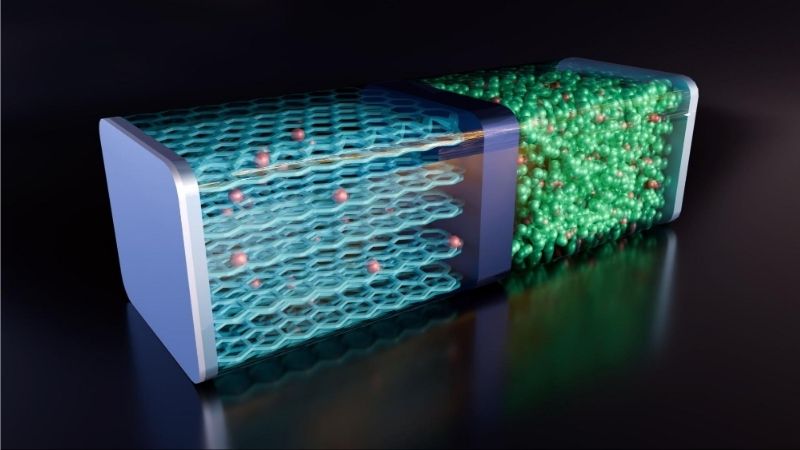
Lithium-ion battery chemistries. Image used courtesy of Adobe Stock
Single-Crystal Cathodes Fail Differently Than Expected
Researchers from the University of Chicago Pritzker School of Molecular Engineering and Argonne National Laboratory have challenged long-held assumptions about why single-crystal Ni-rich cathodes degrade in lithium-ion batteries, such as those used in electric vehicles. Their study in Nature Nanotechnology shows that failure mechanisms derived from polycrystalline cathodes do not directly apply to single-crystal materials.
Polycrystalline Ni-rich cathodes suffer from grain boundary cracking caused by repeated volume expansion and contraction during cycling, typically on the order of 5% to 10%. Scientists expected single-crystal cathodes to avoid this problem because they lack grain boundaries, but in practice, these cathodes still exhibited capacity loss and mechanical damage.
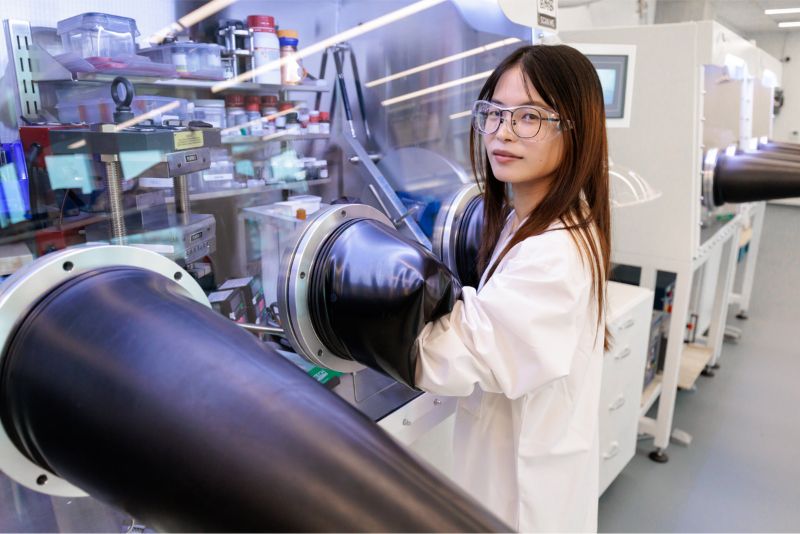
A study has uncovered some causes of the nanoscopic strains that could affect EV batteries. Image used courtesy of University of Chicago
Using synchrotron X-ray techniques and high-resolution transmission electron microscopy, the research team found that degradation in single-crystal cathodes is driven by reaction heterogeneity within individual particles. Different regions of a single crystal react at different rates during charge and discharge, generating internal strain that leads to cracking from within rather than along grain boundaries.
The study also revisits the roles of cobalt and manganese in Ni-rich cathodes. While scientists traditionally viewed cobalt as mechanically detrimental in polycrystalline systems, these researchers found that in single-crystal cathodes, manganese caused more severe mechanical degradation. Cobalt, despite its cost, improved structural durability in these materials.
Electrochemical Tuning Suppresses Lattice Collapse
Researchers at Stanford University, SLAC National Accelerator Laboratory, and the Korea Institute of Science and Technology addressed a related but distinct failure mechanism in Ni-rich cathodes: c-lattice collapse. Published in Nature Energy, the work focuses on controlling anisotropic strain that develops during lithium insertion and extraction.
In layered Ni-rich cathodes, changes in lithium concentration can cause a sudden contraction of the interlayer spacing along the c-axis. This so-called c-collapse deforms the crystal lattice, promotes particle cracking, and accelerates capacity loss. Rather than attempting to suppress atomic disorder, the researchers deliberately induced partial cation disorder through electrochemical activation.
By leveraging anion redox reactions to drive irreversible cation migration, the team transformed a conventional layered Ni-rich structure into what they describe as a disordered layered cathode. This imperfect structure exhibited far lower anisotropic strain during cycling, effectively suppressing c-collapse without sacrificing energy density.
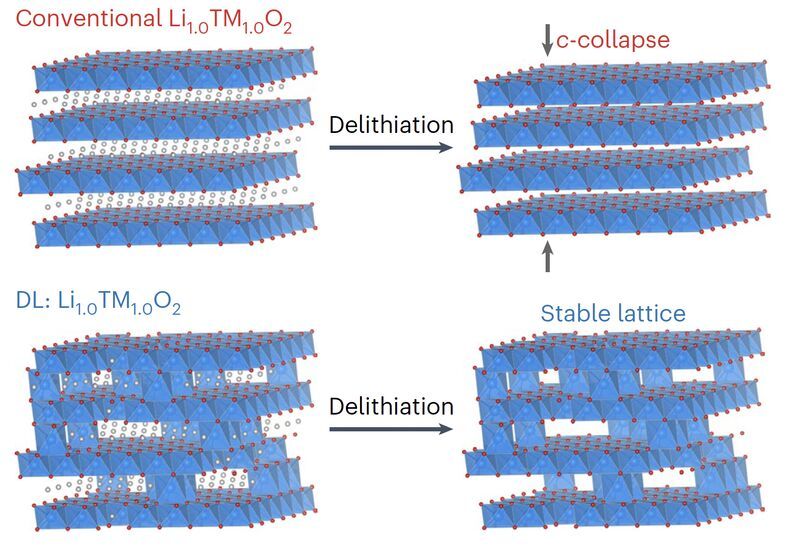
C-collapse vs. stable lattice. Image used courtesy of Jungjin Park
They demonstrated the approach on a high nickel composition material, already attractive for its energy density. Cells built with the electrochemically tuned cathodes showed high capacity retention, improved cycle life, and minimal voltage decay.
The work suggests that controlled structural imperfection, introduced electrochemically rather than through bulk doping, can be a viable path to improving durability in Ni-rich lithium-ion batteries.
Tantalum Oxide Addition Slows Capacity Loss In Cathodes
The third study, from the Skolkovo Institute of Science and Technology, takes a more materials-engineering-driven approach. Researchers reported that adding a small amount of tantalum oxide to Ni-rich gradient cathodes can slow capacity degradation by nearly 50% per cycle. The work was published in Advanced Functional Materials.
Nickel-rich cathodes are widely used to increase energy density, but higher nickel content typically accelerates degradation due to cracking and transition metal migration. One mitigation strategy involves concentration-gradient particles, in which nickel content is highest at the core and decreases toward a manganese- and cobalt-rich surface. Maintaining this gradient during high-temperature lithiation, however, has proven difficult.
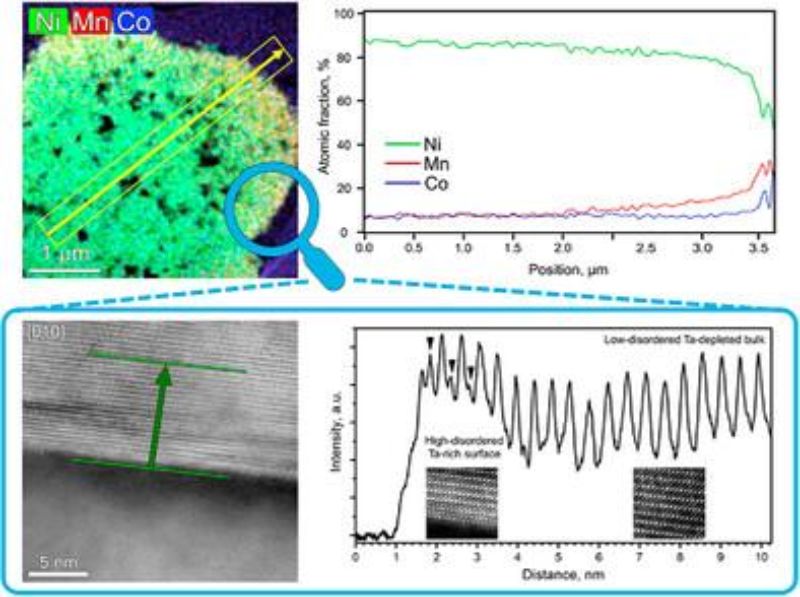
An analysis of material composition and crystal structure at the nanoscale level. Image used courtesy of Sara Nasser
The Skoltech team found that adding 0.5 mol% tantalum oxide during synthesis stabilizes the gradient structure. Rather than forming a separate phase, tantalum segregates to the surface of primary crystallites, creating a nanometer-scale tantalum-rich layer that suppresses nickel migration and grain boundary mobility.
Density functional theory calculations supported the experimental results, showing that tantalum segregation is thermodynamically favorable and effective at preserving both particle morphology and compositional gradients. The researchers report improved cycling stability and thermal stability, and note that pilot production of the modified cathode material is already underway, with planned output of up to 100 tons per year.
Together, these three studies highlight how subtle differences in structure, composition, and processing can dominate battery lifetime in modern Ni-rich lithium-ion systems. Rather than a single dominant failure mechanism, the research points to multiple, chemistry-dependent degradation pathways that require targeted solutions.