Facebook
 Google
 GitHub
 Linkedin
Solar on Steroids: MPPT—The Secret Weapon to Maximize Sun Power
Solar cell output can be variable, and weather can interfere with voltage, but maximum power point tracking allows operators to maximize solar energy.
As the world grapples with increasing levels of greenhouse gas emissions and fuel costs, many consider adopting renewable energy systems as the key solution for a cleaner future. Solar cells are popular because of their high potential power output.
However, many solar panels do not put out the expected voltage. The voltages can also vary depending on the local and ever-changing weather environment. Maximum power point tracking (MPPT) has been developed to increase solar cells’ lifetime and efficiency.

Solar panels. Image used courtesy of Unsplash
How Are MPPTs Used With Solar Panels?
MPPT algorithms enable harvesting the maximum energy from variable power sources under varying conditions, including changes in environmental or operating conditions. MPPTs are used in charge controllers to extract the maximum charge from solar cells to store in batteries or the grid. The maximum power point, also known as the peak power voltage, is the voltage at which the solar cell module will produce its maximum power. This point will vary depending on the local temperature.
MPPTs act as electronic DC-to-DC converters with digital tracking capabilities to optimize the voltage mismatch between solar cells and batteries (or a power grid). They convert the higher DC voltage output from the solar panels into a lower DC voltage for charging batteries (and storing the energy).
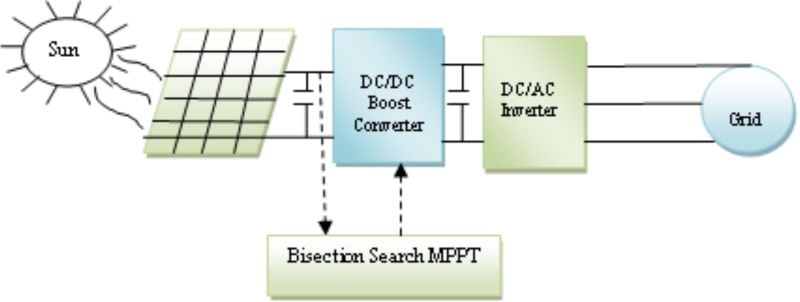
Maximum power point tracking. Image used courtesy of Wikimedia Commons
In practice, the charge controller assesses the solar panel’s output and compares it with the battery’s. The algorithm then determines the optimal power the panel can output to charge the battery.
How Local Conditions Affect Solar Cell Performance
A standard solar cell has a maximum power point (MPP) voltage between 18 V and 36 V, depending on the solar panel’s nominal (approximate) voltage (12 V-24 V). While solar cells are built to put out their nominal voltage values, in practice, the operating voltage varies based on the environmental conditions.
The MPP voltage will be lower on warm days and higher on cold days. This variability means solar cells will always perform differently than under their standard test conditions. In general, the power output increases as panel temperature decreases, and vice versa.
Under these variable conditions, the challenge also lies in the batteries storing the energy because their operating voltage runs close to their nominal voltage. So, if a 12 V solar cell is actually putting out 16-18 V, but the battery requires close to 12 V (11-13 V as a rough example), there’s a voltage mismatch. This is where MPPT algorithms become useful because they track the solar cell's MPP to produce the optimal output to the battery.

Identifying the maximum power point. Image used courtesy of the authors
MPPTs are efficient control solutions, but their effectiveness does vary by season. In summer, when the temperatures are higher, MPPTs contribute less power gain than in winter. In real terms, MPPTs provide a power gain of 20-45% in winter compared to 10-15% in the summer. This also depends on factors like the battery's charge state. In general, MPPTs are the most effective under the following conditions: cold weather, low battery charge, and long wire runs.
MPPT Techniques in Large-Scale Solar Farms
MPPTs focus on individual solar cells, but multiple cells are often grouped to produce a larger output. These cells are connected parallel to supply more energy to the grid, but each panel operates differently based on variable local temperatures and light irradiation. This can lead to different shading conditions (full and partial) in a solar farm. However, different MPPT methods can be used to harvest the most power from each solar cell in these scenarios.
Some common methods include:
- The constant voltage method uses a reference voltage to track the MPP under different shading conditions and determine the required output to the battery/grid.
- Perturbation and observation compare recent power outputs with historical data to track individual solar cells’ MPPs.
- Current sweeping method determines the I-V characteristics of a solar cell to determine the MPP at different periods.
- The one-cycle control method converts DC power to grid-compatible AC power using a single-stage inverter that functions as both the converting device (from DC to AC) and the MPPT.
Alongside more traditional MPPT methods, intelligent MPPT methods are starting to be implemented in solar cells but are not yet as mature as more classical methods. These include artificial neural networks, fuzzy logic controllers, sliding mode controls, Newton-Raphson, and Fibonacci Series MPPTs.
MPPTs Boost Solar Cell Performance Under Variable Conditions
MPPTs improve solar cell performance by controlling and optimizing their output into storage devices and the wider grid. Without them, solar cells' ability to store charge post-harvesting would be suboptimal and lead to power losses. While MPPTs can be used in the different weather conditions solar cells are exposed to, they optimally work in cooler conditions and in charging scenarios where they can input more current into an energy storage system, such as batteries with low charge.