Facebook
 Google
 GitHub
 Linkedin
A Modular Approach to 48V Automotive Power Delivery Networks
Vicor discusses high-density, high-performance DC-DC power modules, where they are used, and their advantages over discrete solutions.
This article is published by EEPower as part of an exclusive digital content partnership with Bodo’s Power Systems.
EEPower’s exclusive digital content partner, Bodo’s Power Systems, caught up with Vicor’s Greg Green, Director of Automotive Marketing, and Maury Wood, VP of Strategic Marketing, to discuss high-density, high-performance DC-DC power modules in 48 V automotive Power Delivery Networks (PDN) and their advantages over discrete solutions.
Vicor is known for its high-density, high-performance DC-DC power modules in the power supply sector. What are the distinguishing features of these modules?
Green: Since the company’s inception almost 40 years ago, Vicor has focused on four pillars of innovation: power delivery architectures, power switching topologies, control systems, and packaging. Each plays a critical role in achieving the highest power density and current density by minimizing power losses within the module and power delivery network.
For example, Vicor fixed ratio converters use a proprietary Sine Amplitude Converter (SAC) circuit topology with high-frequency zero voltage switching and zero current switching to minimize conducted and radiated emissions at maximum power efficiency. Recent advanced products are molded to ensure thermal adeptness, mechanical rigidity, and environmental robustness across temperature, humidity, and vibration. Plated exteriors enable high-yield surface-mount assembly, which provides an ideal thermal conductor for forced-air or liquid cooling using cold plates.
Vicor products are distinctive for having the highest power density in broad DC-DC converter application market segments. For example, Vicor has recently begun sampling a 73.6 cm2 sized module for automotive boost DC charging applications with an astounding power density of 672 kW per liter.
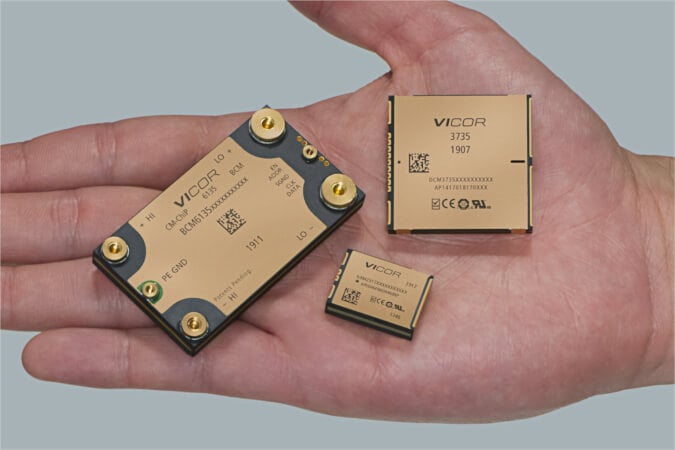
Image used courtesy of Bodo’s Power Systems [PDF]
What are the unique characteristics of power modules, and what advantages are there compared to conventional discrete solutions?
Green: Vicor has invested in a new vertically integrated, highly automated factory where numerous power modules are manufactured simultaneously on panels in a process much like that used to fabricate semiconductor chips. State-of-the-art surface mount assembly methods, advanced package over-molding combined with unique module construction, and functional test methodologies have been developed over Vicor’s 40-year history. A three-dimensional interconnect (3DI) is performed on Vicor’s advanced products within its new environmentally responsible manufacturing facility. Vicor refers to this complete set of manufacturing capabilities as ChiP (converter housed in package) fabrication.
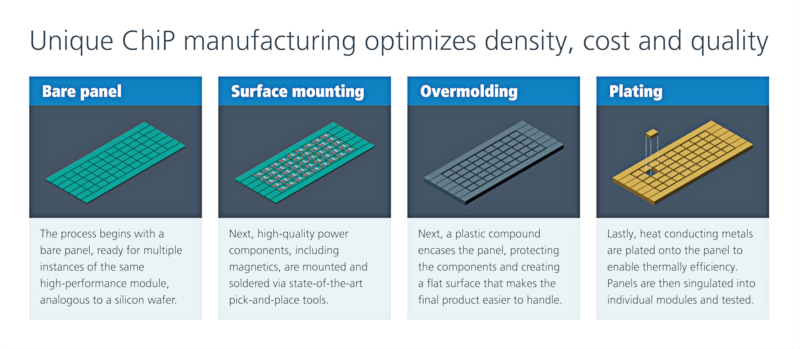
Figure 1. Chip manufacturing panel process. Image used courtesy of Bodo’s Power Systems [PDF]
Vicor delivers complete DC-DC converter solutions with a range of PCB mounting options suitable for automotive applications. These solutions require a minimum of additional components for EMI filtering and telemetry communication. Many compact Vicor modules (including BCM bus converters, PRM regulators, and DCM DC-DC converters) are designed to work bidirectionally and in parallel arrays for greater output power efficiency and capacity. This adds flexibility to the target system PCB layout, enabling the power architecture to be easily scaled up or down to match changes in power requirements. This capability also simplifies the system-level design and BOM cost. Furthermore, all DC-DC conversion functions and isolated magnetics reside within the modules, greatly simplifying the end application system design. The use of high-frequency switching topologies plus zero voltage and current switching not only reduces power losses and increases density but also reduces electromagnetic emissions and costly regulatory certification processes.

Figure 2. Automotive solutions combined. Image used courtesy of Bodo’s Power Systems [PDF]
Where are Vicor modules used, and what has the success rate been?
Green: Vicor products are used today in a broad range of end applications, including high-performance generative AI computing, industrial factory automation, and aerospace systems. Vicor entered the automotive segment about five years ago, bringing advanced modular power technologies to the rapidly electrifying automotive ecosystem. In the focus application areas, Vicor modules create 12 V power zones from 48 V supplies and provide power conversion between 800 VDC and 400 VDC batteries and charging stations, creating legacy compatibility and future-proofing the on-vehicle PDN.
Could you describe the anatomy of an automotive modular power delivery network?
Wood: In battery electric vehicles (BEV) and plug-in hybrid electric vehicles (PHEV), the power network will typically use a series of modules to provide separated extra low voltage (SELV) power to loads throughout the vehicle. A Bus Converter Module (BCM) often converts the battery high voltage, typically 800 VDC, down to 48 VDC, creating the baseline SELV for the vehicle PDN. The BCM also provides galvanic isolation internally, enabling a small DC-DC converter subsystem. If needed, the PDN will include a Power Regulation Module (PRM) to create a regulated 48 VDC source or a DC-DC Converter Module (DCM) to create a regulated 12 VDC feed to legacy subsystems.
For hybrid electric vehicles, Vicor customers typically use PRMs and DCMs to manage a multiplicity of 12 V and 48 V loads.
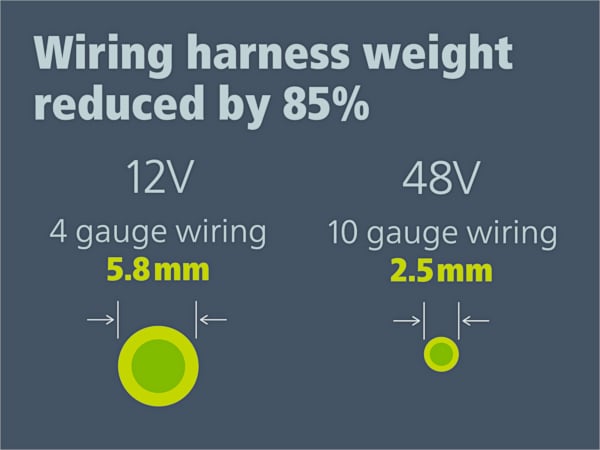
Figure 3. Automotive e-wiring harness comparison. Image used courtesy of Bodo’s Power Systems [PDF]
Let’s go deeper into a specific application area of Vicor power modules. Vicor has years of experience in the automotive industry and, more recently, in automotive high-voltage power supply subsystems. There are many important reasons for developing 48 V power supplies and buses. Why did Vicor develop its 48 V zonal architecture as an alternative to the traditional centralized architecture?
Green: Vicor has been providing 48 V power solutions for customers in applications outside of the automotive industry (such as in cloud computing rack applications) for many years. Automotive OEMs have faced the classic chicken or egg first dilemma for a long while in terms of transitioning vehicles to 48 V. Obviously, the benefits of higher voltage and lower current power distribution are well known by electrical engineers. ICE vehicles continue to use long-proven and reliable 12 V supply subsystems, and generally speaking, virtually all of the multitudinous vehicle loads are performance- and cost-optimized at 12 V. BEVs and PHEVs provide a new and exciting opportunity to use a 48 V PDN, but most existing loads today (for example, fans and heaters) are 12 V peripheral devices.
The 48 V zonal architecture is a bridging approach to supporting the largely economically driven transition from 12 V PDN to 48 V PDN. It creates a 48 VDC main (or backbone) PDN to achieve the immediate performance benefits of a 48V system, including lower wiring harness weight, cost, and PDN power losses, but then uses local 12 V networks to support existing cost-optimized loads (e.g., window motors, and lock actuators).
The 48 V zonal architecture is scalable to meet changing end market requirements. On a typical vehicle, 15% to 20% of the low voltage subsystem loads use more than 80% of the available system power (e.g., power steering, active suspension, compressors, and pump subsystems). The zonal architecture allows OEMs and their suppliers to change out these heavy hitters to 48 V first to recognize an immediate improvement in battery power allocation, efficiency, and weight/cost. The remaining “legacy” loads are placed in 12 V zones to change out over time as it becomes economically practical.
This approach supports reusing new and existing designs across different vehicle platforms and platform derivatives. With power dense modules from Vicor, customers can convert more power in less space, preserving flexibility concerning their physical placement within the vehicle.
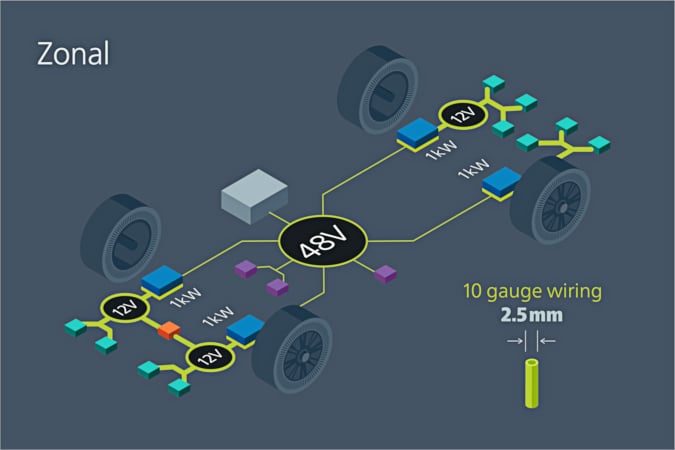
Figure 4. Automotive zonal architecture. Image used courtesy of Bodo’s Power Systems [PDF]
How are you assisting industry engineers with designing power supplies?
Wood: Vicor offers diverse and comprehensive products and services to meet today’s demanding customer requirements. Vicor application engineers work closely with customer product development engineers across the full product lifecycle process—definition, design, sampling, qualification, volume manufacturing, and sustaining engineering—to ensure customers receive the most efficient, dense, flexible, and cost-effective power solutions.
What else do Vicor power modules offer?
Green: The high-voltage bus converter module or HV BCM6135 is a proprietary, ratiometric SAC using a circuit topology to transfer energy from either 800 V or 48 V. It can start up from 800 V or 48 V, providing full power. The BCM6135 has a PMBus feature enabling readout of the high voltage level to allow the application system to identify when precharge has been completed without any additional circuitry.
DCM, PRM, BCM, and high-voltage non-isolated bus converter (NBM) modules provide PMBus communication, allowing the supervisory microcontroller to monitor the power status and control the module’s operation.
The proprietary SAC circuit topology does not require any output inductors and operates at a very high frequency, allowing for the transfer of current at an extremely high rate. The related figure of merit dI/dt (time rate of change of current) can be as high as an unprecedented 8,000,000 amperes per second. This allows vehicle designers to create a virtual battery to eliminate the low-voltage battery, saving weight, space, and cost.
This article originally appeared in Bodo’s Power Systems [PDF] magazine.