Facebook
 Google
 GitHub
 Linkedin
WECs: Calculating Power Output Using Wave Characteristics
This article explores wave energy converters and provides calculations for generated power output using wave characteristics.
Recently, wave energy has gained attention due to its predictability and abundance. With the world constantly seeking alternative energy sources, the shift to wave energy converters (WEC) is becoming popular in harnessing and converting kinetic ocean wave energy into usable electricity.

Image used courtesy of Adobe Stock
Wave Characteristics and Resource Assessment
Knowing the wave characteristics and how to access available resources is important to understanding how to harness wave energy. Ocean waves result from wind blowing over the ocean’s surface. The power output of the wave is influenced by the shape, size, wind duration, speed, and distance it blows (known as the fetch). The wavelength is the distance between two consecutive crests, while the wave period is the time the wave takes to pass a fixed point.
The measurement and analysis of parameters related to the wave characteristics are involved in wave energy resource assessments. One commonly measured parameter is wave height (Hs), or the average height of the highest one-third of the wave in a given wave climate. Hs predicts the wave energy available in a certain location and is measured by a satellite radar or wave buoy.
The peak period (Tp) and the energy period (Te) are the other measurable parameters relating to wave energy characteristics. Tp is the time between two respective wave crests with the highest wave energy, while Te is the time taken for half wave energy to pass a fixed point in a given wave climate. Spectral wave density explains how waveforms are distributed across different wavelengths.
In the resource assessment of wave energy, mathematical models are also used to predict the condition of the waves at a particular location. The model considers wind direction, wind speed, and ocean current to provide valuable information on wave energy resources over time.
For the successful design and operation of wave energy converters, it is important to make accurate resource energy assessments. Therefore, understanding these resources' characteristics will simplify optimizing WECs and maximize power output.
Wave Energy Converter Types
Here are some common WECs, each with a different design and conversion technique:
Point Absorber
Point absorbers (PA) use a floating structure's up-and-down motion to drive an electrical generator or hydraulic pump to convert kinetic energy into electrical power. Single, dual, and multi-buoy systems are available.
Looking at design, PAs consist of a buoyant structure that floats and is tethered to the sea bed. The energy of the wave is converted into hydraulic pressure used to drive the electrical generator in the power take-off (PTO) system. The electricity generated is transmitted by subsea cable to the shore.
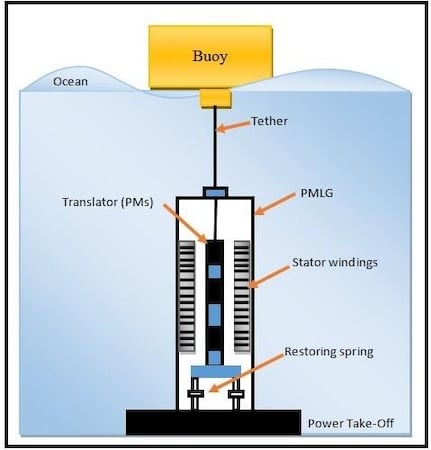
Figure 1. Point absorber wave energy converter. Image used courtesy of Bob Odhiambo
How PAs perform depends on wave energy resources, design, and hydraulic system efficiency. The power output can be calculated with:
P = 0.5 × ρ × A × C × Hs2 × Cg
Where
P is the power output in kW
ρ is the density of seawater given by 1025 kg/m3
A is the area of the buoy (floating structure) in m3
C is the capture width ratio
Hs is the significant wave height in m
Cg is the group velocity of the ocean waves in m/s
Example calculation:
To calculate the maximum theoretical power output of a point absorber whose radius is 5 m with a maximum displacement of 2 m, assume the wave height is 4 m and the seawater density is 1025 kg/m3.
From the earlier discussed formula, the power output of a point absorber is determined using:
P = 0.5 × ρ × A × C × Hs2 × Cg
The first step is calculating the area of the point absorber:
A = pi × r2
= 3.14 × 52
= 78.5 m2
The next step is calculating the group velocity of the waves using the formula:
\[Cg=0.5\times\sqrt{\frac{g\times T}{\pi}}\]
Where T represents the period of the wave.
\[Cg=0.5\times\sqrt{\frac{9.81\times 10}{\pi}}\]
= 7.86 m/s
Substitute all the values in the formula below to get the value of the power output of the point absorber:
P = 0.5 ×1025 × 9.81 ×78.5 ×42 ×7.86
= 22,196,223.6 W
= 22.2 MW
This example's theoretical electrical power generated by the point absorber is 22.2 MW. The actual power will depend on wave conditions and the conversion mechanism’s efficiency.
In a point absorber's power take-off (PTO) system, latching control can reduce the energy lost during the PTO process by improving efficiency. Due to the system not always synchronizing, latch control aims to counteract this. Below is a graph showing how the efficiency of the PTO system is affected when latching control is incorporated into the system and when there is no latching control.

Figure 2. The efficiency of the point absorber wave energy converter with and without latching control in a range of frequencies. Image used courtesy of Bob Odhiambo
Overtopping Wave Energy Converters
Overtopping wave energy converters (OWEC) use the potential energy of water flowing through the reservoir to generate electrical power. OEWECs have a partially submerged slopping structure on the top and a reservoir. The converter also consists of a hydroelectric turbine at the bottom.
The water level in the reservoir rises and falls when the wave enters the structure. This causes the water to flow through the basin or channel, which drives the hydroelectric turbine to generate electricity. To calculate the theoretical power output of OWECs, we use the formula below;
P = η × ρ × g × V × Hs3 × C
Where:
P is the power output in kW.
ρ is the density of seawater given by 1025 kg/m3
Hs is the significant wave height in m
η is the turbine’s efficiency
g is the acceleration due to gravity and equals 9.81 m/s2
V is the reservoir’s volume in m3
C is the coefficient of device capture
Turbine efficiency can be evaluated using the following formula:
\[\eta=\frac{P}{(\rho\times g\times V\times Hs^{3})}\]
Example calculation:
Assume an OWEC has a reservoir of 1000 cm3. If the converter is located in an area with an efficiency of 0.4 and a significant wave height of 2 m, calculate the system's theoretical power output and the turbine's efficiency if the device capture coefficient is 0.8.
Using the formula discussed earlier:
P = η × ρ × g × V × Hs3 × C
The power output of the device can be calculated as follows:
P = 0.4 × 1025 × 9.81 × 1000 × 23 × 0.8
P = 9,820.80 kW
Therefore, the OWEC’s power output is approximately 9,820.80 Kw.
The turbine’s efficiency is calculated as follows:
\[\eta=\frac{P}{(\rho\times g\times V\times Hs^{3})}\]
\[\eta=\frac{9,820.80}{(1025\times 9.81\times 1000\times 2^{3})}\]
η = 0.39 = 39%
Wave Energy Converter Takeaways
Understanding wave characteristics and how to access available resources is crucial in harnessing wave energy. Point absorbers and overtopping WECs are common in converting the kinetic energy of ocean waves to usable electrical energy and demonstrate a valuable alternative in the quest for renewable energy sources.