Facebook
 Google
 GitHub
 Linkedin
Can Google Power Its Data Centers With Renewable Energy?
Google’s energy consumption and carbon footprint grow with every data center it opens. Is renewable energy the solution?
Google is facing a dilemma. It needs more data centers for its growing artificial intelligence and cloud services. Yet, it also wants to meet its sustainability goals.
The tech giant has approached the problem in numerous ways, including using AI to increase energy efficiency, offsetting carbon emissions with renewable energy projects, and investing in nuclear energy. Its latest effort is to co-locate new data centers with renewable energy sources.
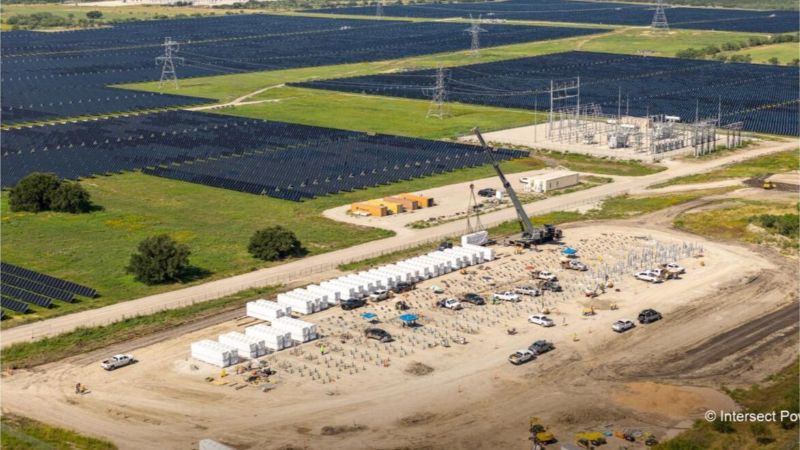
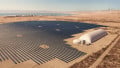
Solar plus storage facility. Image used courtesy of Intersect Power
Google’s Data Center + Renewable Energy Plan
Google plans to co-locate its new data centers with renewable energy projects and has partnered with renewable energy developer Intersect Power and the Rise Fund in a $20 billion project extending through 2030.
The “power-first” strategy will build grid-connected renewable power sources before Google constructs its database centers nearby. The additional power generation with battery storage systems will increase capacity and ease the grid stress. It will also provide Google with clean energy to meet data center energy demands.
The partners state that the initial renewable facility will be operational by 2026 and fully online by 2027.
Intersect Power has secured over $800 million in funding with TPG Rise Climate and Google. Other investors include Greenbelt Capital Partners and Climate Adaptive Infrastructure.
Energy-Hungry Data Centers
Data centers, especially those processing artificial intelligence, are notorious for energy consumption. The power drain increases with AI training. While data centers make up a small percentage of total energy users—about 1%—their impact is much greater. A large data center uses 100 MW annually, equivalent to the power needed by 350,000 to 400,000 electric vehicles, according to the International Energy Agency (IEA). The IEA estimates data centers’ energy demand could double by 2026.
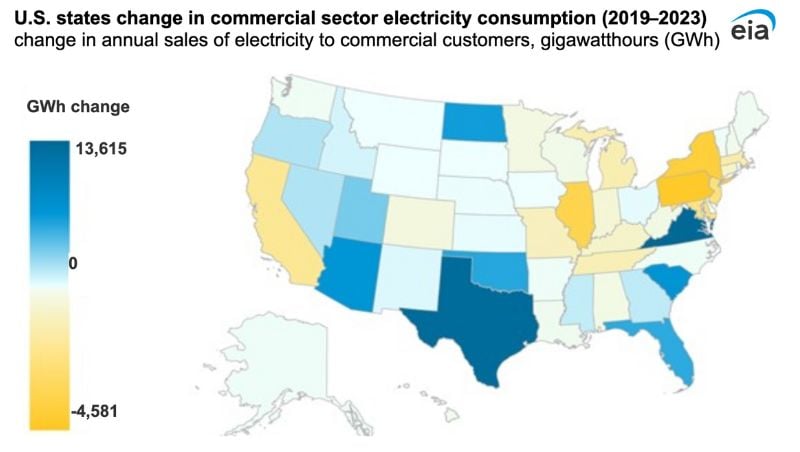
Energy consumption grew most in states with many data centers. Image used courtesy of Energy Information Administration
However, the local impact is most keenly felt. While distributed worldwide, data centers tend to be concentrated in certain locations. In the U.S., Northern Virginia has the most data centers, but Texas may soon take the lead due to the state’s relatively low cost of electricity. Each new data center strains the local grid.
Fossil fuels still provide about 60% of the nation’s electricity, according to the U.S. Energy Information Administration. The main fuel sources are natural gas and coal, which accounted for 99% of carbon dioxide emissions in the latest figures.
Google’s Efforts to Lessen Data Center Impacts
Major tech companies using AI—Meta, Amazon, Google, and Microsoft (which owns the majority of OpenAI)—have all made strides in reducing CO2 emissions and making data centers more energy efficient. However, data centers and their impacts may be growing faster than any sustainability plan.
Google’s goal is to reach net-zero emissions by 2030. Data centers have been a setback, as Google readily admits in its 2024 Environmental Report. In 2023, greenhouse gases rose by 13% over 2022 and 48% compared to the 2109 base year.
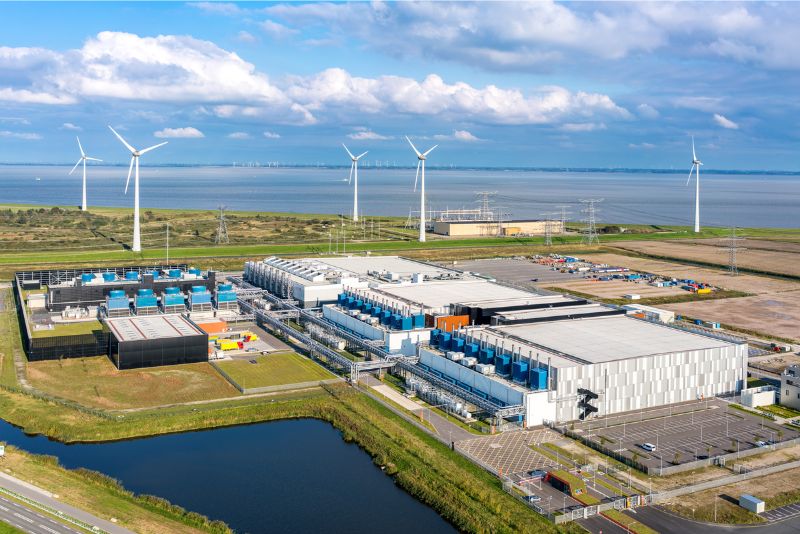
Wind turbines near a Google data center in the Netherlands. Image used courtesy of Google
Google claims it has used 100% renewable energy for each of the last seven years. However, this renewable energy isn’t directly used to power Google operations. The figure includes providing wind and solar energy to communities to match its use of carbon fuels.
In 2024, Google refocused its efforts on generating carbon-free power for its data centers and other facilities. Google and its parent company, Alphabet, invested $1 billion in battery-powered microgrids for AI data centers. It also planned a 1 GW solar project in Taiwan. Notably, the company is also investing in nuclear power, which isn’t renewable but is emissions-free. With Kairos Power, Google plans to build small nuclear reactors to supplement the grid in areas where it has data centers.