Facebook
 Google
 GitHub
 Linkedin
Mirror, Mirror in the Sky: Satellite Solar Ready for Trial
Reflect Orbital could be months away from launching mirrored satellites into orbit to harvest sun energy at night, in winter, or in bad weather.
Sunlight can only generate electricity in the photovoltaic process when its rays can reach the solar panels. Yet, what if sunlight—any time of day and in any weather—could be harnessed and directed at the panels? California-based Reflect Orbital thinks it can be done with gigantic mirrors orbiting the Earth.
While it seems like science fiction, it could soon become a reality. U.S officials have approved the first phase of Reflect Orbital’s project to place 50,000 mirrored satellites into orbit by 2035, which would then beam clean energy on demand to targeted areas on the ground.
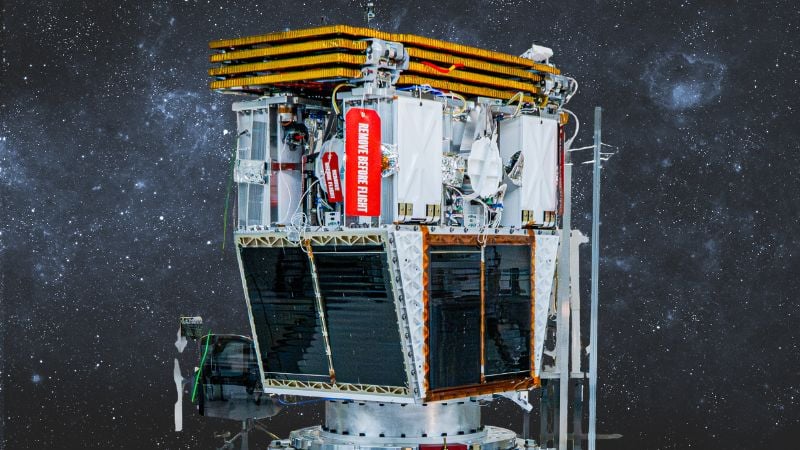
Reflect Orbital’s mirrored satellite. Image used courtesy of Reflect Orbital
How Reflection Technology Works
The orbiting mirrors catch the direct sunlight and bounce the rays down at specific targets on Earth, such as solar farms. The solar panels convert the reflected light into electricity. The idea is to provide a source for generating solar energy even when night or weather interferes.
This space-based solar process is not a new idea, but so far, no one has successfully put it into operation. According to NASA, the idea was first proposed in 1968. The initial proposal for space-based solar was to beam the sun’s energy to Earth as microwaves aimed at specialized antennas, or rectennas, which would then convert the microwaves into electrical energy.
Reflect Orbital has simplified the process by using pure optical reflection. The orbiting mirrors simply reflect the sunlight to Earth, where it can be directed to PV panels or simply used as illumination in specific locations. The company says the brightness can extend the solar farms’ energy generation into the evening hours, when most regions experience peak demand.
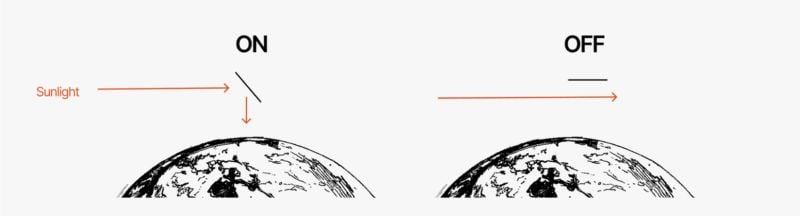
The satellites can be directed to a specific location or turned off completely. Image used courtesy of Reflect Orbital
The low-orbit satellites are steerable and equipped to use GPS coordinates to avoid sensitive sites such as astronomical observatories, so reflected light won’t disrupt their normal functions. Satellite positions and reflection schedules will be shared via standard tracking channels.
Reflect Orbital states that the illumination could be used to provide light for longer work times in construction or agriculture, assistance in natural disasters, or other purposes.
The Trial Period
In 2024, Reflect Orbital conducted early proof-of-concept testing using an 8 x 8-foot Mylar mirror suspended from a hot air balloon about 240 meters above ground. The mirror successfully reflected sunlight onto a ground-based solar array mounted on a truck. It generated about 500 W of power per square meter, showing that reflected sunlight could work in the photovoltaic process.
In early July, the FCC approved a radio operations license for the company’s first experimental text satellite, Eärendil-1, stating that the radio met safety and debris-mitigation requirements. The clearance allows the satellite to operate communications frequencies for up to two years. With this go-ahead, Reflect Orbital can prepare for the launch.
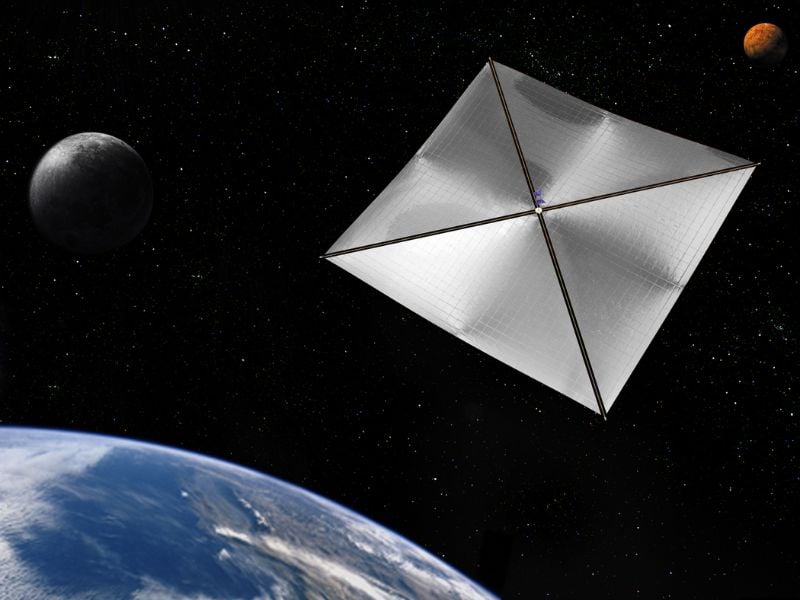
One concept of an orbiting satellite for space-based solar. Image used courtesy of NASA
Reflect Orbital plans to launch two Eärendil-1 satellites in the trial sometime later in 2026 via a SpaceX rideshare mission.
The Eärendil-1 weighs about 142 kg and is covered with an 18 x 18-meter square of ultra-lightweight thin-film aluminized Mylar. The mirrored sheet is folded when launched and then unfurled when it reaches orbit.
The orbit height will be between 600 and 650 km. The satellite will sweep a moving, 5-km-wide beam of light across the ground for up to 5 minutes. This will deliver about 0.1 lux, or roughly equivalent to the light of a full moon.
Reflect Orbital expects the trial period will demonstrate the satellite’s technical validity and commercial potential. A successful launch will prove that the satellite can deploy the reflector panel without tearing or tangling, and the reaction wheels can point, tilt, and hold a targeted beam of light on a specific spot on Earth during its five-minute flyover.
The mission will also collect flight data on atmospheric scattering, beam precision, and light intensity. Reflect Orbital will work with researchers, scientists, and early commercial partners to measure the satellite’s real-world performance.
What’s Next for Space Mirrors
The company will also continue to work on gradually increasing the satellite’s potential brightness from the demonstration's 0.1 lux. By 2027, it hopes to achieve 2 lux, the standard intensity of an indoor office or work area. By 2030, the company plans to have up to 5,000 satellites in orbit, producing 5,000 lux. At full scale in 2035, with tens of thousands of mirrored satellites orbiting the Earth, the space-based system could reach 36,000 lux, or full daylight.
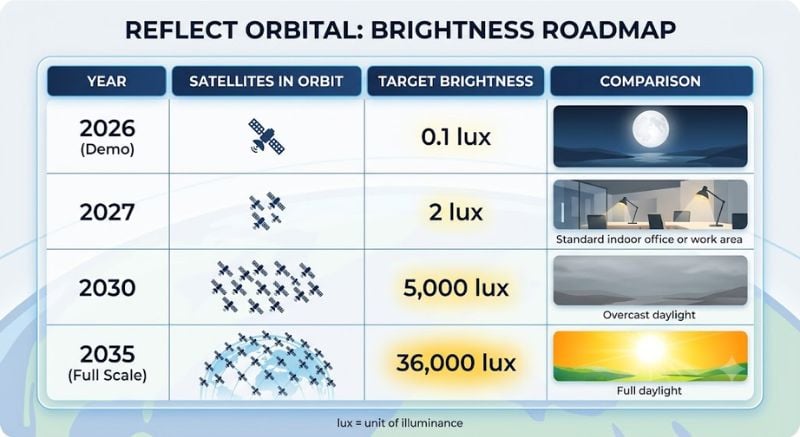
Anticipated timetable for increasing illumination. Image created courtesy of Gemini
Reflect Orbital acknowledges the mission is risky. A minor flaw in hardware or software could interfere with its functions, and hazards from space debris are always present. Yet, if all goes well, the world’s first commercial space-based energy system could soon be beaming an abundant, clean energy source.